Table of Contents
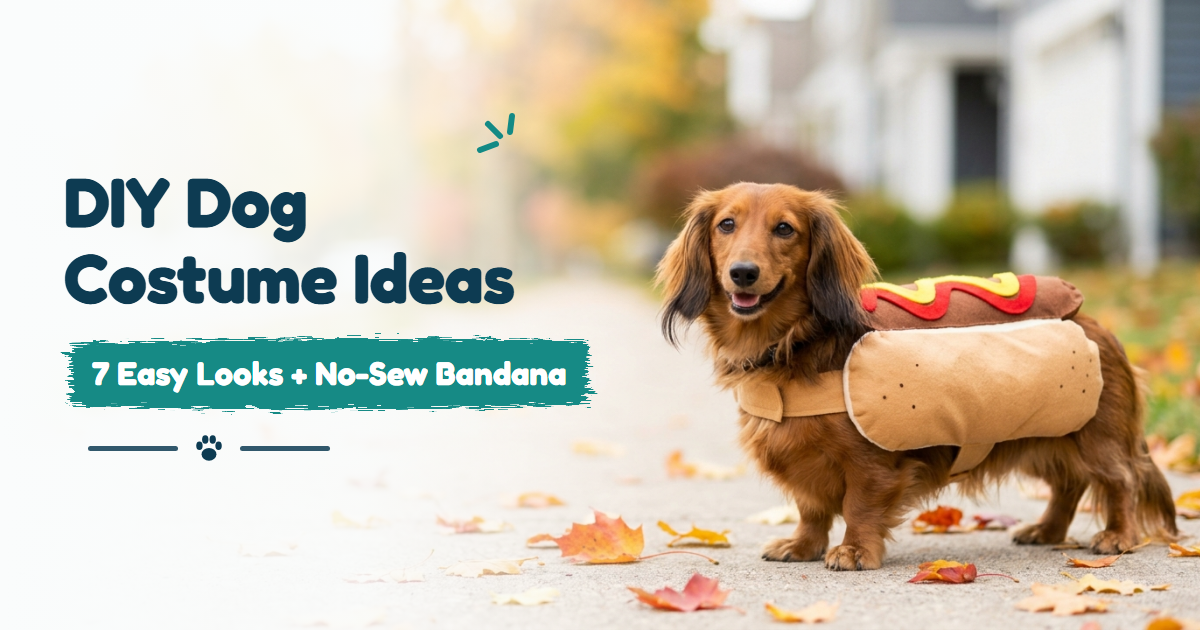
Quick answer: The easiest DIY dog costume starts with something your dog already wears comfortably, like a harness, collar, or T-shirt, and adds light felt or fleece pieces with Velcro. Popular ideas include a lion mane, a hot dog bun, a superhero cape, and spider legs. A no-sew DIY dog bandana is the simplest of all. Keep the eyes, ears, mouth, and legs free, and skip costumes on hot days.
Dog costumes are pure fun. Whether it’s Halloween, a birthday party, a holiday photo, or a parade, a dressed-up dog makes everyone smile. Have a cat too? See our DIY cat costume guide for simple ideas. But store-bought costumes often fit poorly, block a dog’s vision, or have elastic that rubs.
Homemade costumes fix that. You can size them to your dog, use soft fabrics, and build them on gear your dog already accepts. This guide covers seven easy DIY dog costume ideas, a no-sew bandana in two styles, fitting tips, signs your dog isn’t comfortable, and Halloween safety basics.
Table of Contents
- The Golden Rules of Dog Costumes
- How to Measure Your Dog for a Costume
- How to Make a No-Sew DIY Dog Bandana
- 7 Easy DIY Dog Costume Ideas
- How to Help Your Dog Get Used to a Costume
- Signs Your Dog Is Uncomfortable
- Halloween Safety Tips for Dogs
- Make It a Party
- Frequently Asked Questions
The Golden Rules of Dog Costumes
Before you start cutting fabric, keep these rules in mind.
- Build on what your dog already wears. A harness, collar, or dog T-shirt makes the perfect base. Your dog is used to it, so the costume feels familiar.
- Keep it light. Felt, fleece, and thin cotton are best. Heavy or stiff costumes tire dogs out and make them overheat.
- Leave the face free. Nothing should cover the eyes, ears, nose, or mouth. Your dog needs to see, hear, pant, and drink.
- Let them move. Your dog should be able to walk, sit, lie down, and potty without trouble.
- Use Velcro, not tight elastic. Velcro comes off fast if your dog is uncomfortable.
- No small parts. Skip buttons, pom-poms, googly eyes, and bells that could be chewed off and swallowed.
How to Measure Your Dog for a Costume
| Measurement | How to measure | What it’s for |
| Neck | Around the base of the neck, where the collar sits | Bandanas, manes, capes |
| Chest (girth) | Around the widest part of the chest, behind the front legs | Vests, harness-based costumes |
| Back length | From the base of the neck to the base of the tail | Capes, buns, “body” costumes |
Add 1 to 2 inches to each so the costume isn’t tight. You should be able to slip two fingers under any strap.
How to Make a No-Sew DIY Dog Bandana
A bandana is the easiest costume there is, and it works for every holiday.
Style 1: Classic Tie Bandana
You need: a square of cotton fabric and scissors.
| Dog size | Neck size | Fabric square |
| Small | 8 to 12 in | 14 x 14 in |
| Medium | 12 to 16 in | 18 x 18 in |
| Large | 16 to 22 in | 22 x 22 in |
| Extra large | 22 in and up | 26 x 26 in |
How to make it:
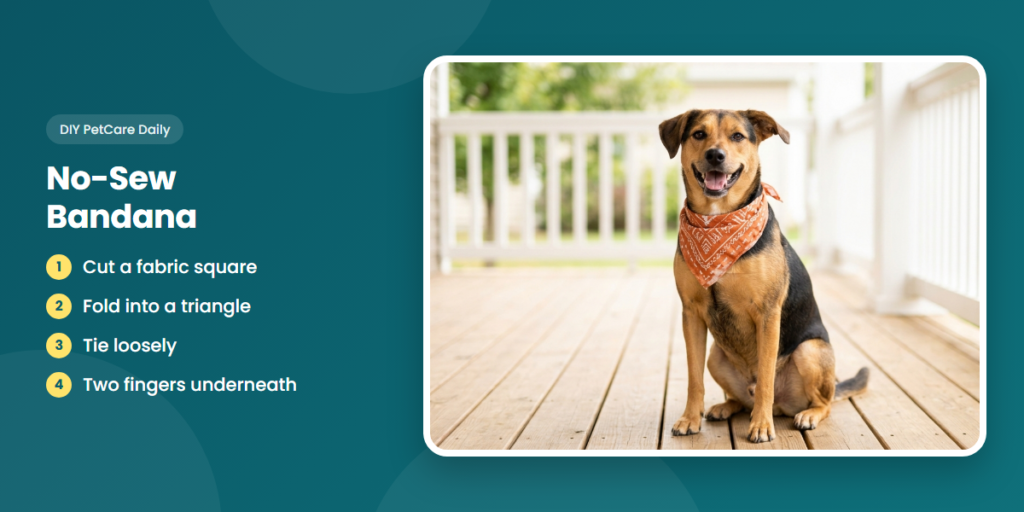
- Cut your fabric square. Use pinking shears if you have them, which stop fraying.
- Fold it in half diagonally to make a triangle.
- Tie the two side corners loosely around your dog’s neck, with the point hanging down the chest.
- Check that two fingers fit underneath.
Style 2: Over-the-Collar Bandana
This one slips onto your dog’s collar, so there’s no knot to come loose.
- Cut a triangle of fabric.
- Fold the long top edge over about 1 1/2 inches to make a tunnel.
- Glue the edge down with fabric glue (or stitch it), leaving the ends open.
- Let it dry, then thread your dog’s collar through the tunnel.
Use breakaway collars or flat collars only, never choke or prong collars, with any costume.
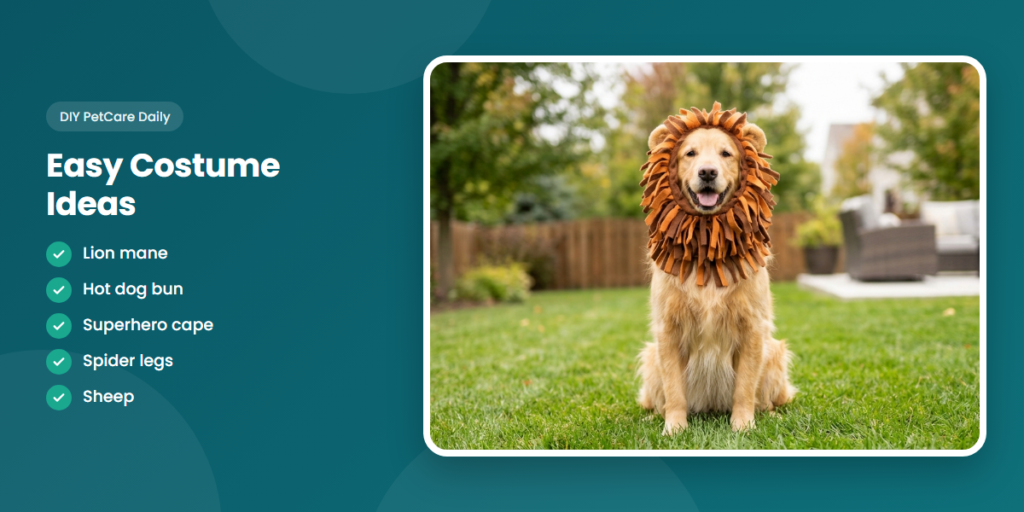
7 Easy DIY Dog Costume Ideas
1. Lion Mane
Perfect for fluffy medium and large dogs.
You need: brown and orange fleece, a fabric strip or an old collar cover, and Velcro.
Cut dozens of fleece strips about 1 inch wide and 6 to 8 inches long. Tie them tightly along a fabric band sized to your dog’s neck. Add Velcro at the ends. Fasten loosely, and fluff it out so it frames the face without covering the ears.
2. Hot Dog Bun
Made for Dachshunds, but any long dog can pull it off.
You need: tan felt, a thin foam sheet or fiberfill, red and yellow felt, fabric glue, and Velcro.
- Cut two long tan felt rectangles the length of your dog’s back.
- Stuff each lightly with fiberfill or line with foam to make “bun halves.”
- Glue them along each side of a strip of fabric that lies over your dog’s back.
- Add a squiggle of red (ketchup) and yellow (mustard) felt down the middle.
- Add Velcro straps that wrap under the chest.
3. Superhero Cape
You need: a felt or satin rectangle and Velcro.
Cut a cape about two-thirds the length of your dog’s back, with a rounded bottom. Attach it at the neck with Velcro, or fix it to the back of a harness. Glue on a felt letter or logo. Keep it short so it doesn’t drag or trip your dog.
4. Spider Legs
Easy, spooky, and very funny on a walking dog.
You need: a dog harness, black fleece or felt, fiberfill, and safety pins or Velcro.
- Make 4 “legs” by rolling black fleece into tubes about 8 to 12 inches long, stuffed lightly with fiberfill. Glue or stitch them closed.
- Attach two on each side of the harness so they stick out sideways.
- Make sure they don’t touch your dog’s real legs or drag on the ground.
5. Sheriff or Cowboy Vest
You need: an old T-shirt or a felt rectangle, a felt star, and Velcro.
Cut a simple vest shape that fits over your dog’s back and around the chest. Glue on a gold felt star “badge.” Pair it with a bandana from above.
6. Pumpkin Patch Pup
Use an orange T-shirt sized for your dog (or an old kid’s T-shirt with the sleeves cut and hemmed for the front legs). Glue on a green felt stem at the collar and black felt jack-o’-lantern eyes and a smile on the back. Quick, cute, and comfy.
7. Sheep
You need: an old white T-shirt or fleece vest and lots of white fleece scraps.
Glue small puffs or knotted loops of white fleece all over the back and sides of the shirt. Avoid cotton balls, which pull off easily and get eaten. Add a black felt “ear” headband only if your dog accepts it; otherwise skip the headpiece.
How to Help Your Dog Get Used to a Costume
- Practice early. Start a week or two before the big day.
- Let them sniff it and give a treat.
- Put on one piece at a time. Start with just the bandana or harness.
- Reward calm behavior. Treats and praise make it a good experience.
- Short sessions. A few minutes at first, then build up.
- Practice walking. Take a short walk in the costume so your dog gets used to the feel. Our guide on how to leash train a dog helps if walks are already a challenge.
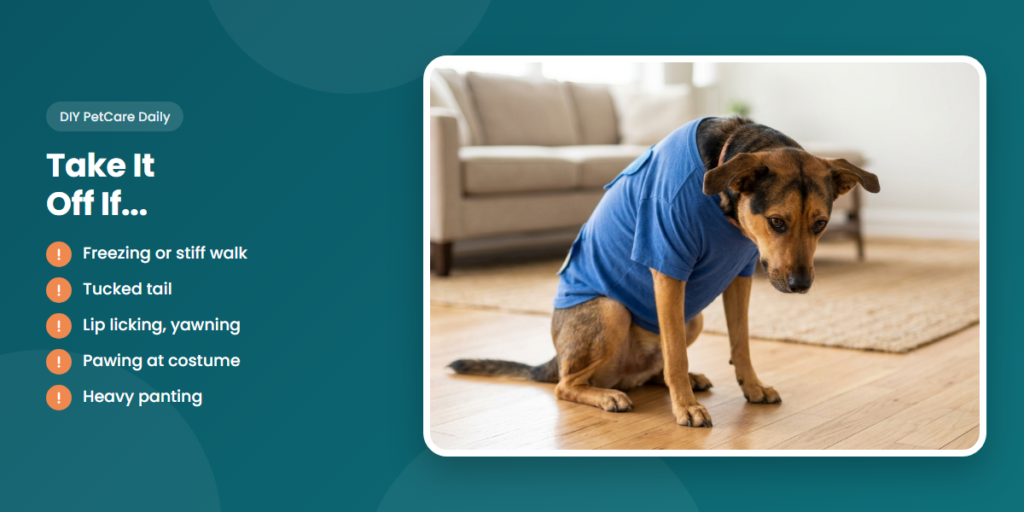
Signs Your Dog Is Uncomfortable
Take the costume off if your dog:
- Freezes, won’t walk, or walks stiffly
- Tucks their tail or lowers their body
- Licks their lips, yawns a lot, or shows the whites of their eyes
- Paws, scratches, or tries to bite the costume
- Pants heavily when it isn’t hot
- Hides or tries to get away
Some dogs just don’t like costumes. A festive bandana or a decorated collar is a great alternative.
Watch the Heat
Costumes trap body heat. Skip them on warm days and keep them off short-nosed breeds like Pugs, Bulldogs, and Boston Terriers when it’s warm, since they overheat easily. Never leave a costumed dog unsupervised.
Halloween Safety Tips for Dogs
- Candy: Chocolate, raisins, and anything with xylitol are toxic. Keep the candy bowl up high and wrappers in a closed trash can.
- Door dashing: Constant doorbells can stress dogs or tempt them to bolt. Keep your dog in a quiet room during trick-or-treat hours.
- ID tags and microchip: Make sure your dog’s tag and microchip info are current, in case they slip out.
- Reflective gear: If you trick-or-treat with your dog, add a reflective leash or light-up collar.
- Decorations: Keep candles, jack-o’-lanterns, fake cobwebs, and electrical cords out of reach.
- Strangers in masks: Masks and costumes can scare dogs. Let your dog keep their distance.
Make It a Party
Pair the costume with a homemade celebration. Our dog birthday cake recipe works for any special day, and a new homemade dog toy makes a great party favor for dog friends. Find more ideas in our DIY Dog Projects section.
Frequently Asked Questions
What is the easiest DIY dog costume?
A bandana is the easiest. Fold a square of fabric into a triangle and tie it loosely around your dog’s neck. A felt cape attached to a harness with Velcro is another quick option.
How do you make a no-sew dog bandana?
Fold a fabric square diagonally into a triangle and tie it loosely around your dog’s neck. For an over-the-collar style, fold the top edge over to make a tunnel, glue it with fabric glue, and slide the collar through.
Is it okay to put a costume on a dog?
Yes, if the costume is light, comfortable, doesn’t block the face or legs, and your dog is relaxed. Take it off if your dog shows signs of stress, and never leave them alone while dressed up.
How long can a dog wear a costume?
Short periods are best: long enough for photos, a party, or a short walk. Check for rubbing, overheating, or stress, and remove the costume at the first sign of discomfort.
What size bandana does my dog need?
Measure around your dog’s neck and choose a fabric square about 6 inches larger than the neck size. Small dogs usually need a 14-inch square, medium dogs 18 inches, and large dogs 22 inches.