Table of Contents
- Table of Contents
- Before You Build: Check These First
- How Tall Should a Dog Fence Be?
- Cheap Dog Fence Ideas Compared
- How to Build a DIY Dog Fence With Welded Wire
- How to Stop a Dog From Digging Under the Fence
- How to Stop a Dog From Jumping or Climbing the Fence
- How to Build a DIY Dog Gate
- How to Build a DIY Dog Run
- Keep Your Dog Safe in the Yard
- Frequently Asked Questions
Quick answer: A DIY dog fence can be as simple as welded wire mesh stretched between metal T-posts, with sturdy wood posts at the corners and gate. Make it at least 4 feet tall for most dogs and 6 feet for jumpers, bury or lay wire along the bottom to stop diggers, and add a self-closing gate. Call 811 before you dig, and check property lines and HOA rules first.
A fenced yard gives your dog room to sniff, run, and play without a leash. It also gives you peace of mind. But professional fencing can cost thousands of dollars, which is out of reach for a lot of families.
The good news is that a sturdy, dog-proof fence is a very doable weekend project. This guide covers how tall your fence needs to be, cheap dog fence ideas compared side by side, how to build a basic wire fence, how to stop diggers and jumpers, and how to add a DIY dog gate and dog run.
Table of Contents
- Before You Build: Check These First
- How Tall Should a Dog Fence Be?
- Cheap Dog Fence Ideas Compared
- How to Build a DIY Dog Fence With Welded Wire
- How to Stop a Dog From Digging Under the Fence
- How to Stop a Dog From Jumping or Climbing the Fence
- How to Build a DIY Dog Gate
- How to Build a DIY Dog Run
- Keep Your Dog Safe in the Yard
- Frequently Asked Questions
Before You Build: Check These First
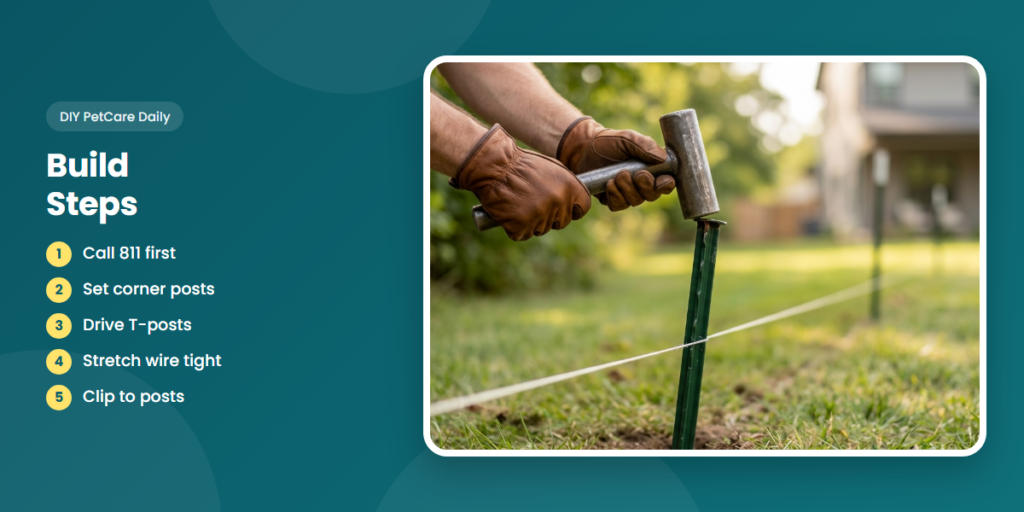
- Call 811. In the US, calling 811 (or using your state’s online request) before you dig is free. Utility companies will mark underground gas, water, and power lines so you don’t hit one.
- Know your property line. Check your survey or plat map. Building on a neighbor’s land can mean tearing the fence down later.
- Check HOA and city rules. Many places limit fence height, materials, and placement, especially in front yards.
- Permits. Some cities require one for fences over a certain height.
- Talk to your neighbors. It’s a courtesy, and they may even split the cost of a shared fence.
How Tall Should a Dog Fence Be?
| Dog | Minimum fence height |
| Small dogs (Chihuahua, Shih Tzu, Pug) | 3 to 4 feet |
| Medium dogs (Beagle, Cocker Spaniel) | 4 to 5 feet |
| Large dogs (Labrador, Golden Retriever) | 5 to 6 feet |
| Athletic jumpers and escape artists (Husky, German Shepherd, Border Collie, Belgian Malinois) | 6 feet or more |
Some determined dogs can clear even a 6-foot fence. If your dog is a jumper, see the tips on stopping jumpers below.
Cheap Dog Fence Ideas Compared
Here’s how the most common DIY fence types stack up. Costs are rough materials-only estimates per linear foot and vary by region.
| Fence type | Approx. cost per foot | Pros | Cons |
| Welded wire on T-posts | $2 to $5 | Cheap, quick, strong enough for most dogs | Plain look; small dogs may squeeze through larger openings |
| Hog or cattle panels on T-posts | $4 to $8 | Very sturdy, rigid, long-lasting | Heavy panels; larger gaps at the top |
| Plastic deer or garden netting | $1 to $2 | Cheapest, nearly invisible | Chewers and big dogs can break it |
| No-dig steel fence panels | $5 to $10 | No concrete; easy for renters | Shorter heights; less sturdy for large dogs |
| Chain link (DIY install) | $10 to $20 | Durable, classic | More work to install; climbers can scale it |
| Wood privacy fence | $15 to $30 | Blocks the view, which calms reactive dogs | Most expensive; diggers can still dig under |
For most families on a budget, welded wire on T-posts is the best mix of price, strength, and ease.
What About Invisible or Wireless Fences?
Electronic fences use a collar and a boundary signal instead of a physical barrier. They’re cheaper and work on any terrain, but they have real downsides. They don’t keep other animals or people out. Some dogs run through the boundary when excited and then won’t come back in. And many trainers prefer positive methods over collar corrections. A physical fence is the more reliable choice.
How to Build a DIY Dog Fence With Welded Wire
This plan builds a 4 to 5-foot fence that suits most dogs.
Materials
- Welded wire mesh, 14-gauge, 4 or 5 feet tall, with 2 x 4-inch openings (1 x 2-inch for small dogs)
- Metal T-posts, 6 to 7 feet long (one every 8 to 10 feet)
- Pressure-treated 4×4 wood posts for corners and the gate (or heavy steel corner posts)
- Bags of fast-setting concrete
- T-post driver
- Fence clips or heavy zip ties rated for outdoor use
- Fence stretcher or a come-along
- Post-hole digger, level, string line, and stakes
- Heavy work gloves
Steps
- Mark the line. Put a stake at each corner and gate spot. Run a string line between them as a guide.
- Set the corner and gate posts. Dig holes about 2 feet deep (deeper in areas where the ground freezes hard). Set the 4×4 posts, check they’re straight with a level, and fill with concrete. Let them cure for 24 to 48 hours.
- Drive the T-posts. Use a T-post driver to pound posts in along the string line every 8 to 10 feet. Drive them about 18 to 24 inches into the ground, with the studs facing out.
- Unroll and attach the wire. Staple or screw the end of the wire to a corner post. Unroll it along the line.
- Stretch it tight. Use a fence stretcher or come-along to pull the wire tight before fastening it. A tight fence is much harder for dogs to push or climb.
- Clip it to the T-posts. Use fence clips at the top, middle, and bottom of each post.
- Attach the other end to the next corner post and trim any extra.
- Walk the line. Look for gaps at the bottom, loose spots, and sharp wire ends. Bend any sharp ends inward or cover them.
How to Stop a Dog From Digging Under the Fence
Some dogs are expert tunnelers. Terriers, Huskies, and Beagles are famous for it. Add one of these to the bottom of your fence:
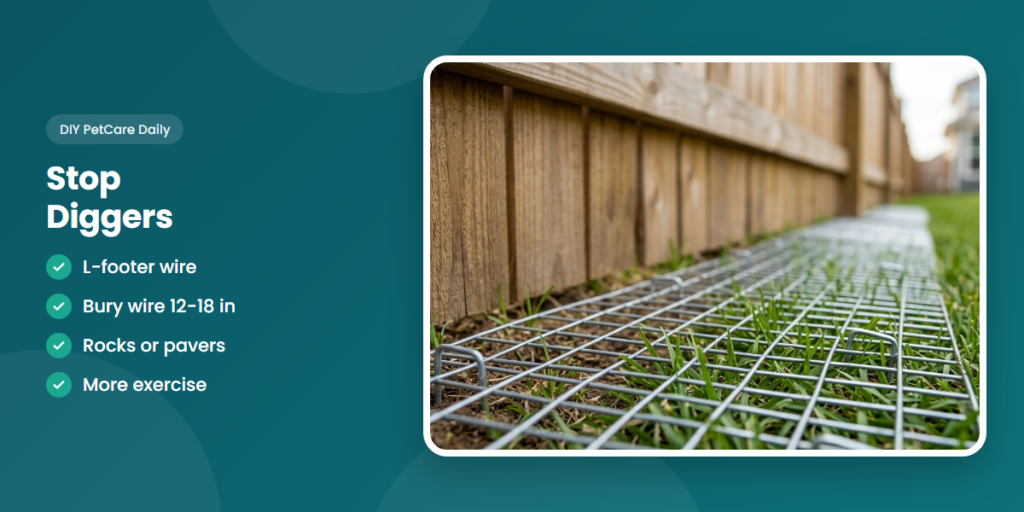
- L-footer: Lay a 2-foot strip of wire mesh flat on the ground along the inside of the fence, attached to the bottom of the fence. Pin it down with landscape staples. Grass grows through it, and dogs who dig hit wire.
- Buried wire: Bury the bottom of the fence (or an extra strip of mesh) 12 to 18 inches deep.
- Rocks or pavers: Line the base of the fence with large rocks or pavers.
- Concrete footer: A strip of concrete under the fence line stops even serious diggers.
Digging is often boredom. Daily walks, play, and brain games help a lot. Our guide to a DIY snuffle mat is an easy way to tire out a busy nose.
How to Stop a Dog From Jumping or Climbing the Fence
- Go higher. Add fence extenders to the top of existing posts.
- Angle the top inward. A 45-degree inward lean at the top makes jumping out much harder.
- Add rollers. Coyote rollers are spinning bars mounted along the top. Dogs can’t get a grip on them.
- Remove launch pads. Move tables, woodpiles, trash cans, and doghouses away from the fence.
- Plant a buffer. A row of shrubs a few feet inside the fence keeps dogs from getting a running start.
How to Build a DIY Dog Gate
The gate is the weak spot in most fences. Make it strong and self-closing.
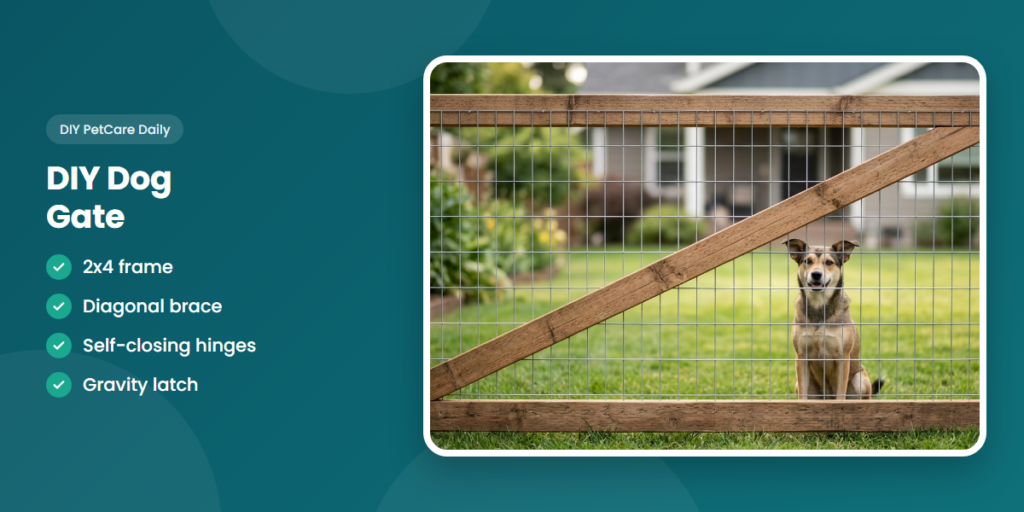
- Build a frame. Make a rectangle from 2x4s, slightly narrower than the gap between your gate posts (leave about 1/2 inch on each side for swing).
- Add a diagonal brace. Run a 2×4 from the bottom hinge corner up to the top latch corner. This stops sagging.
- Cover with wire. Staple welded wire across the frame.
- Hang it. Use heavy strap hinges, and add a spring or self-closing hinge so the gate shuts on its own.
- Add a latch. A gravity latch catches automatically when the gate closes. Put it high enough that clever dogs can’t nose it open, or add a padlock if kids or guests might leave it open.
- Close the gap at the bottom. Keep the gap under the gate to 2 inches or less.
Indoor gates: For blocking a doorway or stairs inside, a simple wooden frame with spindles or a sheet of plywood with a cutout window works. Mount it with hinges into the door frame and add a latch.
How to Build a DIY Dog Run
A dog run is a smaller fenced area within your yard. It’s handy if you can’t fence the whole property or want to protect a garden.
- Size: At least 4 x 10 feet for small dogs and 6 x 12 feet or larger for big dogs. Bigger is always better.
- Surface: Pea gravel, artificial turf made for pets, or wood chips. Avoid cocoa mulch, which is toxic to dogs.
- Shade and shelter: A tarp, shade sail, or roof keeps your dog cool. Concrete and gravel get very hot in summer, so protect paws; see our guide on dog paw protection.
- Water: A tip-proof bowl or an automatic waterer.
- Drainage: Slope the ground slightly so rain runs off.
Build the run the same way as the fence, with T-posts, wire, and a gate. For winter, add an insulated dog house inside.
Keep Your Dog Safe in the Yard
Even the best fence isn’t a babysitter. Check on your dog often, especially at first. Dogs left alone outside for long stretches may dig, bark, or try to escape out of boredom or loneliness. Dogs who panic when left alone may also try to break out; our guide on dog separation anxiety covers how to help.
Check your fence monthly for loose wire, holes, leaning posts, and new dig spots. For more projects, browse our DIY Dog Projects section.
Frequently Asked Questions
What is the cheapest way to fence in a yard for a dog?
Welded wire mesh attached to metal T-posts is one of the cheapest sturdy options, often $2 to $5 per foot in materials. Plastic netting is even cheaper but won’t hold up to chewers or large dogs.
How tall should a fence be for a dog?
At least 4 feet for most small and medium dogs, 5 to 6 feet for large dogs, and 6 feet or more for athletic jumpers like Huskies and German Shepherds.
How do I stop my dog from digging under the fence?
Lay a 2-foot strip of wire mesh flat along the inside of the fence base (an L-footer), bury wire 12 to 18 inches deep, or line the bottom with rocks or concrete. Extra exercise also helps reduce boredom digging.
Do I need a permit to build a dog fence?
It depends on your city and the fence height. Many areas need a permit for fences over 6 feet, and HOAs often have their own rules. Check with your local building office before you build, and always call 811 before digging.
How big should a dog run be?
At least 4 x 10 feet for small dogs and 6 x 12 feet or more for large dogs. Your dog should have room to move around freely, plus shade, water, and a dry place to rest.