Table of Contents
- Table of Contents
- Why an Insulated Dog House Matters in Winter
- Get the Size Right First
- Materials and Tools You’ll Need
- How to Build an Insulated Dog House Step by Step
- Bedding: Use Straw, Not Blankets
- Should You Add Heat?
- Where to Put the Dog House
- Common Mistakes That Make a Dog House Cold
- Getting Your Dog to Use It
- Frequently Asked Questions
Quick answer: An insulated dog house keeps your dog warm by trapping body heat inside a small, dry, draft-free space. Build it just big enough for your dog to stand and turn around, raise the floor 2 to 4 inches off the ground, line the walls, floor, and roof with rigid foam board covered by plywood, add a door flap, and fill it with clean straw, not blankets.
A dog house that keeps out rain isn’t always a dog house that keeps out cold. Plenty of store-bought houses are thin plastic or a single layer of wood. On a 25°F night, those walls pull heat away from your dog almost as fast as their body can make it.
The good news is that a warm house isn’t hard to build. You need the right size, a raised floor, a layer of foam insulation, and a door that blocks wind. This guide walks you through each part, with a full materials list and the mistakes that make a dog house cold.
One honest note before you start: no dog house replaces bringing your dog inside on dangerously cold nights. An insulated house is for dogs who spend part of the day outdoors, and for keeping them comfortable in normal winter weather.
Table of Contents
- Why an Insulated Dog House Matters in Winter
- Get the Size Right First
- Materials and Tools You’ll Need
- How to Build an Insulated Dog House Step by Step
- Bedding: Use Straw, Not Blankets
- Should You Add Heat?
- Where to Put the Dog House
- Common Mistakes That Make a Dog House Cold
- Getting Your Dog to Use It
- Frequently Asked Questions
Why an Insulated Dog House Matters in Winter
Dogs lose heat in three main ways: through the cold ground, through wind, and through damp bedding. A good insulated dog house blocks all three.
- The ground: Frozen soil and concrete pull heat out of a dog’s body fast. A raised, insulated floor stops this.
- Wind: Even a light breeze makes the air feel much colder. A small door with a flap keeps it out.
- Moisture: A wet coat loses its insulating power. A dry roof and the right bedding keep your dog dry.
Some dogs handle cold better than others. Huskies, Malamutes, and Bernese Mountain Dogs have thick double coats. Chihuahuas, Greyhounds, senior dogs, puppies, and thin dogs get cold much faster. If your dog is on the lean side, our guide on why is my dog so skinny explains why low body fat makes cold weather harder.
How Cold Is Too Cold for Dogs?
Here is a general guide for healthy adult dogs with shelter. Use more caution with small, short-coated, young, old, or sick dogs.
| Temperature | What it means for most dogs |
| Above 45°F | Comfortable for most dogs |
| 32°F to 45°F | Small, short-coated, and senior dogs start to feel cold |
| 20°F to 32°F | Limit outdoor time for at-risk dogs; shelter is a must |
| Below 20°F | Risk of hypothermia and frostbite for many dogs; bring them in |
Wind chill and wet weather make each of these numbers feel colder. Many states and cities also have laws that require adequate shelter for dogs kept outdoors, so check your local rules.
Get the Size Right First
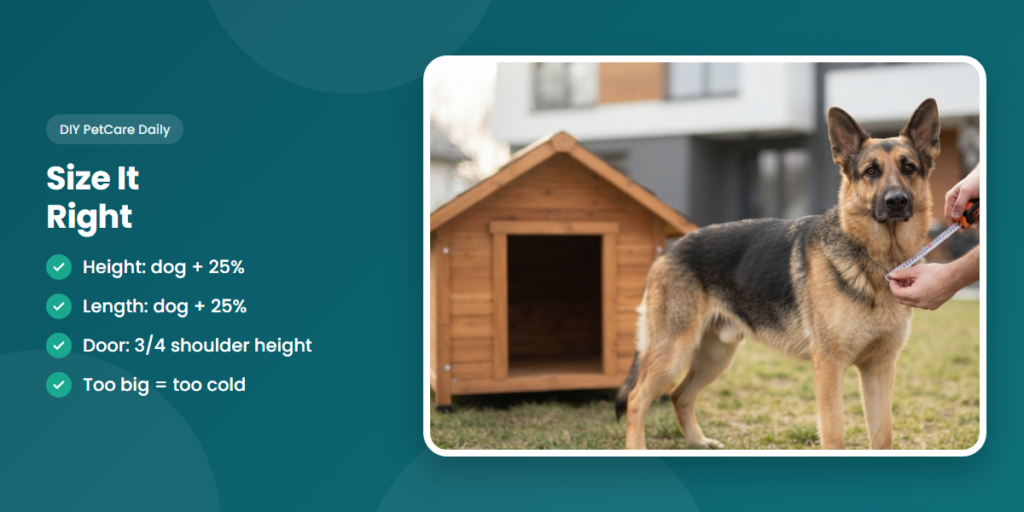
Size is the most common mistake people make. A bigger house feels kind, but it’s actually colder. Your dog’s body is the only heater in there. If the space is too large, that heat drifts away before it can warm the air.
Measure your dog while they stand, then use these simple rules:
- Inside height: About 25% taller than your dog’s height at the top of the head when standing.
- Inside length: Your dog’s length from nose to the base of the tail, plus about 25%.
- Inside width: Roughly the same as the inside length, so your dog can turn around and curl up.
- Door height: About three-quarters of your dog’s height at the shoulder. Dogs duck to enter, and a smaller door lets out less heat.
- Door width: Just wide enough for the widest part of your dog’s chest, plus an inch or two.
Example Sizes
| Dog size | Example breeds | Inside floor (L x W) | Inside height | Door (W x H) |
| Small (up to 25 lb) | Beagle mix, Jack Russell | 24 x 20 in | 22 in | 8 x 12 in |
| Medium (25 to 50 lb) | Border Collie, Australian Shepherd | 32 x 28 in | 28 in | 10 x 16 in |
| Large (50 to 90 lb) | Labrador, German Shepherd | 42 x 36 in | 34 in | 12 x 20 in |
| Giant (90 lb and up) | Bernese, Great Pyrenees | 50 x 42 in | 40 in | 15 x 24 in |
These are starting points. Always go by your own dog’s measurements. Not sure where your dog falls? Our dog weight chart lists healthy ranges for popular breeds.
Materials and Tools You’ll Need
This list covers a medium to large dog house. Adjust the amounts for your size.
Lumber and boards
- Exterior-grade plywood, 1/2 inch (3 to 4 sheets, 4 x 8 ft)
- 2×4 lumber for the frame and floor joists (8 to 10 pieces)
- 2×4 or 4×4 pieces for the raised base
- Pressure-treated lumber only for the base that touches the ground (not inside, where your dog can chew it)
Insulation
- Rigid foam insulation board, 1 to 2 inches thick (XPS or polyiso)
- Foil tape for the seams
Roof and weatherproofing
- Asphalt shingles or corrugated roof panels
- Roofing felt or underlayment
- Exterior caulk
- Pet-safe exterior paint or stain (let it cure fully before use)
Door
- Heavy vinyl or rubber flap (a cut-up vinyl mud flap or a strip curtain works)
Tools
- Circular saw or jigsaw
- Drill and exterior wood screws (1 1/4 and 2 1/2 inch)
- Tape measure, square, and pencil
- Utility knife for the foam
- Sandpaper
Why Rigid Foam Board?
Rigid foam is light, cheap, and doesn’t soak up water like fiberglass batts. The catch is that dogs love to chew it, and swallowed foam can cause a blockage. That’s why every piece of foam in this build sits between two layers of wood, where your dog can never reach it.
How to Build an Insulated Dog House Step by Step
Step 1: Build a Raised Base
Make a rectangle from 2x4s the size of your floor. Add cross pieces every 16 inches. Set it on 4×4 blocks or bricks so the floor sits 2 to 4 inches above the ground. This air gap keeps the floor dry and away from frozen dirt.
Step 2: Add an Insulated Floor
Cut foam board to fit between the floor joists. Lay a sheet of plywood on top and screw it down. Now the foam is sealed under the floor where it stays dry and out of reach.
Step 3: Frame and Sheath the Walls
Build four wall frames from 2x4s. Screw plywood to the outside of each frame. Cut the door opening in the front wall now, using the size you worked out earlier.
Tip: Put the door off to one side instead of in the center. Your dog can curl up in the back corner, out of the draft.
Step 4: Insulate the Walls
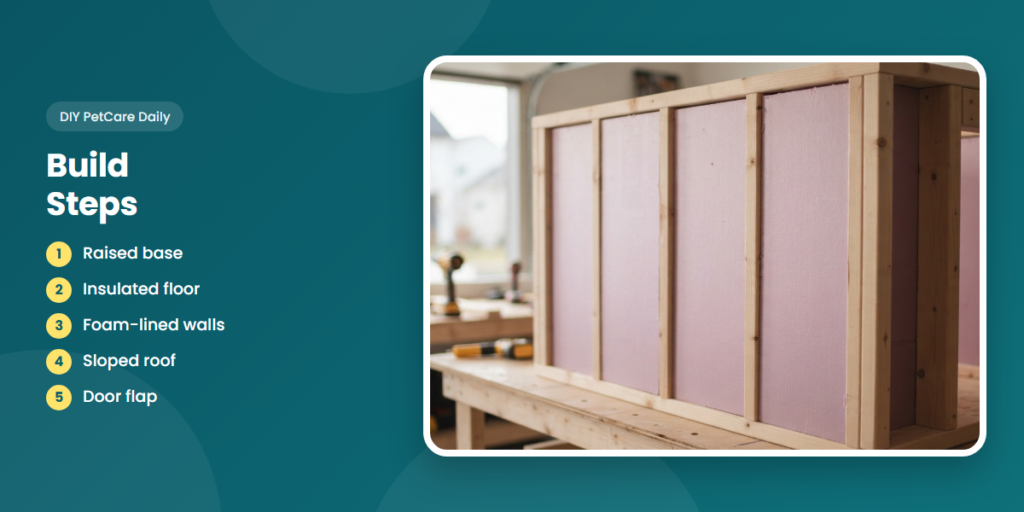
Press foam board into the spaces between the studs. Tape the seams with foil tape. Then cover the inside with a second layer of plywood. Your walls now go plywood, foam, plywood. This “sandwich” is what keeps the heat in.
Step 5: Build a Sloped Roof
A sloped roof lets rain and snow slide off. A single slope (lean-to style) is the easiest to build. Make it hang over the walls by 2 to 3 inches on every side. Insulate the roof the same way as the walls, then add felt and shingles or roof panels on top.
Many builders attach the roof with hinges. A hinged roof makes it easy to change the bedding and clean the house.
Step 6: Add a Door Flap
Screw a heavy vinyl flap above the door so it hangs down and covers the opening. Cut it into two or three vertical strips so your dog can push through easily. For extra warmth, add a small wall inside, just past the door, so wind can’t blow straight in. Builders call this a baffle or windbreak.
Step 7: Seal and Finish
Caulk gaps on the outside. Sand any rough edges your dog might rub against. If you paint, use exterior paint on the outside only, and let it cure for several days before your dog moves in.
Bedding: Use Straw, Not Blankets
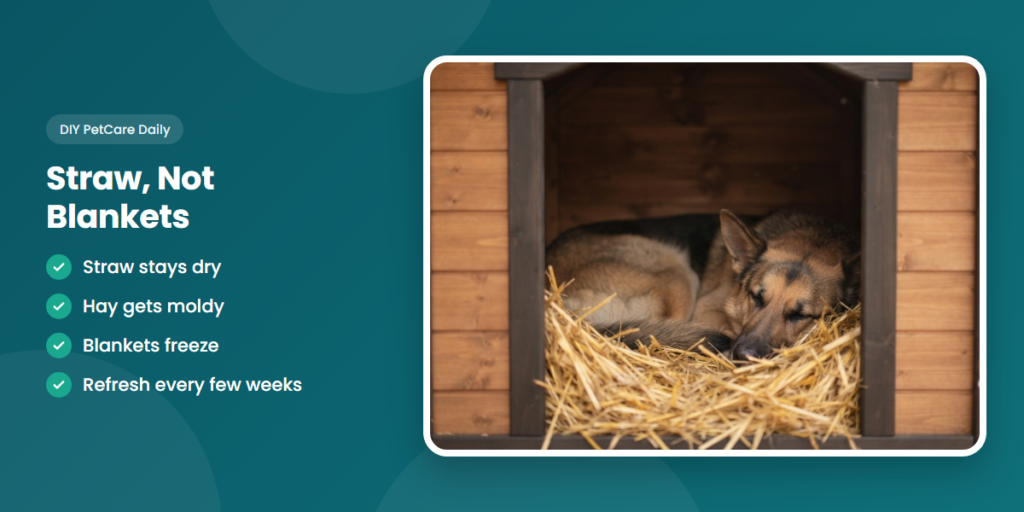
This is the part most people get wrong. Blankets, towels, and pillows feel cozy, but outdoors they soak up moisture and freeze. A damp blanket makes your dog colder.
Straw is the best bedding for an outdoor dog house. The hollow stems hold warm air, shed moisture, and let dogs burrow in. Fill the house with a thick, loose layer and refresh it every few weeks, or right away if it gets wet.
Don’t confuse straw with hay. Hay is food for horses and cattle. It soaks up water, gets moldy, and can bother your dog’s skin and lungs.
Other good options:
- A raised dog cot inside the house
- Cedar or pine shavings (some dogs are sensitive, so watch for skin irritation)
- A pet-safe heated pad, described below
Should You Add Heat?
A well-insulated house with straw is often warm enough. If you live where winters stay well below freezing, you can add heat, but do it safely.
Safe choices
- Heated pet pads made for outdoor use. Look for low wattage, a thermostat, and a chew-resistant cord.
- Microwavable heat discs made for pets. They stay warm for several hours.
Avoid these
- Space heaters of any kind
- Heat lamps and bulbs (a common cause of fires)
- Electric blankets made for people
- Any cord your dog can reach and chew
Run any outdoor cord through a chew guard and plug it into a GFCI outlet.
Where to Put the Dog House
Good placement adds warmth for free.
- Face the door away from the wind. In most of the US, winter winds come from the north or west, so a south or east-facing door is usually best.
- Put it near the house or a fence, which blocks wind.
- Pick a spot that drains well, not a low area where water pools.
- Keep it out of deep snow drifts.
Make sure your dog also has fresh, unfrozen water. A heated water bowl helps a lot in freezing weather.
Common Mistakes That Make a Dog House Cold
- Too big: The extra space can’t stay warm. Size it to your dog.
- Sitting on the ground: The cold soaks right through the floor.
- No door flap: Wind blows straight in.
- Blankets for bedding: They hold water and freeze.
- Exposed foam: Dogs chew it, and it can cause a blockage.
- Door facing the wind: Easy to fix by turning the house around.
Getting Your Dog to Use It
Some dogs walk right in. Others need time. Toss a few treats inside, feed meals near the door, and praise your dog when they go in. Put a worn T-shirt of yours inside for a familiar smell during the first few days, then swap it for straw once the weather turns wet.
If you want more weekend builds, see our DIY Dog Projects section. And if your older dog struggles with steps, our guide to a DIY dog ramp is a good next project.
Frequently Asked Questions
What is the best insulation for a dog house?
Rigid foam board, such as XPS or polyiso, 1 to 2 inches thick, works best. It’s light, holds up to moisture, and fits easily between the studs. Always cover it with plywood on both sides so your dog can’t chew it.
How warm does an insulated dog house stay?
It depends on the outside temperature, the size of the house, and the dog. A snug, well-sealed house with straw bedding usually stays several degrees warmer than the outside air, mostly from your dog’s own body heat. That’s why a small house stays warmer than a big one.
Can I put a blanket in my dog’s outdoor house?
It’s best not to. Blankets soak up moisture and can freeze, which makes your dog colder. Use clean straw instead, or a raised cot. Blankets are fine for indoor dog beds.
How big should a dog house be?
The inside should be just tall enough for your dog to stand and long enough for them to turn around and lie down. A rough rule is your dog’s height and length plus about 25%. Too much space makes the house harder to keep warm.
At what temperature should I bring my dog inside?
Below about 20°F, most dogs should come inside, and small, short-coated, young, old, or sick dogs need to come in at higher temperatures. Watch for shivering, lifting paws, slowing down, or whining, which all mean your dog is too cold.