Table of Contents
Quick answer: A dog body condition score (BCS) is a 1 to 9 rating of how much fat your dog is carrying, based on their ribs, waist, and belly. A score of 4 or 5 is ideal. Scores of 1 to 3 are too thin, and scores of 6 to 9 are overweight. Each point above 5 equals about 10% extra body weight.
Weight on a scale tells you only part of the story. A healthy Greyhound and a healthy Bulldog can weigh the same and look completely different. Even within a breed, one dog’s perfect weight can be another’s overweight number.
That’s why vets use a hands-on score. You can learn to do the same thing at home in just a couple of minutes. This guide explains what each number means, how to score your dog step by step, and what to do with the result.
Table of Contents
- What Is a Dog Body Condition Score?
- The 9-Point Dog BCS Chart
- How to Score Your Dog at Home
- What Your Dog’s Score Means
- How to Find Your Dog’s Ideal Weight From Their Score
- Muscle Condition: The Other Score
- How Often to Check Your Dog’s Score
- Frequently Asked Questions
What Is a Dog Body Condition Score?
A dog body condition score is a simple way to judge body fat by looking at and feeling your dog. Most US vets use a 9-point scale, while some use a 5-point scale. On the 9-point scale, 1 is severely underweight, 9 is severely obese, and 4 to 5 is the target.
It works well for almost any breed because it looks at shape instead of comparing your dog with a chart. Research has found that BCS scores line up well with body fat measured by DEXA scans, a medical test used to measure body composition. So your hands can tell you quite a bit.
Body Condition Score vs Weight
Both numbers help, but they answer different questions.
| Measure | What It Tells You | Limits |
| Scale weight | Your dog’s exact weight today, and whether it’s changing | Doesn’t show if it’s fat or muscle, or if it’s right for your dog |
| Body condition score | If your dog is thin, ideal, or heavy for their own frame | It’s an estimate, and a thick coat makes it harder |
| Muscle condition | If your dog is losing muscle, which is separate from fat | Takes practice; your vet can check it |
Use them together. Weigh your dog, score your dog, then track both over time.
The 9-Point Dog BCS Chart
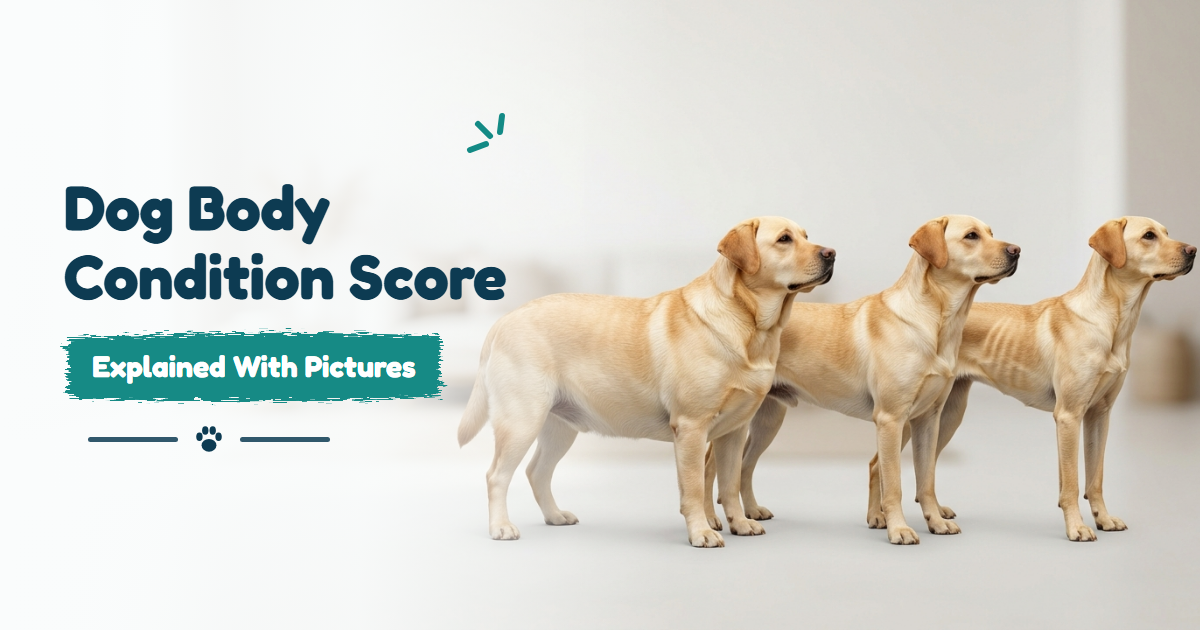
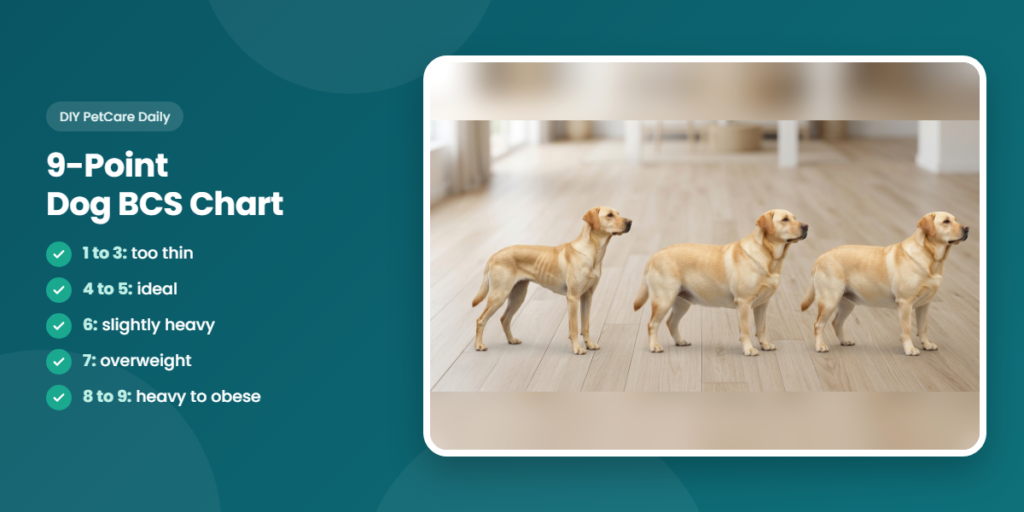
This chart shows what you should notice at each score. It works best alongside the pictures on this page, which show the shape from above and from the side.
| Score | Rating | Ribs | From Above | From the Side | Weight vs Ideal |
| 1 | Very thin | Stick out, no fat | Extreme waist; spine and hips stick out | Extreme tuck | About 30% under |
| 2 | Thin | Easy to see | Sharp waist; bones show | Sharp tuck | About 20% under |
| 3 | Lean | Easy to feel, may show a little | Clear waist | Clear tuck | About 10% under |
| 4 | Ideal | Easy to feel, thin fat layer | Clear waist | Clear tuck | On target |
| 5 | Ideal | Felt without pressing hard | Waist behind the ribs | Slight tuck | On target |
| 6 | Slightly heavy | Felt with some pressure | Faint waist | Slight tuck | About 10% over |
| 7 | Overweight | Hard to feel | Barely visible waist | Little or no tuck | About 20% over |
| 8 | Heavy | Can’t be felt without firm pressure | No waist | No tuck; belly may sag | About 30% over |
| 9 | Obese | Buried under fat | Back looks wide and flat | Belly hangs | About 40% or more over |
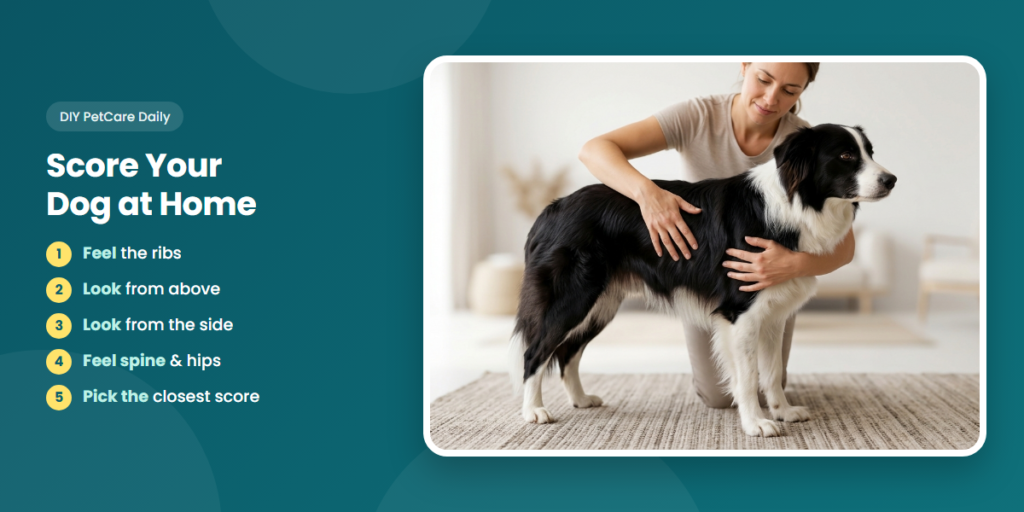
How to Score Your Dog at Home
Have your dog stand on a flat surface in good light. It helps to have someone hold their attention with a toy. Long-coated dogs need extra hands-on checking, since fur can hide both fat and bones.
- Feel the ribs. Run your fingers over your dog’s sides with light pressure. You should be able to feel the ribs of a healthy dog about as easily as you feel the back of your hand..
- Look from above. Check for a waist that narrows behind the ribs.
- Look from the side. The belly should slope up toward the back legs.
- Feel the spine and hips. They should be easy to feel, but not sharp or sticking out.
- Check for fat pads. Heavy dogs often have soft fat at the base of the tail, over the hips, and along the neck.
- Choose the closest score. If your dog falls between two, pick the one that fits best, or use a half point.
Write the score and date in your phone. A monthly photo from above and from the side also helps, because slow changes are hard to see when you look at your dog every day.
Common Scoring Mistakes
- Looking without touching: Thick coats can hide a lot. Always use your hands.
- Comparing with other dogs: So many dogs are overweight that a heavy dog can look normal at the park.
- Pressing too hard: You should find the ribs with light pressure. If you have to dig, the score is above ideal.
- Scoring a pregnant or bloated dog: A swollen belly can change their shape, and a sudden one needs a vet.
- Ignoring breed shape: Greyhounds and other sighthounds naturally look leaner, and their ribs may show a little even when healthy. Bulldogs and Pugs have broad chests, so their waist can be harder to judge.
What Your Dog’s Score Means
Scores 1 to 3: Too Thin
Your dog may need more calories, or they may have a health problem. Start with a vet visit, especially if the weight loss is new. Common causes include parasites, dental pain, stomach and gut problems, and other illnesses. Read our guides on why a dog is so skinny and why a dog may be losing weight.
Scores 4 and 5: Ideal
Well done. Keep up what you’re doing and recheck once a month. Update portions when your dog’s age or activity level changes. Our guide on how much dog food to feed can help you stay on track.
Scores 6 and 7: Overweight
Your dog has some extra fat, but small changes can make a big difference. Measure food, count treats, and add a bit more activity. Our guide on how to help a dog lose weight lays out a safe plan.
Scores 8 and 9: Heavy to Obese
Talk with your vet before starting a plan. Dogs at these scores are at higher risk of joint pain, breathing trouble, and diabetes, and they may need blood tests before they start exercising more. Slow, steady loss is the goal.
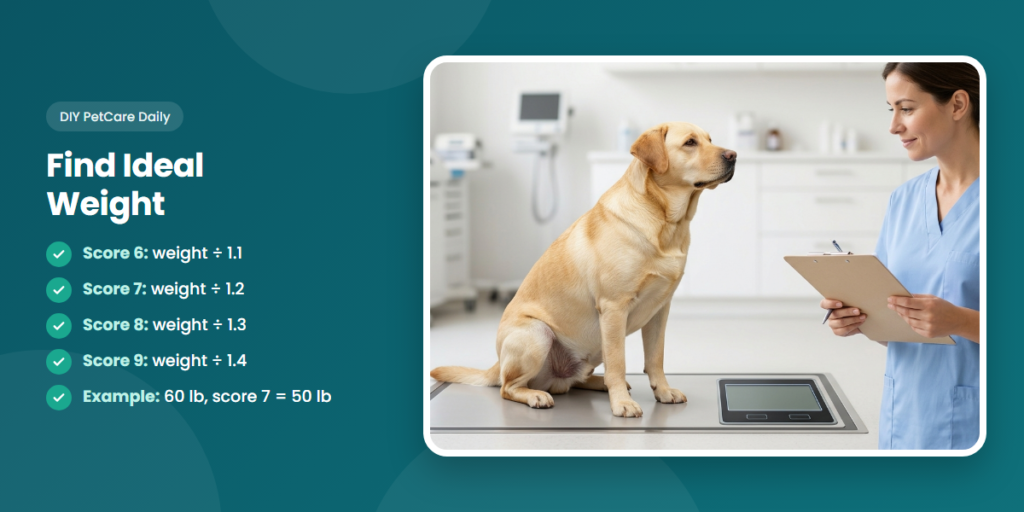
How to Find Your Dog’s Ideal Weight From Their Score
Vets often use a simple rule: each point above 5 equals about 10% extra weight. To estimate ideal weight, divide your dog’s current weight by the matching number.
| Score | Divide Current Weight By | Example: 60 lb Dog | Weight to Lose |
| 6 | 1.1 | 54.5 lb | About 5.5 lb |
| 7 | 1.2 | 50.0 lb | About 10 lb |
| 8 | 1.3 | 46.2 lb | About 13.8 lb |
| 9 | 1.4 | 42.9 lb | About 17.1 lb |
This estimate gets less exact at very high scores. It’s still a great starting point, and your vet can refine it. Our dog BMI calculator does this math for you and also tracks a body index over time. Once you have a goal weight, our dog weight calculator can estimate how long it may take, and our dog calorie calculator gives you a daily calorie number.
Muscle Condition: The Other Score
Fat isn’t the whole picture. Vets also look at muscle, especially over the spine, shoulders, hips, and skull. An older or sick dog can lose muscle while still carrying fat. That means a dog can be overweight and still have muscle loss.
Watch for:
- A bony spine or hips, even with a soft belly
- Thinner back legs
- A sunken look along the top of the head
- Weakness on stairs or when getting up
Muscle loss is common as dogs age, but it can also signal illness or pain. Mention it to your vet, especially if your dog is also slowing down. Our guide on when a dog is considered a senior explains what to watch for at each size.
How Often to Check Your Dog’s Score
- Healthy adult dogs: About once a month
- Puppies: At each vet visit, since they are changing quickly. Large-breed puppies do best when kept lean
- Dogs on a weight plan: Every 2 weeks, along with a weigh-in
- Older dogs: Every month, because weight and muscle can change quickly
- After any big change: Spay or neuter surgery, a new food, or an injury
Ask your vet to score your dog at each visit, and compare it with your own score. It’s the quickest way to get better at this.
For more guides on keeping your dog healthy, visit our Dog Health & Wellness section.
Frequently Asked Questions
What is a good body condition score for a dog?
On the 9-point scale, 4 or 5 is ideal. You should be able to feel the ribs easily, see a waist from above, and see a belly tuck from the side.
What does a body condition score of 7 mean in dogs?
A score of 7 means your dog is overweight, about 20% above their ideal weight. The ribs are hard to feel, and the waist is barely visible.
Is the dog BCS scale 5 or 9 points?
Both exist, but the 9-point scale is more common among US vets. On a 5-point scale, 3 is ideal. Ask your vet which scale they’re using when they give you a number.
Can I do a body condition score on a fluffy dog?
Yes, but rely on your hands instead of your eyes. Feel the ribs, waist, spine, and hips under the fur. Wetting the coat during a bath can also show you the true body shape.
How often should I check my dog’s body condition?
About once a month is enough for most dogs. Check every 2 weeks during a weight loss plan, and mention any fast changes to your vet.