Table of Contents
Quick answer: To learn how to leash train a dog, start indoors with a 6-foot leash and lots of small treats. Reward your dog every time they stand or walk next to you, stop the moment the leash goes tight, and only move forward when it loosens again. Practice 5 to 10 minutes a day and most dogs pull much less within a few weeks.
Your arm aches, your dog is wheezing against the collar, and a 15-minute walk around the block feels like a tug-of-war. If that sounds like your daily routine, you’re far from alone. Pulling is one of the most common reasons owners start looking for training help.
The good news is that pulling is a habit, not a personality trait. Dogs pull because pulling works: it gets them to the next tree, the next smell, the next dog faster. Change what works, and the habit changes too.
This guide walks you through a simple plan you can start today, the gear that helps (and the gear that backfires), and fixes for the problems that show up on real walks.
Table of Contents
- Why Does My Dog Pull on the Leash?
- Gear That Helps (and Gear to Skip)
- How to Leash Train a Dog in 7 Steps
- Common Problems and Quick Fixes
- How Long Does Leash Training Take?
- Mistakes That Make Pulling Worse
- When to Call a Trainer or Your Vet
- Frequently Asked Questions
Why Does My Dog Pull on the Leash?
Before you fix pulling, it helps to know why it happens. If you’ve ever asked “why does my dog pull on the leash?”, the answer is usually a mix of these:
- Dogs walk faster than we do. A dog’s natural trotting pace is quicker than a person’s walking pace. To your dog, your speed feels like slow motion.
- Pulling gets rewarded. Every time your dog pulls and you keep walking, they learn that a tight leash moves them forward. That’s a reward, even if you didn’t mean it as one.
- The opposition reflex. When something pulls against a dog’s body, many dogs lean into the pressure instead of giving in to it. Yanking back often makes them pull harder.
- Excitement and smells. The outdoor world is full of scents, sounds, and other animals. A young or under-exercised dog has a lot of energy to burn.
- Nobody taught them another way. Walking politely on a leash isn’t natural for dogs. It’s a skill, just like sit or come.
Once you see pulling this way, the fix makes sense. Your job is to make a loose leash the thing that pays off and a tight leash the thing that gets them nowhere.
Gear That Helps (and Gear to Skip)
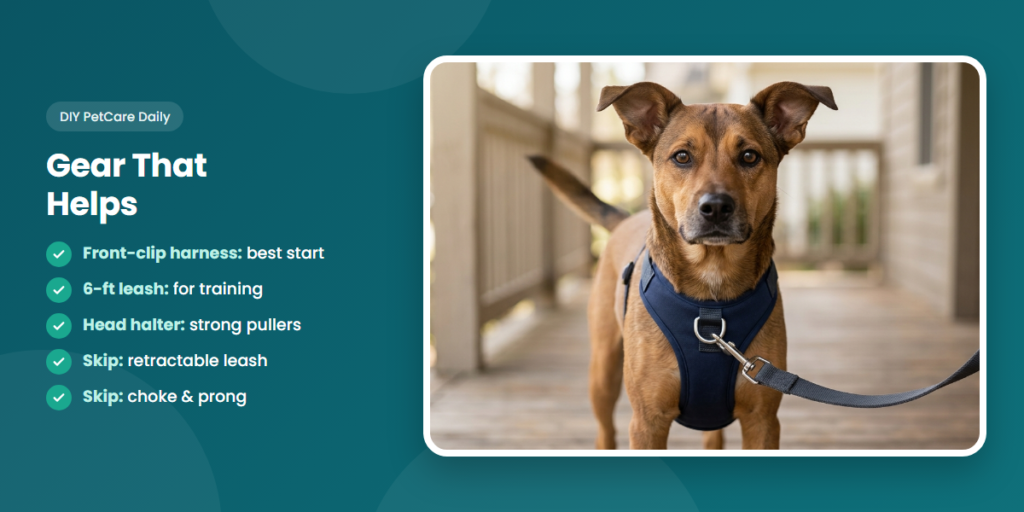
The right equipment won’t train your dog for you, but it can make practice safer and easier while you work on the skill. Here’s a quick comparison.
| Gear | How It Works | Good For | Watch Out For |
| Flat collar | Holds ID tags; leash clips at the neck | Calm dogs that already walk well | Hard pullers can strain their throat and neck |
| Front-clip no pull harness | Leash clips on the chest, so pulling turns the dog sideways | Most dogs that pull | Must fit snugly; can rub under the legs if loose |
| Back-clip harness | Leash clips between the shoulders | Small dogs, dogs with neck or airway problems | Can make pulling easier, like a sled harness |
| Head halter | Loop around the nose steers the head | Strong dogs, lungers | Needs slow introduction; never jerk the leash |
| 6-foot standard leash | Fixed length you can control | Daily training walks | None; this is the best training leash |
| Retractable leash | Leash extends when the dog pulls | Open areas, not training | Teaches dogs that pulling earns more room |
Many trainers suggest a front-clip no pull harness as the first thing to try. It doesn’t stop pulling on its own, but it takes away the dog’s leverage, so you’re not fighting their whole body weight while they learn.
Skip choke chains, prong collars, and shock collars. The American Veterinary Society of Animal Behavior recommends reward-based training over methods that use pain or fear, because aversive tools can increase fear and aggression. They can also injure the neck.
You’ll also want a treat pouch and soft, pea-sized treats your dog loves. If you’re using a lot of treats during training, cut back a little on meals that day. Our dog calorie calculator can help you keep the daily total in check.
How to Leash Train a Dog in 7 Steps
This plan works for puppies, adult dogs, and rescue dogs. Keep sessions short, about 5 to 10 minutes, and end while your dog is still doing well.
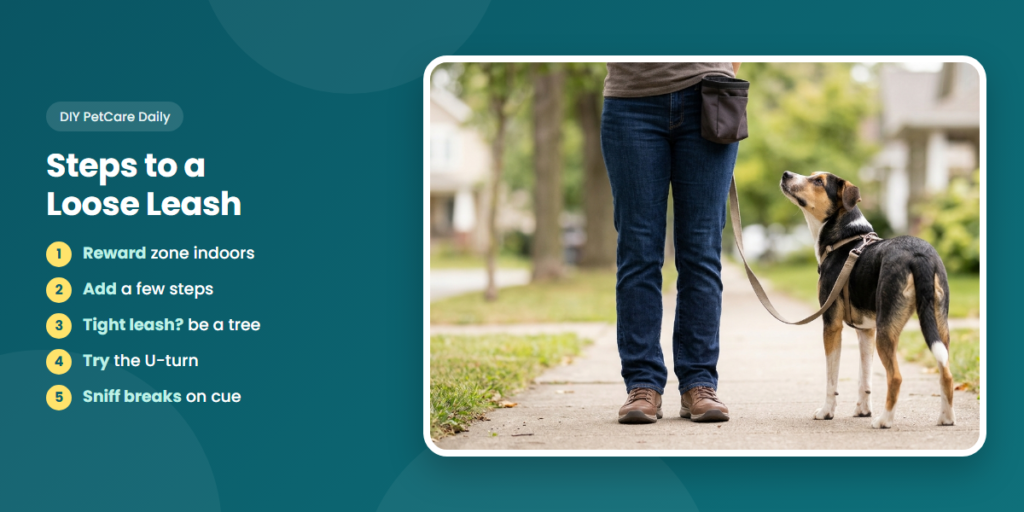
Step 1: Teach a “Reward Zone” Indoors
Pick a side, left or right, and stick with it. Stand still in a quiet room with your dog on leash. Each time your dog is near your leg on that side, say “yes” and drop a treat right next to your foot.
Within a few minutes, most dogs start hanging around that spot because that’s where the good stuff happens. This spot is your “reward zone.”
Step 2: Add a Few Steps
Take one or two steps, then reward your dog in the zone. Take three steps, reward. Slowly build up to 10 or 15 steps around the room. If your dog darts ahead, just turn around and start again.
Step 3: Be a Tree When the Leash Gets Tight
This is the heart of learning how to stop a dog from pulling on the leash. The moment the leash goes tight, stop. Don’t pull back, don’t talk, don’t yank. Just stand still like a tree.
Wait for your dog to look back or step toward you so the leash loosens. The instant it does, say “yes,” reward in the zone, and start walking again. Your dog learns that a tight leash stops the walk and a loose one keeps it going.
Step 4: Try the U-Turn
Some dogs get the idea quickly from being a tree. Others just stand there and lean. For these dogs, turn around and walk the other way when they pull. Cheerfully call their name, and reward them when they catch up to your side.
The U-turn adds a little movement, which keeps bored or excited dogs engaged. It also teaches them to keep an eye on you, since you might change direction at any time.
Step 5: Move to the Backyard or Driveway
Once your dog walks well indoors, practice in a slightly more interesting place. Expect a step backward here. That’s normal. Reward more often for a few sessions, then slowly space the treats out again.
Step 6: Take It to Quiet Streets
Choose quiet times of day for your first real walks, such as early morning. Bring higher-value treats like small bits of chicken. Reward every few steps at first. Stop or turn around every single time the leash goes tight.
Consistency matters more than anything else. If you let your dog pull “just this once” because you’re running late, you’re teaching them that pulling sometimes works, and that keeps the habit alive.
Step 7: Give Sniff Breaks on Cue
Walks are a big part of a dog’s mental exercise, and sniffing is how they read the news. Instead of banning sniffing, use it as a reward. Ask for a few loose-leash steps, then say “go sniff” and let them explore a spot for 20 to 30 seconds.
This turns the thing your dog wants most into payment for good walking. It’s one of the easiest ways to make loose leash walking stick.
Common Problems and Quick Fixes
Real walks rarely go as smoothly as practice in the living room. Here’s how to handle the situations that trip up most owners.
| Problem | What’s Going On | Try This |
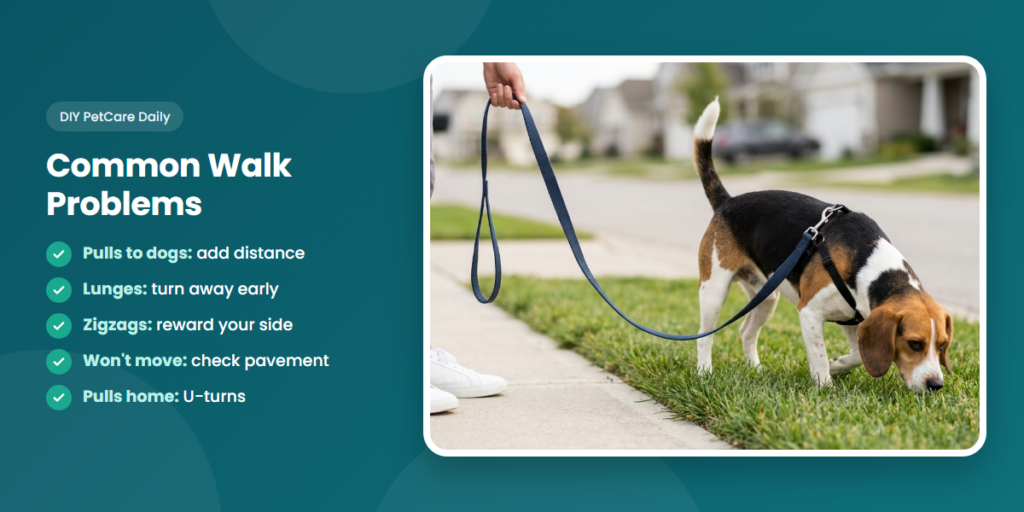
| Dog pulls toward other dogs | Excitement or worry about the other dog | Cross the street, add distance, reward calm looks |
| Dog lunges at squirrels or cats | Strong prey drive | Practice a “watch me” cue at home first; turn away early |
| Dog zigzags in front of you | Following smells from side to side | Reward heavily in your chosen zone; shorten the leash a little |
| Dog stops and won’t move | Fear, tiredness, or hot pavement | Check the ground temperature; go back to an easier route |
| Dog pulls hardest at the start | Pent-up energy | Play fetch in the yard for 5 minutes before you leave |
| Dog pulls on the way home | Wants to get home fast | Practice U-turns on the last block of the walk |
If your dog stops on hot days, test the pavement with the back of your hand for 7 seconds. If it’s too hot for you, it’s too hot for paws. Our guide to dog paw protection explains how to keep pads safe in summer heat and winter salt.
How Long Does Leash Training Take?
There’s no single timeline, because every dog starts in a different place. As a rough guide:
- Young puppies often get the basics in 1 to 3 weeks of short daily sessions.
- Adult dogs with a long pulling habit may need 4 to 8 weeks before walks feel easy.
- Strong, excitable breeds like Labradors, Huskies, and terriers can take longer, especially around distractions.
You’ll usually see progress in the house within a few days. The busy outdoors takes longer. Track a few walks a week. If your dog pulls less often or recovers faster after each pull, you’re on the right track, even if walks aren’t perfect yet.
Mistakes That Make Pulling Worse
When leash training a dog, these common habits can quietly undo your progress:
- Following your dog when they pull. Even a few steps forward on a tight leash pays off the pulling.
- Jerking the leash. It can hurt the neck and makes many dogs pull even harder, thanks to the opposition reflex.
- Long sessions. A 45-minute training walk can wear out a young dog’s focus. Do short practice walks plus separate play or exercise.
- Rewarding too late. Treats should arrive within a second or two of the loose leash, right in the reward zone.
- Skipping exercise. A dog with tons of extra energy will struggle to walk calmly. Add fetch, tug, or puzzle toys on busy days.
- Changing the rules. If one family member lets the dog pull and another doesn’t, progress slows down. Get everyone on the same plan.
When to Call a Trainer or Your Vet
Some dogs need extra help. Reach out to a certified trainer if your dog:
- Lunges, barks, or growls at people or other dogs on walks
- Is too strong for you to hold safely, even with a harness
- Seems scared outdoors and pulls to get back home
- Hasn’t improved after 6 to 8 weeks of steady practice
A sudden change in walking habits can also point to a health problem. If your dog suddenly lags, limps, or doesn’t want to walk, they may be in pain. Check their paws and nails, and see your vet if the problem lasts more than a day or two.
Leash manners are part of a bigger picture. Dogs that struggle when left at home may also be tense on walks. If that sounds familiar, our guide to dog separation anxiety can help. You’ll find more guides like this one in our Dog Training & Behavior section.
Frequently Asked Questions
What is the fastest way to stop a dog from pulling on the leash?
The fastest approach for most dogs is a front-clip no pull harness plus the “be a tree” method. Stop every time the leash goes tight and only move forward when it’s loose. Short daily practice brings results faster than one long session a week.
Do no pull harnesses really work?
A front-clip no pull harness reduces pulling right away for many dogs, because pulling turns them sideways. It manages the problem while you train. Your dog still needs to learn that a loose leash is what moves the walk forward.
How do you teach a dog to walk on a leash without pulling?
Pick one side, reward your dog often for being next to your leg, and stop or turn around when they pull. Start indoors, then move to the yard, then quiet streets. Add more distractions slowly.
Can you leash train an older dog?
Yes. Older dogs can learn new walking habits at any age. It may take a few extra weeks if they’ve been pulling for years, but the same steps work. Keep sessions short and gentle for seniors with stiff joints.
Should my dog walk on my left or right side?
Either side is fine. The left side is traditional in dog shows, but what matters is that you pick one side and stay consistent. That way your dog always knows where the reward zone is.