Table of Contents
Quick answer: A dog weight chart gives you a typical adult range for each breed. For example, Labrador Retrievers usually weigh 55 to 80 lb, Beagles 20 to 30 lb, and Chihuahuas 6 lb or less. Use these numbers as a general guide, not a strict target, since a dog’s frame and body shape matter more than the scale.
How much should your dog weigh? It’s a simple question, and a breed chart is a handy first answer. It’s a good way to see whether your dog is roughly in the normal range or far outside of it.
But a chart can’t tell you everything. Two healthy Labs can be 15 pounds apart, and a dog can be right in the middle of the range and still carry too much fat. This guide gives you the charts you came for, then shows you how to use them the right way.
Table of Contents
- Dog Weight Chart by Breed
- Dog Weight by Size Group
- Puppy Weight Chart by Age
- Why Body Shape Matters More Than the Chart
- How to Weigh Your Dog at Home
- What If Your Dog Is Outside the Range?
- Frequently Asked Questions
Dog Weight Chart by Breed
These are typical adult weight ranges for healthy dogs, in pounds. Many are based on breed standards, and individual dogs can fall outside these numbers and still be fine.
Small Dog Breeds (20 lb or Less)
| Breed | Male | Female |
| Chihuahua | 6 lb or less | 6 lb or less |
| Pomeranian | 3 to 7 lb | 3 to 7 lb |
| Toy Poodle | 4 to 6 lb | 4 to 6 lb |
| Yorkshire Terrier | About 7 lb | About 7 lb |
| Maltese | Under 7 lb | Under 7 lb |
| Miniature Dachshund | 11 lb or less | 11 lb or less |
| Shih Tzu | 9 to 16 lb | 9 to 16 lb |
| Cavalier King Charles Spaniel | 13 to 18 lb | 13 to 18 lb |
| Pug | 14 to 18 lb | 14 to 18 lb |
| Miniature Schnauzer | 11 to 20 lb | 11 to 20 lb |
Medium Dog Breeds (21 to 50 lb)
| Breed | Male | Female |
| French Bulldog | Under 28 lb | Under 28 lb |
| Pembroke Welsh Corgi | Up to 30 lb | Up to 28 lb |
| Beagle | 20 to 30 lb | 20 to 30 lb |
| Cocker Spaniel | 25 to 30 lb | 20 to 25 lb |
| Standard Dachshund | 16 to 32 lb | 16 to 32 lb |
| Border Collie | 30 to 55 lb | 30 to 55 lb |
| Bulldog | About 50 lb | About 40 lb |
| Siberian Husky | 45 to 60 lb | 35 to 50 lb |
Large Dog Breeds (51 to 90 lb)
| Breed | Male | Female |
| Australian Shepherd | 50 to 65 lb | 40 to 55 lb |
| Standard Poodle | 60 to 70 lb | 40 to 50 lb |
| Boxer | 65 to 80 lb | Up to about 65 lb |
| Golden Retriever | 65 to 75 lb | 55 to 65 lb |
| Labrador Retriever | 65 to 80 lb | 55 to 70 lb |
| German Shepherd | 65 to 90 lb | 50 to 70 lb |
| Doberman Pinscher | 75 to 100 lb | 60 to 90 lb |
Giant Dog Breeds (Over 90 lb)
| Breed | Male | Female |
| Bernese Mountain Dog | 80 to 115 lb | 70 to 95 lb |
| Rottweiler | 95 to 135 lb | 80 to 100 lb |
| Saint Bernard | 140 to 180 lb | 120 to 140 lb |
| Great Dane | 140 to 175 lb | 110 to 140 lb |
| Mastiff | 160 to 230 lb | 120 to 170 lb |
Don’t see your breed? A similar-sized breed can still give you a ballpark number. For a mixed breed, the next sections will be more helpful than any chart.
Dog Weight by Size Group
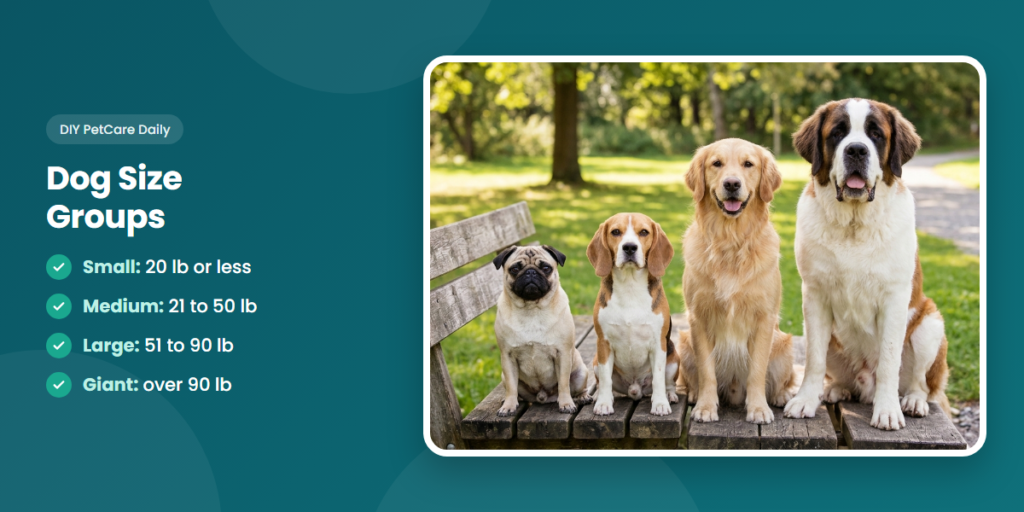
Vets and pet food companies often sort dogs into size groups. These matter when you choose food and estimate lifespan.
| Size Group | Typical Adult Weight | Examples |
| Small | 20 lb or less | Yorkie, Pug, Shih Tzu |
| Medium | 21 to 50 lb | Beagle, Cocker Spaniel, Bulldog |
| Large | 51 to 90 lb | Lab, Golden Retriever, German Shepherd |
| Giant | Over 90 lb | Great Dane, Saint Bernard, Mastiff |
You’ll see slightly different cutoffs from different brands. Some call a dog “giant” only at over 100 lb, but it’s close enough for everyday use. Size group also affects aging. Our guide on how long dogs live explains why.
Puppy Weight Chart by Age
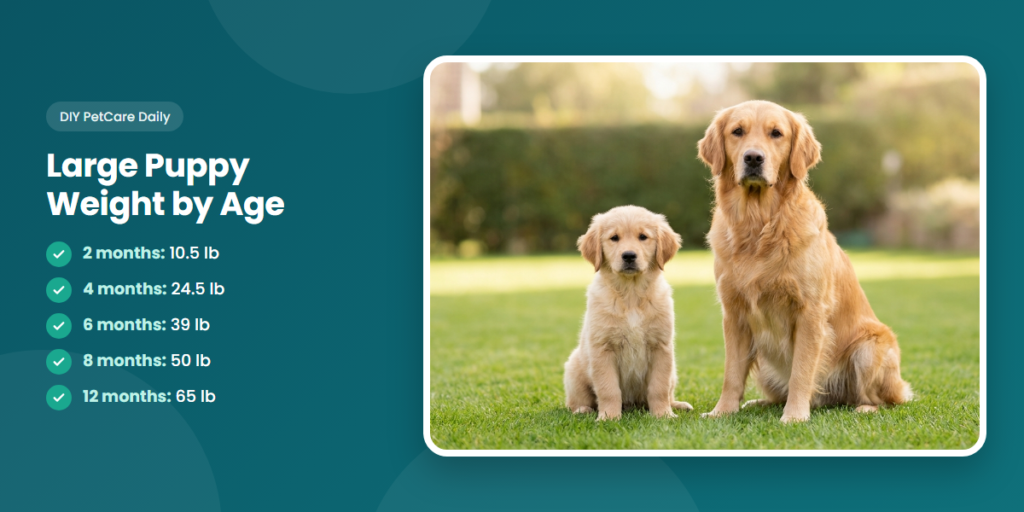
Puppies grow on different timelines, depending on their expected adult size. This chart shows typical weight at each age for four example dogs.
| Age | Small (10 lb Adult) | Medium (40 lb Adult) | Large (70 lb Adult) | Giant (120 lb Adult) |
| 2 months | 2.5 lb | 7 lb | 10.5 lb | 12 lb |
| 3 months | 4 lb | 12 lb | 17.5 lb | 20 lb |
| 4 months | 5.5 lb | 17 lb | 24.5 lb | 31 lb |
| 6 months | 8 lb | 26 lb | 39 lb | 53 lb |
| 8 months | 9 lb | 33 lb | 50 lb | 72 lb |
| 10 months | 9.5 lb | 37 lb | 60 lb | 88 lb |
| 12 months | 10 lb | 39 lb | 65 lb | 100 lb |
| 18 months | 10 lb | 40 lb | 70 lb | 118 lb |
These are estimates, so don’t worry if your puppy is a bit above or below. To estimate your own puppy’s adult size, read our guide on how big a puppy will get or try our dog weight calculator.
Why Body Shape Matters More Than the Chart
Breed charts are good for a rough check, but they have real limits:
- Frame size varies. A big-boned dog can be healthy above the range, while a small-framed dog can be overweight inside it.
- Standards aren’t health limits. Many breed numbers come from show standards. They describe an ideal show dog rather than the healthiest weight for your pet.
- Mixes don’t fit. A Lab and Poodle mix may not match either parent.
- Muscle weighs a lot. Fit, working dogs can weigh more than their chart suggests and still be lean.
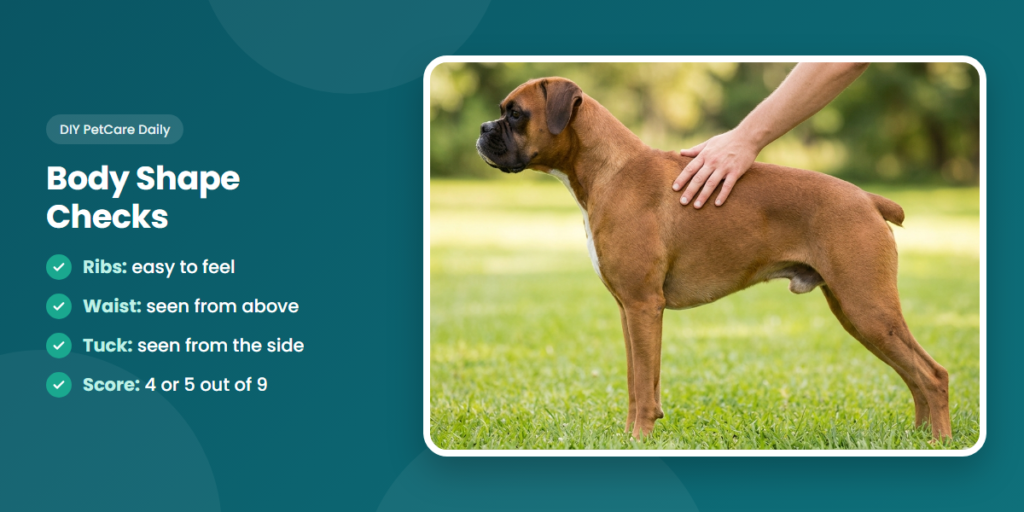
Here’s what matters more. A dog at a healthy weight should have:
- Ribs you can feel easily, with a light covering, like the back of your hand
- A clear waist when you look from above
- A belly tuck when you look from the side
Vets use this kind of check to give dogs a score from 1 to 9. A score of 4 or 5 is ideal. You can learn more in our guide to the dog body condition score, or get a quick answer from our dog BMI calculator.
Find Your Own Dog’s Healthy Weight
Here’s a better way to find your dog’s own number:
- Look for an old record. The weight at 1 to 2 years old is often a good target, if your dog was lean then.
- Score your dog today. Each point above 5 is about 10% extra weight.
- Do the math. A 66 lb dog with a score of 6 is about 10% over, so 66 divided by 1.1 means a goal of about 60 lb.
- Ask your vet. They can confirm your target and adjust it for your dog’s frame.
How to Weigh Your Dog at Home
Regular weigh-ins help you catch changes early. Daily ups and downs are normal, so look for a trend over a few weeks.
- Small and medium dogs: Weigh yourself, then step on the scale holding your dog, and subtract your own weight.
- Large dogs: Most vet clinics are happy to let you use their walk-on scale, often for free.
- Puppies: A baby scale or kitchen scale works best.
- Same conditions: Weigh at about the same time of day and on the same scale.
How often should you weigh?
| Dog | How Often |
| Puppies | Every 1 to 2 weeks |
| Healthy adults | About once a month |
| Dogs on a weight plan | Every 2 weeks |
| Older dogs | About once a month |
What If Your Dog Is Outside the Range?
Being outside a range doesn’t always mean there’s a problem. First, check your dog’s body shape.
Above the Range
If you can’t feel your dog’s ribs easily or there’s no waist, they’re probably carrying extra weight. Our guide, is my dog overweight, can help you find out. If they do need to slim down, follow our plan on how to help a dog lose weight. Weight gain with a measured diet should be checked by a vet, since low thyroid and other problems can be the cause.
Below the Range
If ribs and hips stick out, or your dog has lost weight, they may need a vet visit. See why a dog may be so skinny for possible causes. A sudden drop is a different concern, so read about dog losing weight too.
Once you know your dog’s goal weight, our guide on how much dog food to feed can help you set the right portions. For more guides, visit our Dog Health & Wellness section.
Frequently Asked Questions
What is a healthy weight for my dog?
A healthy weight is one where your dog has easy-to-feel ribs, a clear waist, and a belly tuck. A breed chart gives you a rough number, but body shape is the better test.
Are dog weight charts accurate?
They’re useful averages, not exact targets. Many are based on breed standards, and individual dogs vary. Use a chart as a first check, then confirm with a body score.
How much should a Labrador weigh?
Male Labs usually weigh 65 to 80 lb, and females usually weigh 55 to 70 lb. A lean, fit Lab may fall outside that range, so check their ribs and waist too.
Why does my dog weigh more than the breed chart says?
They may have a larger frame, more muscle, or a mixed background. If the ribs are easy to feel and they have a waist, the extra pounds may be fine. If not, your dog may need to lose some weight.
How do I find the right weight for a mixed-breed dog?
Use your dog’s body shape instead of a breed chart. Aim for a score of 4 or 5 out of 9, and ask your vet to confirm a goal weight at their next visit.