Table of Contents
Quick answer: To learn how to help a dog lose weight, start with a vet check and a goal weight. Then measure every meal, keep treats to 10% of daily calories, and add a little more activity each week. A safe pace for most dogs is about 1% to 2% of body weight per week, so expect the process to take a few months.
If your vet has told you your dog needs to lose a few pounds, you’re in good company. More than half of US dogs are estimated to be overweight, and those extra pounds can put real strain on joints, breathing, and overall health.
The good news is that dog weight loss doesn’t require fancy products. It mostly comes down to controlling food, being consistent, and staying patient. This guide gives you a simple step-by-step plan, including how to set a goal, how much to feed, what to do about begging, and what to do when progress stalls.
Table of Contents
- Before You Start: See Your Vet
- How to Help a Dog Lose Weight in 7 Steps
- How to Handle Begging and Hunger
- What to Do When Weight Loss Stalls
- Mistakes to Avoid
- When to Call the Vet
- Frequently Asked Questions
Before You Start: See Your Vet
It’s tempting to jump right in, but a quick visit first is worth it. Your vet can:
- Check for medical causes of weight gain, such as low thyroid or Cushing’s disease
- Check joints and heart before you add exercise
- Confirm your dog’s body condition score and goal weight
- Recommend a weight loss food if it makes sense
- Adjust the plan if your dog has diabetes, kidney disease, or another health problem
Not sure if your dog really needs to lose weight? Try the home checks in our guide, is my dog overweight, or get a number from our dog BMI calculator.
How to Help a Dog Lose Weight in 7 Steps
Follow these steps in order. Simple habits matter much more than a perfect plan.
Step 1: Set a Goal Weight
Vets often use a simple rule: each body condition point above 5 means about 10% extra weight. To estimate a goal, divide your dog’s weight by the right number.
| Body Score | Divide Current Weight By | Example: 60 lb Dog |
| 6 | 1.1 | Goal: about 54.5 lb |
| 7 | 1.2 | Goal: about 50 lb |
| 8 | 1.3 | Goal: about 46 lb |
| 9 | 1.4 | Goal: about 43 lb |
If your dog has a lot to lose, set smaller steps. A first goal of 5% to 10% of body weight can already help mobility and comfort. Learn how to score your dog in our dog body condition score guide.
Step 2: Work Out a Daily Calorie Target
A common starting point for weight loss is about 1.0 x RER, based on your dog’s goal weight rather than current weight. RER is the energy your dog would burn at rest. Here are the numbers for common goal weights.
| Goal Weight | Daily Calorie Target (About) | Treat Budget (10%) |
| 10 lb | 218 | 22 |
| 20 lb | 366 | 37 |
| 30 lb | 496 | 50 |
| 40 lb | 615 | 62 |
| 50 lb | 727 | 73 |
| 60 lb | 834 | 83 |
| 70 lb | 936 | 94 |
| 80 lb | 1,035 | 104 |
Your vet may suggest a slightly different target. Our dog calorie calculator does the math and turns the number into cups or cans, and our guide on how many calories a dog needs explains how it works.
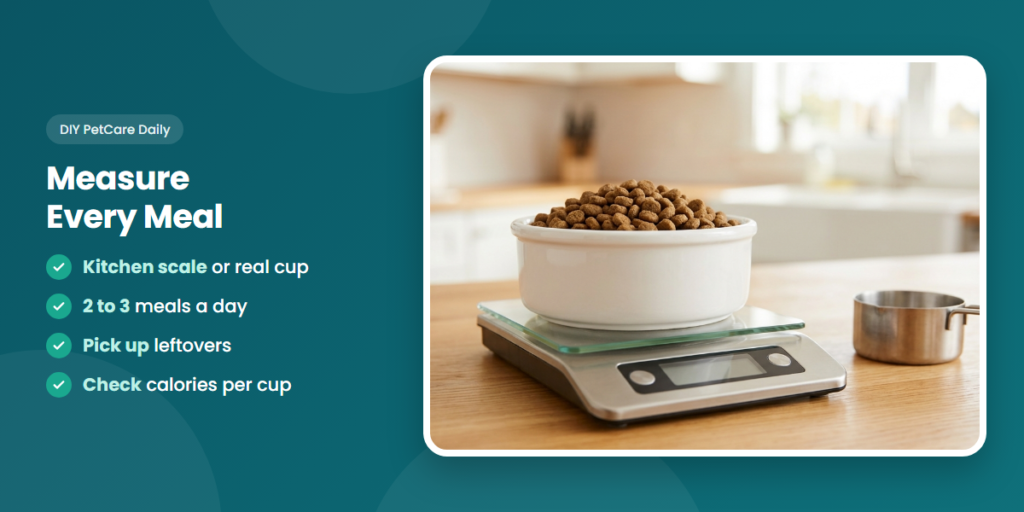
Step 3: Measure Every Meal
This step makes the biggest difference. A heaping scoop can easily hold far more than you think, and that extra food adds up day after day.
- Use a kitchen scale, or at least a real measuring cup.
- Divide the day’s food into 2 or 3 meals. This helps many dogs feel less hungry.
- Pick up leftovers. Don’t leave food out all day.
- Check the label. Compare foods by calories per cup, since they can differ a lot.
Don’t simply cut your current food by a large amount without checking with your vet. Big cuts of a regular food can also cut vitamins and minerals. If your dog needs a lot less food, your vet may suggest a weight loss formula made to keep nutrition balanced at lower calories.
Step 4: Fix the Treats
Treats are often the hidden problem. Keep them to 10% of the daily target, and count everything, including chews and table scraps.
Swap high-calorie treats for small pieces of green beans, carrots, or cucumber. Our list of low calorie dog treats has more ideas, and our fruits dogs can eat chart shows what’s safe.
You can also set aside some of the day’s kibble and use it for training. Your dog gets rewards without extra calories.
Step 5: Add More Movement
Exercise helps your dog burn calories, keep muscle, and feel better. Start slowly, especially if your dog is very heavy, older, or has sore joints.
- Start small. Add 5 minutes to your daily walk, then build up each week.
- Add a second walk. Two short walks are often easier than one long one.
- Pick up the pace. Mix in short bursts of faster walking.
- Try swimming. It’s gentle on joints, if your dog likes water.
- Play indoors. Fetch in a hallway, tug, or a game of hide and seek all count.
- Make food work. Puzzle feeders and snuffle mats slow eating and keep the brain busy.
Avoid hard exercise during hot weather. Heavy dogs and flat-faced breeds overheat quickly. Stop if your dog limps, pants hard, or wants to quit.
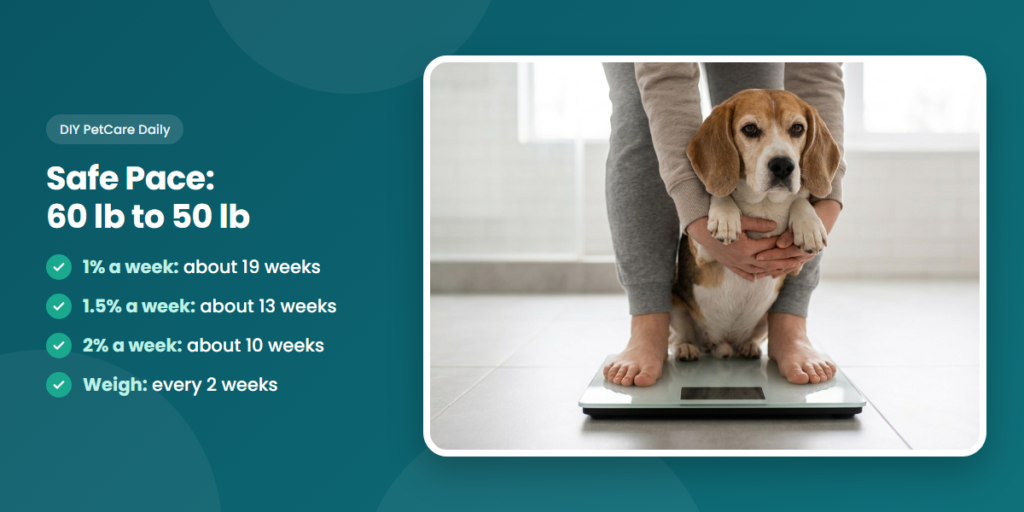
Step 6: Weigh In Every 2 Weeks
Use the same scale at about the same time of day. Weigh your dog with the same method each time, then write it down. A monthly side-and-top photo can also show progress when the numbers seem slow.
Most dogs can safely lose about 1% to 2% of body weight per week. Here’s what that looks like for a 60 lb dog with a goal of 50 lb.
| Pace Per Week | Loss in Week 1 | Estimated Time to Goal |
| 1% | 0.6 lb | About 19 weeks |
| 1.5% | 0.9 lb | About 13 weeks |
| 2% | 1.2 lb | About 10 weeks |
Our dog weight calculator can make a timeline for your dog.
Step 7: Keep the Weight Off
Once your dog reaches their goal, don’t go straight back to their old portions. Slowly raise calories by about 5% to 10% and keep weighing them every few weeks. Find the amount that holds their weight steady, and make it the new normal. Our guide on how much dog food to feed can help with long-term portions.
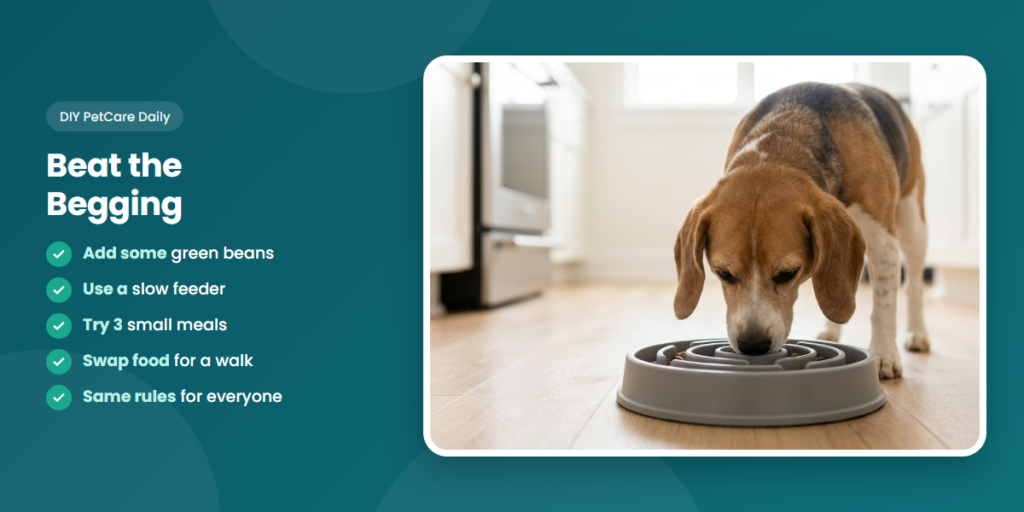
How to Handle Begging and Hunger
A hungry dog can be very convincing. Most begging is really about attention and routine, so try these tricks:
- Add low-calorie volume. A little plain canned pumpkin or some green beans can help your dog feel fuller. Keep it small and count it.
- Feed smaller, more frequent meals. Three meals may work better than two.
- Use slow feeders. Meals last longer this way.
- Replace food with attention. Offer a walk, brushing, or play when your dog begs.
- Keep the family on the same plan. One person sneaking snacks can undo a lot of hard work. Write the plan on the fridge.
- Feed dogs separately. Pets shouldn’t share bowls or finish each other’s meals.
If you change foods, do it slowly over 7 to 10 days. Our guide on how to switch dog food has a simple plan.
What to Do When Weight Loss Stalls
It’s normal for progress to slow. Smaller dogs burn fewer calories, so the same portion may stop working after a while. If your dog hasn’t lost weight for about a month:
- Check portions again. Weigh the food to see whether your scoop has crept up.
- Count everything. Write down every treat, chew, and table scrap for a week.
- Check who’s feeding. Make sure kids, visitors, and neighbors aren’t handing out extras.
- Reduce calories by 5% to 10%. Ask your vet before going much lower.
- Add a bit more activity, if your dog can handle it.
- Book a recheck. Your vet can look for medical problems and adjust the plan.
Mistakes to Avoid
- Crash dieting: Very large calorie cuts can lead to muscle loss and nutrient gaps. Slow loss is safer and easier to keep up.
- Skipping meals: It often makes begging worse.
- Feeding free choice: A bowl that’s always full makes it impossible to track food.
- Too much exercise too soon: It can cause injury or heat stress.
- Trusting the bag alone: Feeding guides are often too generous for neutered or less active dogs.
- Using human diet foods: Some contain xylitol, which is toxic to dogs.
When to Call the Vet
Call your vet if your dog:
- Is losing more than about 2% of their weight each week
- Loses their appetite, or seems tired or weak
- Has vomiting or diarrhea after a diet change
- Isn’t losing weight despite measured meals
- Seems sore or short of breath during activity
If your dog starts losing weight when you haven’t changed anything, read our guide on dog losing weight and contact your vet.
For more guides on keeping your dog healthy, visit our Dog Health & Wellness section.
Frequently Asked Questions
How fast can a dog safely lose weight?
Most dogs can safely lose about 1% to 2% of body weight per week. For a 60 lb dog, that’s about 0.6 to 1.2 lb a week. Ask your vet for a target that fits your dog.
What is the best way to help a dog lose weight?
Measure every meal, count treats, and add a little more activity. Food control has the biggest effect, while exercise helps keep muscle and improves overall health.
Should I just feed my dog less of their regular food?
A small cut is often fine, but a large cut can also shrink vitamins and minerals. If your dog needs far fewer calories, ask your vet about a food made for weight loss.
Can walking alone help my dog lose weight?
It helps, but walking alone usually isn’t enough. Most dogs also need measured portions and fewer treats. Combining both usually gets the best results.
How long does it take a dog to lose 10 pounds?
For a 60 lb dog, it usually takes about 10 to 19 weeks at a safe pace. Smaller dogs may need longer, and a stall along the way is normal.