Table of Contents
- Table of Contents
- What Is the Quick, and Why Is It Hard to See?
- Signs Your Dog’s Nails Are Too Long
- Tools You’ll Need
- How to Cut Black Dog Nails Step by Step
- Using a Grinder on Black Nails
- How Short Should You Cut Dog Nails?
- What to Do If You Cut the Quick
- How to Help a Dog Who Hates Nail Trims
- Keep the Rest of the Paw Healthy
- Frequently Asked Questions
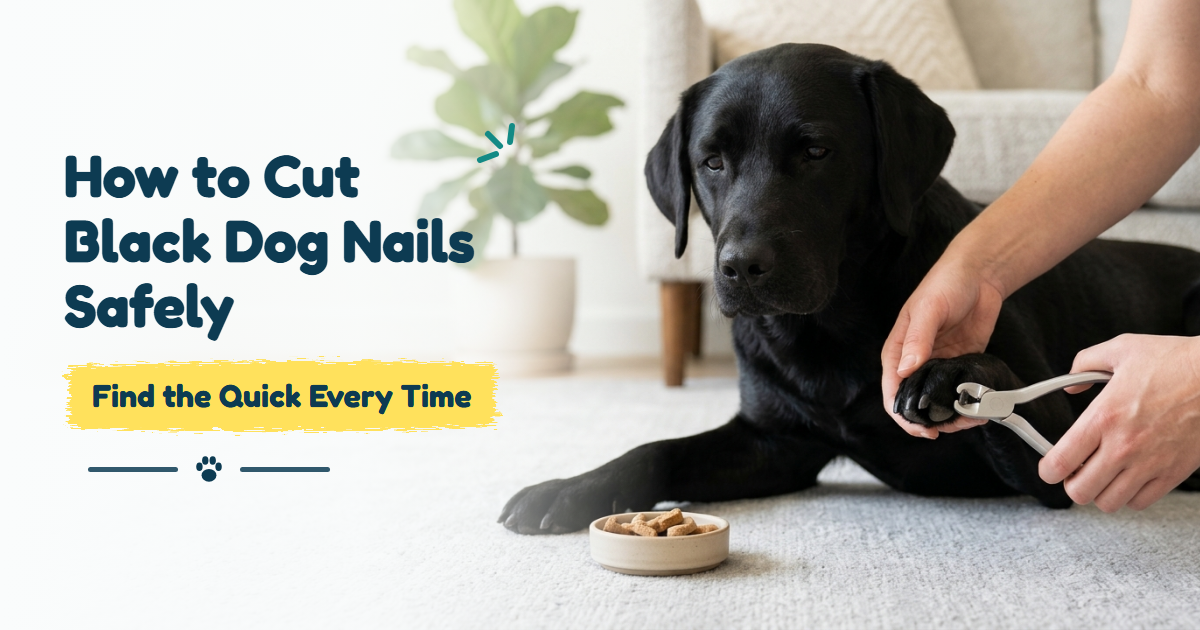
Quick answer: To cut black dog nails safely, trim off tiny slices, about 1/16 of an inch at a time, instead of one big cut. After each slice, look at the cut face of the nail. When it turns from dry and white to a gray or pink oval with a small dark dot in the middle, you’re close to the quick, so stop there. Use sharp clippers or a grinder, work in good light, and keep styptic powder nearby in case a nail bleeds.
If your dog has black nails, you already know the problem. With clear nails, you can see the pink quick inside and cut around it. With black nails, you can’t see anything. So you guess, the clipper squeezes, your dog yelps, and now there’s blood on the floor and a dog who hides every time the clippers come out.
The good news is that you don’t need to see the quick from the outside. The nail tells you when to stop if you know what to look for. This guide shows you how to cut black dog nails in small, safe steps, so you can do it at home without the drama.
Table of Contents
- What Is the Quick, and Why Is It Hard to See?
- Signs Your Dog’s Nails Are Too Long
- Tools You’ll Need
- How to Cut Black Dog Nails Step by Step
- Using a Grinder on Black Nails
- How Short Should You Cut Dog Nails?
- What to Do If You Cut the Quick
- How to Help a Dog Who Hates Nail Trims
- Keep the Rest of the Paw Healthy
- Frequently Asked Questions
What Is the Quick, and Why Is It Hard to See?
The quick is the living part inside your dog’s nail. It holds a blood vessel and a nerve, which is why cutting into it hurts and bleeds. On a white or clear nail, the quick shows up as a pink area. On a black nail, the dark color hides it completely.
Here’s the part many owners don’t know: the quick grows with the nail. When nails are left long, the quick gets longer too. That’s why a dog with overgrown nails can’t be cut short in one go. You have to trim a little at a time and let the quick pull back over a few weeks.
Signs Your Dog’s Nails Are Too Long
You don’t need a ruler for this. Watch for these signs:
- You hear clicking when your dog walks on hard floors.
- The nails touch the ground when your dog is standing still.
- Your dog slips more on smooth floors.
- The toes twist or splay out to the side.
- The dewclaw (the nail on the inner leg) is curling toward the pad.
Long nails aren’t just a looks issue. They change how your dog stands and walks, which can put strain on the toes, wrists, and joints over time. Many dogs need a trim every 3 to 4 weeks, but active dogs who walk on concrete may need it less often. Our dog grooming schedule shows how nail care fits into a weekly and monthly routine.
Tools You’ll Need
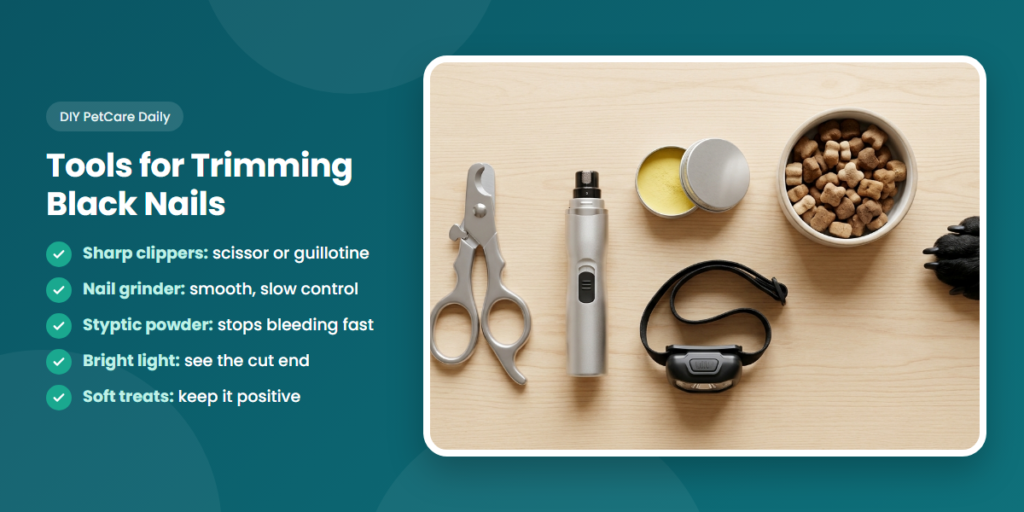
Having the right tools makes this job faster and safer.
- Sharp nail clippers. Scissor-style (also called plier-style) clippers work well for medium and large dogs. Guillotine clippers are fine for small dogs. Dull clippers crush the nail, so replace them when they stop cutting cleanly.
- A nail grinder (optional). A grinder files the nail down slowly, which gives you more control on black nails. Many owners use clippers first and then a grinder to smooth the edge.
- Styptic powder. This stops bleeding fast if you nick the quick. Cornstarch or plain flour will work in a pinch.
- Good light. A bright lamp or a headlamp helps you see the cut surface of the nail.
- High-value treats. Small, soft treats like bits of chicken or cheese keep the session positive.
- A towel or non-slip mat. This helps your dog feel steady.
How to Cut Black Dog Nails Step by Step
Step 1: Get Your Dog Comfortable
Pick a calm time, like after a walk. Small dogs can sit on your lap. Larger dogs can lie on their side on a mat. Give a treat, touch a paw, give another treat. If your dog is very nervous about having paws handled, spend a few days on just this step before you ever pick up the clippers.
Step 2: Hold the Paw Firmly but Gently
Hold the paw with your thumb on the pad and your fingers on top of the foot. Push gently on the pad to extend the nail. Keep your grip relaxed. If you squeeze, your dog will try to pull away.
Step 3: Find Where the Nail Starts to Curve
Look at the nail from the side. Most nails have a thick part near the toe and then a thinner, hooked tip that curves down. That hooked tip is usually safe to remove. Start your first cut just below where the curve begins, cutting at a slight angle that follows the line of the paw pad.
Step 4: Trim Tiny Slices
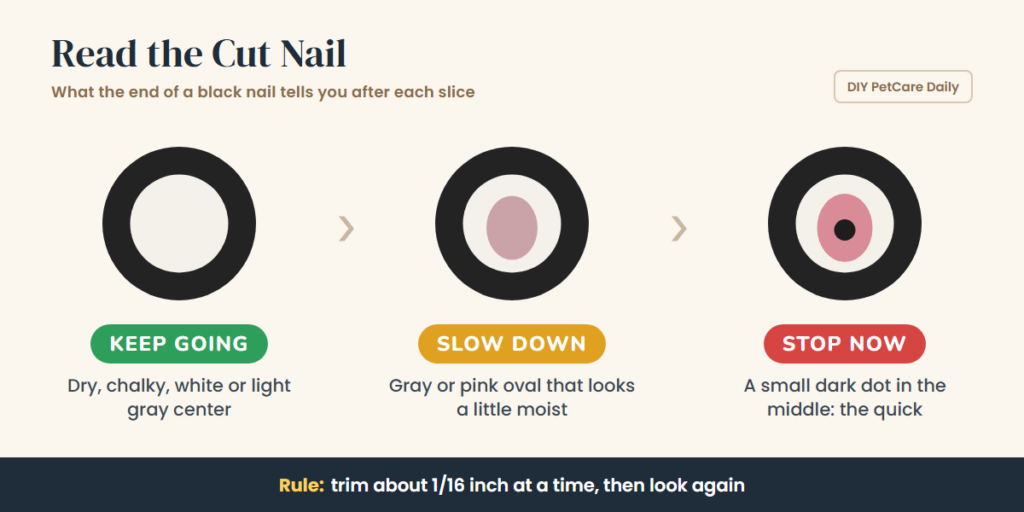
This is the key to cutting black dog nails. Don’t take one big cut. Take a thin slice, about 1/16 of an inch, then stop and look at the cut end before you take another.
Step 5: Read the Cut Surface
After each slice, look straight at the end of the nail. Here’s what you’ll see as you get closer to the quick:
| What the Cut End Looks Like | What It Means |
| Dry, chalky, white or light gray | Safe. Keep trimming in small slices. |
| Gray or pink oval, slightly shiny or moist | Getting close. One more very thin slice at most. |
| A small black or dark dot in the center | The quick is right there. Stop now. |
That dark dot is the best signal you’ll get. Once you see it, that nail is done.
Step 6: Smooth the Edges
Cut nails can be sharp. Use a grinder or a nail file to round off the edge. If you use a grinder, touch it to the nail for a second or two at a time so it doesn’t heat up.
Step 7: Reward and Take Breaks
Give a treat after every nail or two. You don’t have to do all four paws in one sitting. Doing one paw a day is fine, and many dogs do better that way.
Using a Grinder on Black Nails
A grinder is a great choice for dark nails because it removes such a thin layer each time. You can watch the nail surface change and stop as soon as you see the gray oval.
Tips for using a grinder:
- Let your dog hear the sound and sniff the grinder before you use it.
- Hold the grinder at an angle and work in light, short touches.
- Keep fur away from the spinning part. Pull long toe hair back or wrap the paw in old nylon stocking with the nail poking through.
- Use the slowest speed that still files well.
Grinding takes a bit longer than clipping, but it gives a smoother finish and helps you avoid the quick.
How Short Should You Cut Dog Nails?
A good rule is that the nail shouldn’t touch the floor when your dog is standing. For black nails, you’ll usually stop a little longer than you would with clear nails, and that’s fine. A nail that’s slightly long is much better than one that’s bleeding.
If your dog’s nails are already very overgrown, don’t try to fix it in one day. Trim a small amount every 1 to 2 weeks. Each trim encourages the quick to pull back a little, so over a month or two you can get the nails to a healthy length.
What to Do If You Cut the Quick
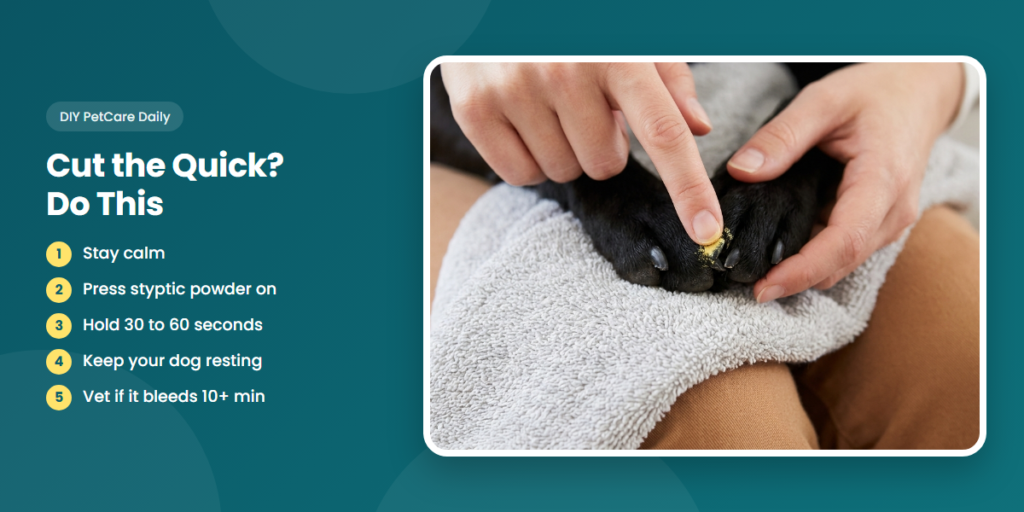
Even groomers hit the quick sometimes. If it happens, stay calm. Your dog will take cues from you.
- Grab some styptic powder, cornstarch, or flour.
- Press a pinch firmly onto the end of the nail and hold it for about 30 seconds to a minute.
- Check if the bleeding has stopped. If not, add more powder and hold again.
- Keep your dog calm and quiet for a little while so the clot can set.
- Give a treat and end the session on a good note.
Most quick cuts stop bleeding within a few minutes. Call your vet if the bleeding doesn’t slow down after 5 to 10 minutes of steady pressure, or if the toe looks swollen or infected in the next few days.
How to Help a Dog Who Hates Nail Trims
Some dogs fight nail trims because of one bad experience. You can change that with short, slow practice.
- Day 1 to 3: Touch the paws and give treats. No tools.
- Day 4 to 6: Show the clippers or grinder, then treat. Touch the tool to a nail without cutting.
- Day 7 and on: Trim one nail, give a big reward, and stop.
Another trick is a scratch board. This is a piece of wood covered in coarse sandpaper. You teach your dog to scratch it with their front paws, which files the nails down without any clippers at all. Many owners of nervous dogs swear by it.
If your dog shows real fear, like growling, snapping, or panting heavily, stop and ask your vet or a professional groomer for help. Some dogs need a calming plan from a vet first.
Keep the Rest of the Paw Healthy
While you’re down at paw level, check the pads and the skin between the toes. Look for cracks, cuts, redness, or anything stuck. If you notice your dog licking or chewing at their feet a lot, our guide on why your dog licks his paws explains the common causes. And if you live somewhere with hot summers or icy winters, our dog paw protection guide covers hot pavement and winter salt.
Long fur between the toes can also trap dirt and form small mats. Trim it level with the pads using small, blunt-tip scissors. For tangles elsewhere on the body, see how to remove matted dog hair gently at home.
For more guides like this one, visit our Dog Nail & Paw Care section.
Frequently Asked Questions
How do you know where the quick is on black dog nails?
You can’t see it from the outside, so you watch the cut surface instead. Trim thin slices. When the end of the nail changes from chalky white to a gray or pink oval with a dark dot in the center, you’ve reached the area just before the quick. Stop there.
Is it better to clip or grind black dog nails?
Both work. A grinder gives you more control and a smoother edge, which helps with black nails. Clippers are faster. Many owners clip off the tip first, then finish with a grinder.
How often should I trim my dog’s black nails?
Most dogs need a trim every 3 to 4 weeks. If you’re trying to shorten overgrown nails, trim a little every 1 to 2 weeks so the quick can pull back over time.
Does cutting the quick hurt my dog?
Yes, it does hurt for a moment, and it bleeds because the quick has a nerve and a blood vessel. The pain is usually short. Stop the bleeding with styptic powder, stay calm, and give a treat.
Can I use human nail clippers on my dog?
Human clippers can work on very small puppies, but they tend to crush or split thicker dog nails. Use clippers made for dogs, sized for your dog’s nails.