Table of Contents
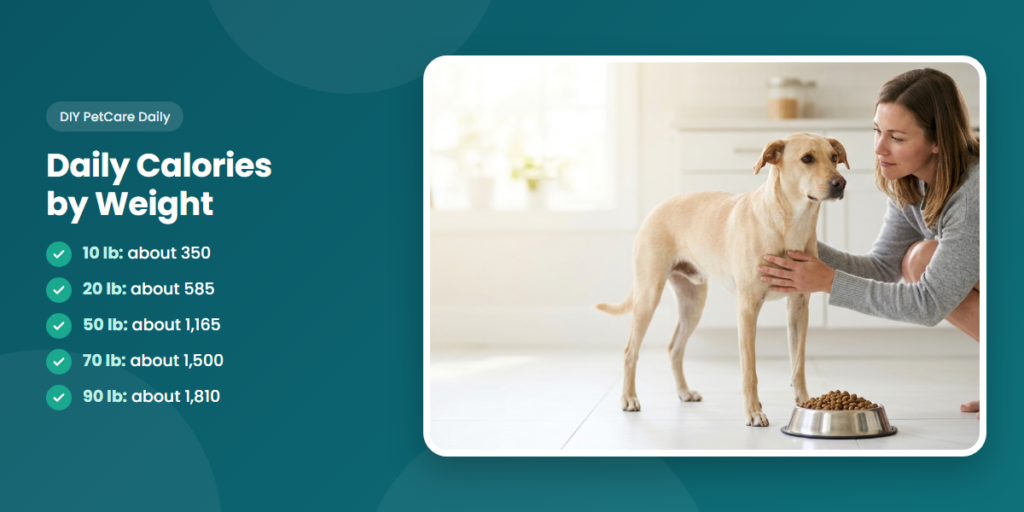
Quick answer: How many calories does a dog need each day? A typical spayed or neutered adult dog needs about 350 calories at 10 lb, 585 at 20 lb, 1,165 at 50 lb, and 1,810 at 90 lb. Puppies and very active dogs need more, while older or low-activity dogs usually need less. Treat these numbers as a starting point and adjust based on your dog’s body shape.
Most owners feed by the scoop and hope for the best. That’s understandable, since the feeding guide on the bag seems simple enough. But that guide has to cover a huge range of dogs, and it doesn’t know if yours is a couch potato or a trail runner.
Knowing your dog’s daily calorie number gives you a much better starting point. This guide explains the simple math behind it, gives you charts for common weights, and shows you how to turn calories into real meals.
Table of Contents
- How Many Calories Does a Dog Need Per Day?
- How to Work Out Your Dog’s Calories
- What Changes Your Dog’s Calorie Needs
- Turning Calories Into Food
- Don’t Forget the Treat Budget
- How to Know If Your Dog’s Calories Are Right
- Frequently Asked Questions
How Many Calories Does a Dog Need Per Day?
Here’s a quick chart for adult dogs at a healthy weight. All numbers are calories (kcal) per day.
| Dog Weight | Low Activity, Neutered | Normal, Neutered | Normal, Intact | Active |
| 5 lb | 155 | 207 | 233 | 259 |
| 10 lb | 261 | 348 | 392 | 435 |
| 15 lb | 354 | 472 | 531 | 590 |
| 20 lb | 439 | 585 | 659 | 732 |
| 30 lb | 595 | 794 | 893 | 992 |
| 40 lb | 738 | 985 | 1,108 | 1,231 |
| 50 lb | 873 | 1,164 | 1,309 | 1,455 |
| 60 lb | 1,001 | 1,335 | 1,501 | 1,668 |
| 70 lb | 1,124 | 1,498 | 1,685 | 1,873 |
| 80 lb | 1,242 | 1,656 | 1,863 | 2,070 |
| 90 lb | 1,357 | 1,809 | 2,035 | 2,261 |
| 100 lb | 1,468 | 1,958 | 2,202 | 2,447 |
Notice that a 100 lb dog doesn’t need twice the calories of a 50 lb dog. Bigger bodies use energy more efficiently, so calorie needs don’t rise evenly with weight.
Want a number for your own dog? Enter their details in our dog calorie calculator, and it will also turn the result into cups or cans per meal.

How to Work Out Your Dog’s Calories
Vets commonly use a two-step formula. It looks harder than it is.
Step 1: Find the Resting Energy Requirement (RER)
RER is the energy your dog would burn just lying around for a full day.
RER = 70 x (body weight in kg)^0.75
To get kilograms, divide your dog’s weight in pounds by 2.2. For the power of 0.75, use a calculator: enter the weight in kg, multiply it by itself 3 times in total (so kg x kg x kg), then press the square root button twice.
For a 50 lb dog: 50 divided by 2.2 is about 22.7 kg. The RER comes out to about 727 calories.
Step 2: Multiply by a Life Stage Factor
Next, multiply RER by the number that fits your dog. These factors are starting points, and a vet may adjust them.
| Dog | Multiply RER By |
| Puppy, under 4 months | 3.0 |
| Puppy, 4 months to adult size | 2.0 |
| Neutered adult, normal activity | 1.6 |
| Intact adult, normal activity | 1.8 |
| Older dog, normal activity (neutered / intact) | 1.4 / 1.6 |
| Low activity (neutered / intact) | 1.2 / 1.4 |
| Active adult | 2.0 |
| Very active or working dog | 3.0 or more |
| Weight loss, using goal weight | 1.0 |
| Weight gain, using goal weight | 1.4 |
For that same 50 lb neutered adult: 727 x 1.6 = about 1,164 calories a day.
What Changes Your Dog’s Calorie Needs
Two dogs of the same weight can have quite different needs. Here’s what makes the biggest difference.
Age
Puppies burn a lot of energy while growing, often needing twice the calories per pound of an adult. Older dogs often need fewer calories because they move less, though some very old dogs need more to keep muscle on. Our guides on how much to feed a puppy and when a dog is considered a senior cover both ends of life.
Activity
A dog on a daily 5-mile run needs far more than one who strolls around the block. Be honest about this. Many owners guess “active” when their dog is closer to “normal.”
Spay or Neuter Status
Spayed and neutered dogs usually burn fewer calories, which is why the factor drops from 1.8 to 1.6. If your dog has just had surgery, watch their weight over the next few months.
Breed and Body Type
Some breeds are prone to weight gain, including Labs, Beagles, and Pugs. Lean, high-energy breeds like Border Collies may need more. Don’t let breed averages replace what you see on your own dog.
Weather and Lifestyle
Dogs who spend a lot of time outside in the cold may burn more. House dogs in a climate-controlled home generally stay about the same year round, but they may be less active in very hot or very cold months.
Health
Pregnant or nursing dogs need much more food, and dogs with diabetes, kidney disease, or pancreatitis need a plan from a vet. Don’t rely on a chart in these cases.
Turning Calories Into Food
A calorie number only helps if you know how much is in your dog’s food. Look for “calorie content” on the bag or can. It’s usually listed as kcal per cup or kcal per can.
Then use this simple math:
Daily calories x 0.9 divided by calories per cup = cups per day
The 0.9 leaves room for treats. For example, a 50 lb neutered dog eating food with 350 calories per cup:
1,164 x 0.9 = 1,048 calories from food. Then 1,048 divided by 350 = about 3 cups per day, or 1.5 cups at each of two meals.
| Food Type | Typical Calories |
| Dry kibble | About 300 to 450 per cup |
| Canned food | About 250 to 500 per 13 oz can |
| Fresh or refrigerated food | Varies a lot; check the package |
Compare foods by calories, not just cups. Two bags can differ by 100 calories or more per cup, which is why a new food can cause surprise weight changes. If you switch brands, recalculate your portions and use a slow food transition.
For a full look at scoops and feeding schedules, see our guide on how much dog food to feed.
Tip: A kitchen scale is more accurate than a scoop. In studies, even careful owners often scoop too much or too little.

Don’t Forget the Treat Budget
Treats count too. A common guideline is to keep them to 10% of daily calories or less, so your dog still gets a balanced diet.
| Dog Weight (Normal, Neutered) | Daily Treat Budget |
| 10 lb | About 35 calories |
| 20 lb | About 59 calories |
| 50 lb | About 116 calories |
| 70 lb | About 150 calories |
| 90 lb | About 181 calories |
To put that in perspective, a tablespoon of peanut butter has about 95 calories. For a 20 lb dog, that’s more than the whole day’s treat budget. Our guide to low calorie dog treats has plenty of better options, and some fruits dogs can eat make simple low-calorie snacks.
How to Know If Your Dog’s Calories Are Right
No formula knows your dog’s exact metabolism. Think of the number as a first draft, then let your dog’s body tell you if it’s right.
- Feed the suggested amount for 2 to 4 weeks. Weight changes take a while to show.
- Weigh your dog. Use the same scale each time.
- Check their shape. You should be able to feel the ribs easily and see a waist. Our dog BMI calculator can help.
- Adjust by 5% to 10%. If your dog is gaining, cut back a little. If they’re losing, add a little.
- Repeat until their weight holds steady.
If your dog needs to slim down, our guide on how to help a dog lose weight walks you through a safe plan. If your dog is losing weight on the same food, or seems hungry all the time, talk to your vet, since illness can change calorie needs. Our guide to dog losing weight explains what to watch for.
For more on feeding your dog, see our Dog Food & Nutrition section.
Frequently Asked Questions
How many calories does a 50 lb dog need?
A typical neutered 50 lb adult dog needs about 1,160 calories a day. A low-activity dog may need closer to 870, and an active one may need about 1,450.
How many calories does a small dog need a day?
A 10 lb neutered adult dog needs about 350 calories a day, and a 20 lb dog needs about 585. Small dogs have small budgets, so even a few extra treats can add up quickly.
How many calories does a puppy need?
Puppies need about 2 to 3 times the RER, depending on age. That’s often about twice as many calories per pound as an adult dog. Portions should be updated often as they grow.
Do neutered dogs need fewer calories?
Usually, yes. A typical factor for neutered adults is 1.6 x RER, compared with 1.8 x RER for intact adults. Watch their weight and adjust their food if needed.
How do I find out how many calories are in my dog’s food?
Look for the “calorie content” statement on the bag or can. It lists kcal per cup or per can, along with kcal per kilogram. If you can’t find it, check the brand’s website.