Table of Contents
- Table of Contents
- Why Puppies Need Special Feeding
- How Much Food to Feed a Puppy: Calorie Basics
- Puppy Feeding Chart by Weight
- How Much to Feed a Puppy Chart by Age
- How Many Times a Day Should You Feed a Puppy?
- Sample Puppy Feeding Schedule
- Is Your Puppy Eating the Right Amount?
- Feeding Large and Giant Breed Puppies
- Choosing the Right Puppy Food
- Treats, Chews, and Training Rewards
- Common Puppy Feeding Mistakes
- When to Switch From Puppy Food to Adult Food
- When to Call the Vet
- Frequently Asked Questions
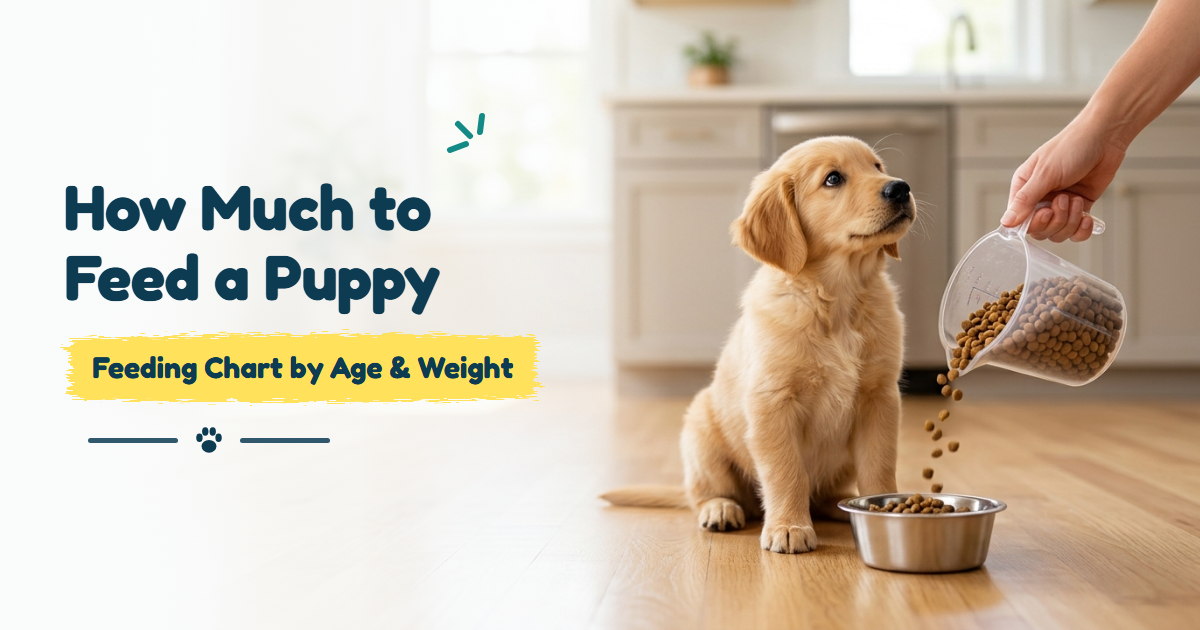
Quick answer: How much to feed a puppy depends on their age and weight. Puppies under 4 months need about 3 times the calories of a resting adult dog their size, and puppies from 4 months to adulthood need about 2 times. For a typical puppy food with about 400 calories per cup, that’s roughly 1 cup a day for a 5-pound young puppy, 1 2/3 cups for a 10-pound puppy under 4 months, and about 2 1/2 cups for a 30-pound puppy over 4 months. Split the daily amount into 3 to 4 meals until about 6 months, then 2 to 3 meals. Adjust so your puppy stays lean, with ribs easy to feel.
Bringing home a puppy is exciting, and one of the first questions most new owners have is how much to feed a puppy. Feed too little and your puppy won’t have the energy and nutrients they need to grow. Feed too much and they can gain weight fast, which puts strain on growing bones and joints.
Puppy food bags give a feeding guide, but those numbers are only a starting point. This guide gives you a simple puppy feeding chart by age and weight, a sample feeding schedule, and easy ways to tell if your puppy is getting the right amount.
Table of Contents
- Why Puppies Need Special Feeding
- How Much Food to Feed a Puppy: Calorie Basics
- Puppy Feeding Chart by Weight
- How Much to Feed a Puppy Chart by Age
- How Many Times a Day Should You Feed a Puppy?
- Sample Puppy Feeding Schedule
- Is Your Puppy Eating the Right Amount?
- Feeding Large and Giant Breed Puppies
- Choosing the Right Puppy Food
- Treats, Chews, and Training Rewards
- Common Puppy Feeding Mistakes
- When to Switch From Puppy Food to Adult Food
- When to Call the Vet
- Frequently Asked Questions
Why Puppies Need Special Feeding
Puppies grow faster in their first year than at any other time in their lives. A Labrador puppy can go from about 10 pounds at 8 weeks to 60 pounds or more by their first birthday. All that growth takes a lot of energy, protein, calcium, and other nutrients.
That’s why puppies need:
- More calories per pound than adult dogs
- Puppy food labeled for growth, with the right balance of protein, fat, calcium, and phosphorus
- Several small meals a day, since their stomachs are small and young puppies can get low blood sugar
- Careful portions, because overfeeding can make large breed puppies grow too fast
How Much Food to Feed a Puppy: Calorie Basics
Vets work out a puppy’s calories with a simple formula based on their current weight.
- Change your puppy’s weight to kilograms: pounds ÷ 2.2.
- Find the Resting Energy Requirement (RER): raise the kilograms to the 0.75 power (use the x^y key on a phone calculator), then multiply by 70.
- Multiply by the growth factor:
– Under 4 months old: RER × 3
– 4 months to adult size: RER × 2
Example: a 10-pound puppy weighs about 4.5 kg. 4.5 to the 0.75 power is about 3.1. Multiply by 70 to get an RER of about 216. At 3 months old, that puppy needs about 216 × 3 = 650 calories a day.
Then divide by the calories per cup on your puppy food bag (often listed as “kcal/cup”). At 400 kcal per cup, 650 ÷ 400 = about 1 2/3 cups a day.
Puppy Feeding Chart by Weight
This chart uses your puppy’s current weight and the vet formula above. Cup amounts assume a puppy food with about 400 calories per cup. Many large breed puppy foods have fewer calories (about 330 to 380 per cup), so check your bag and adjust.
| Puppy’s Current Weight | Daily Calories (Under 4 Months) | Cups per Day (Under 4 Months) | Daily Calories (4 Months to Adult) | Cups per Day (4 Months to Adult) |
| 2 lbs | about 195 | about 1/2 cup | about 130 | about 1/3 cup |
| 5 lbs | about 390 | about 1 cup | about 260 | about 2/3 cup |
| 10 lbs | about 650 | about 1 2/3 cups | about 430 | about 1 cup |
| 15 lbs | about 880 | about 2 1/4 cups | about 590 | about 1 1/2 cups |
| 20 lbs | about 1,100 | about 2 3/4 cups | about 730 | about 1 3/4 cups |
| 30 lbs | about 1,490 | about 3 2/3 cups | about 990 | about 2 1/2 cups |
| 40 lbs | — | — | about 1,230 | about 3 cups |
| 50 lbs | — | — | about 1,460 | about 3 2/3 cups |
| 60 lbs | — | — | about 1,670 | about 4 1/4 cups |
| 80 lbs | — | — | about 2,070 | about 5 1/4 cups |
As your puppy gains weight, their portion grows too. Weigh your puppy every week or two and move to the matching row.
Large and giant breed puppies often do best at the lower end of these ranges, because steady, slower growth is easier on their joints. Your vet may suggest a lower factor for these breeds.
How Much to Feed a Puppy Chart by Age
Most puppy food bags give amounts by age and expected adult weight. This chart shows the general pattern, using a typical puppy food at about 400 calories per cup. It’s a quick way to check if you’re in the right range.
| Expected Adult Weight | 2 to 3 Months | 4 to 5 Months | 6 to 8 Months | 9 to 12 Months |
| Toy (under 10 lbs) | 1/2 to 3/4 cup | 1/2 to 3/4 cup | 1/2 to 3/4 cup | switch to adult food |
| Small (10 to 25 lbs) | 3/4 to 1 1/3 cups | 1 to 1 1/2 cups | 1 to 1 1/2 cups | about 1 1/4 cups |
| Medium (25 to 50 lbs) | 1 1/3 to 2 cups | 1 3/4 to 2 1/2 cups | 2 to 2 3/4 cups | 2 to 2 3/4 cups |
| Large (50 to 100 lbs) | 2 to 3 cups | 2 1/2 to 3 1/2 cups | 3 to 4 1/2 cups | 3 1/2 to 5 cups |
| Giant (over 100 lbs) | 2 1/2 to 3 1/2 cups | 3 1/2 to 5 cups | 4 1/2 to 6 cups | 5 to 7 cups |
These amounts are daily totals, split across meals. Active puppies may need a bit more. Calm puppies, and puppies who have been spayed or neutered, often need a bit less.
How Many Times a Day Should You Feed a Puppy?
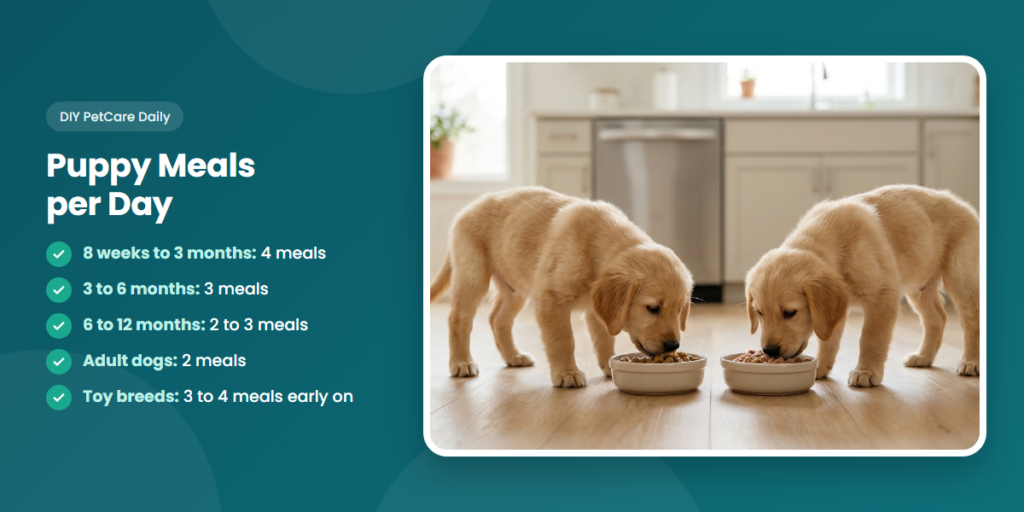
| Puppy’s Age | Meals per Day |
| 6 to 8 weeks (weaning) | 4 small meals of soft or moistened puppy food |
| 8 weeks to 3 months | 4 meals |
| 3 to 6 months | 3 meals |
| 6 to 12 months | 2 to 3 meals |
| Over 12 months (small and medium breeds) | 2 meals |
| 12 to 24 months (large and giant breeds) | 2 meals |
Toy breed puppies like Chihuahuas and Yorkies are at risk of low blood sugar (hypoglycemia), so keep them on 3 to 4 meals a day until at least 4 to 6 months. Signs of low blood sugar include weakness, shaking, wobbly walking, and acting sleepy or dazed. Rub a little honey or corn syrup on their gums and call your vet right away.
Sample Puppy Feeding Schedule
A routine helps with house training too, because puppies usually need to go potty 10 to 30 minutes after eating.
For a puppy eating 4 meals a day (8 weeks to 3 months):
- 7:00 a.m. breakfast
- 11:00 a.m. lunch
- 3:00 p.m. afternoon meal
- 7:00 p.m. dinner
For a puppy eating 3 meals a day (3 to 6 months):
- 7:00 a.m. breakfast
- 12:00 p.m. lunch
- 6:00 p.m. dinner
Give the last meal at least 2 to 3 hours before bedtime so your puppy has time to go potty before sleep. Take your puppy outside right after each meal.
Is Your Puppy Eating the Right Amount?
Charts are a starting point. Your puppy’s body tells you the real answer. Check every week or two:
| What You See and Feel | What It Means | What to Do |
| Ribs, spine, and hip bones easy to see; very little fat | Too thin | Feed about 10% more and check with your vet |
| Ribs easy to feel but not see; a waist from above; belly tucks up | Just right | Keep the same amount, adjust as they grow |
| Ribs hard to feel; round belly; no waist | Too heavy | Feed about 10% less |
A little round puppy belly right after a meal is normal. What matters is how your puppy looks and feels a few hours after eating.
Other signs to watch:
- Loose stool often means too much food or too much at once. Try smaller, more frequent meals.
- Leaving food in the bowl often means the portion is too big, or your puppy is teething.
- Always hungry and thin may mean your puppy needs more food, or has worms. Ask your vet about deworming.
Feeding Large and Giant Breed Puppies
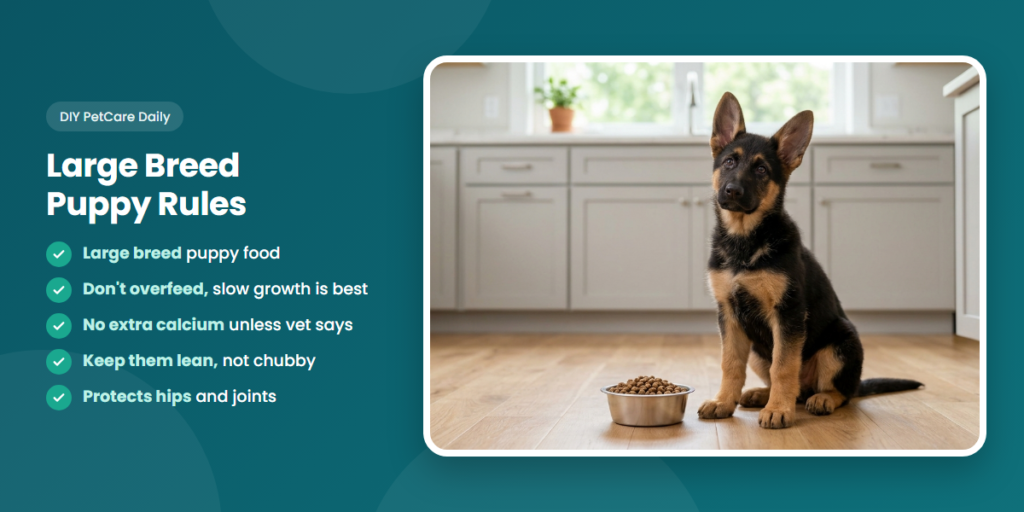
Large breed puppies, like Labradors, Golden Retrievers, German Shepherds, and Great Danes, need extra care.
- Feed a large breed puppy food. These have controlled calcium and calories to support slow, steady bone growth. Look for an AAFCO statement that says the food is complete and balanced for “growth, including growth of large size dogs (70 lbs or more as an adult).”
- Don’t overfeed. Growing too fast can raise the risk of hip dysplasia and other joint problems.
- Never add calcium supplements unless your vet tells you to.
- Keep them lean. A slightly lean large breed puppy is healthier than a chubby one.
Choosing the Right Puppy Food
Look for these things on the label:
- “Complete and balanced” for growth or “all life stages”
- A named animal protein like chicken, lamb, or salmon near the top of the list
- DHA, which supports brain and eye development
- Calories per cup, so you can portion correctly
Wet, dry, or a mix can all work. Dry food is easiest to measure and works well in puzzle toys. If you mix, count the calories from both. Don’t switch puppy foods often, and when you do, follow our guide to how to switch dog food to avoid an upset stomach.
Treats, Chews, and Training Rewards
Puppies get a lot of treats during training, and they add up fast.
- Keep treats to no more than 10 percent of daily calories.
- Use tiny, pea-size pieces for training.
- Use part of your puppy’s daily kibble as training treats.
- Try safe fruit and veggie snacks like blueberries or small carrot pieces. See our list of what fruits can dogs eat for safe options.
- Skip table scraps. Many human foods are too rich, and some, like grapes, onions, and garlic, are toxic.
Common Puppy Feeding Mistakes
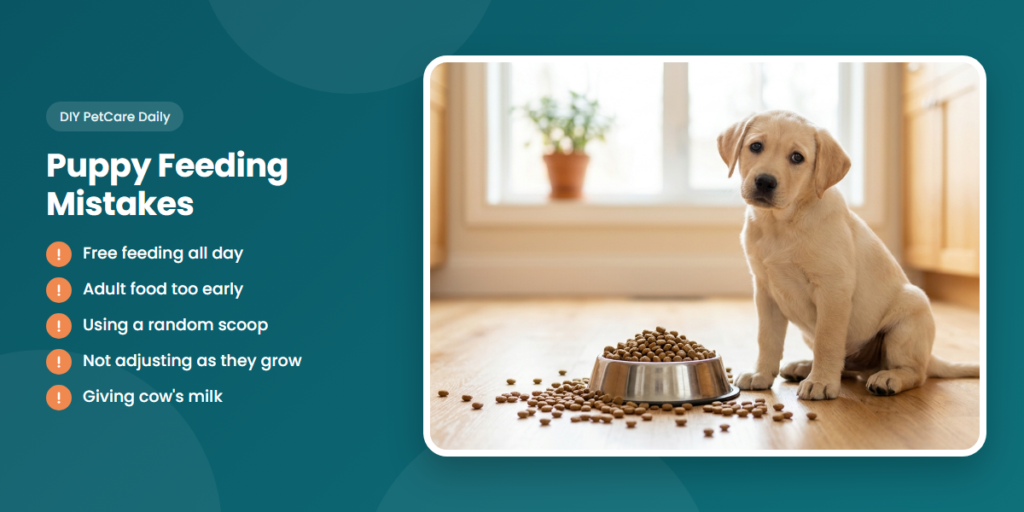
- Free feeding. Leaving food out all day makes it hard to control portions and slows house training.
- Feeding adult dog food too early. Adult food doesn’t have the right nutrients for growth.
- Using a random scoop. Use a real measuring cup, or weigh the food on a kitchen scale.
- Not adjusting as they grow. A puppy’s needs change every few weeks.
- Giving cow’s milk. Many puppies can’t digest it well, and it can cause diarrhea.
- Forgetting water. Keep fresh, clean water available at all times.
When to Switch From Puppy Food to Adult Food
- Toy and small breeds (under 20 lbs as adults): about 9 to 12 months
- Medium breeds (20 to 50 lbs): about 12 months
- Large breeds (50 to 100 lbs): about 12 to 18 months
- Giant breeds (over 100 lbs): about 18 to 24 months
Spaying or neutering also lowers calorie needs, sometimes by up to 30 percent, so watch your puppy’s weight after the surgery. Once your dog is grown, our guide on how much dog food should I feed my dog has an adult feeding chart by weight.
When to Call the Vet
Call your vet if your puppy:
- Refuses food for more than 12 hours (or any meal at all for toy breeds)
- Has vomiting or diarrhea that lasts more than a day, or has blood in it
- Seems weak, shaky, or very sleepy
- Isn’t gaining weight, or is losing weight
- Has a swollen, hard belly
Puppies can get dehydrated and sick very quickly, so it’s always better to call early. If you’re unsure about a change in your puppy’s stool, our dog poop color chart can help.
For more feeding guides, visit our Dog Food & Nutrition section.
Frequently Asked Questions
How much should I feed my puppy?
Puppies under 4 months need about 3 times the calories of a resting adult dog their size, and puppies 4 months and older need about 2 times. For a typical puppy food, that’s about 1 2/3 cups a day for a 10-pound puppy under 4 months. Check the calories per cup on your bag and adjust to your puppy’s body shape.
How much food should a 10-week-old puppy eat?
It depends on their weight. A 10-week-old puppy weighing 10 pounds needs about 650 calories a day, or roughly 1 2/3 cups of a 400 kcal/cup puppy food, split into 4 meals. Smaller puppies need less, and bigger puppies need more.
How many cups of food should a puppy eat?
Most puppies eat between 1/2 cup and 4 cups a day, depending on their size, age, and food. Use the puppy feeding chart by weight above and weigh your puppy every week or two to stay on track.
Should I feed my puppy as much as it wants?
No. Most puppies will overeat if given the chance. Measured meals help prevent fast weight gain, which is especially important for large breed puppies.
When should a puppy go from 3 meals to 2?
Most puppies can move from 3 meals to 2 meals a day at around 6 months. Toy breeds may need 3 meals a little longer to keep their blood sugar steady.