Table of Contents
- Table of Contents
- Love Bites vs Aggressive Bites
- Why Does My Cat Bite Me Gently? Cat Love Bites Explained
- Why Does My Cat Bite Me Then Lick Me?
- Petting-Induced Aggression: The Most Common Reason
- Other Reasons Cats Bite
- Why Does My Cat Bite Me for No Reason?
- Kitten Biting: How to Teach Gentle Play
- How to Stop a Cat From Biting
- When a Cat Bite Needs Medical Care
- Frequently Asked Questions
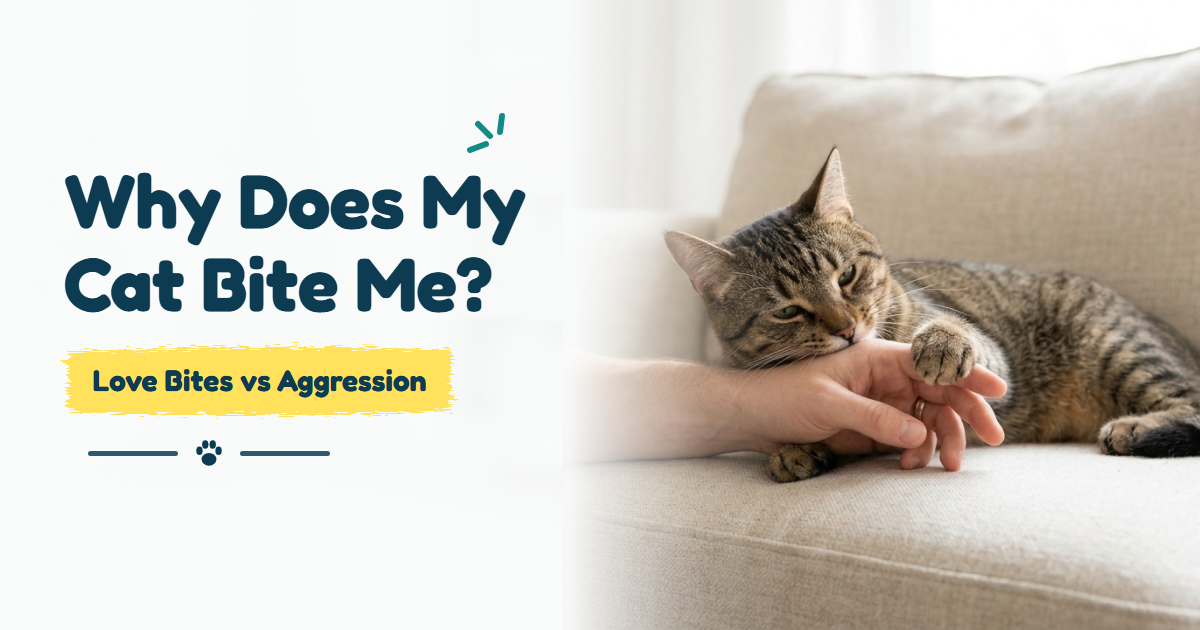
Quick answer: Why does my cat bite me? Most cat bites are gentle “love bites,” play, or a signal that your cat has had enough petting. Cats also bite when they’re scared, in pain, or redirecting frustration. Watch the tail, ears, and skin for early warnings, stop petting before the bite, and give your cat toys to bite instead of hands.
One minute your cat is purring on your lap. The next, they’ve grabbed your hand with their teeth. Maybe it’s a soft nip that doesn’t even hurt. Maybe it’s a real bite that leaves a mark. Either way, you’re left wondering what just happened.
Cats don’t bite for no reason, even when it feels that way. Every bite is a message. Once you learn what your cat is trying to say, most biting can be prevented. This guide covers the most common reasons cats bite, how to tell a love bite from aggression, and what to do about it.
Table of Contents
- Love Bites vs Aggressive Bites
- Why Does My Cat Bite Me Gently? Cat Love Bites Explained
- Why Does My Cat Bite Me Then Lick Me?
- Petting-Induced Aggression: The Most Common Reason
- Other Reasons Cats Bite
- Why Does My Cat Bite Me for No Reason?
- Kitten Biting: How to Teach Gentle Play
- How to Stop a Cat From Biting
- When a Cat Bite Needs Medical Care
- Frequently Asked Questions
Love Bites vs Aggressive Bites
The first step is figuring out what kind of bite you’re dealing with. Here’s how they usually compare.
| Love Bite | Play Bite | Warning or Aggressive Bite | |
| Pressure | Soft, rarely breaks skin | Light to medium | Hard, often breaks skin |
| Body language | Relaxed, purring, slow blinks | Wide pupils, pouncing, wiggling rear | Ears flat or sideways, tail lashing, tense body |
| When it happens | During cuddles or grooming | During play or when you move | During petting, handling, or when cornered |
| What follows | Licking, more cuddling | More pouncing | Running away, hissing, or more bites |
Why Does My Cat Bite Me Gently? Cat Love Bites Explained
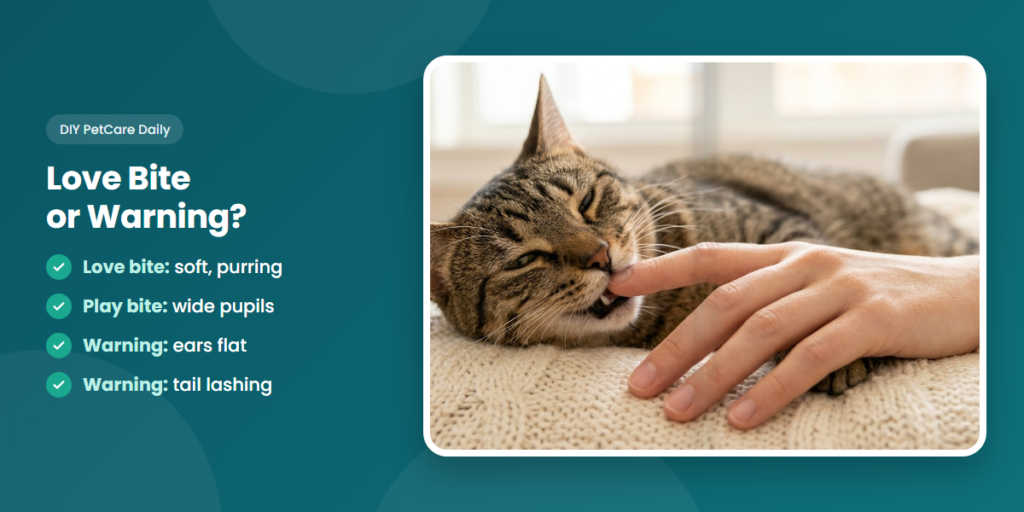
Cat love bites are soft nibbles, often during a cuddle. Your cat may be purring, kneading, or rubbing against you at the same time. Experts don’t fully agree on why cats do this, but the most likely reasons are:
- Grooming. Cats groom each other with licks and small nibbles. When your cat nibbles you gently, they may be grooming you like a family member.
- Affection. A gentle bite can be part of how a relaxed cat shows closeness.
- Kitten habits. Kittens nibble each other while playing and nursing, and some cats keep the habit.
Gentle love bites are usually harmless. But they can also be the first step toward overstimulation, so watch your cat’s tail and ears. If the nibbles get harder, it’s time to stop.
Why Does My Cat Bite Me Then Lick Me?
This mix confuses a lot of cat owners. In most cases, bite-then-lick is a grooming behavior. When cats groom each other, they lick and then nibble to work out knots or dirt, then lick again.
Some cats also lick, then bite when they’ve had enough contact. Watch what comes after. If your cat keeps cuddling, it’s grooming. If they bite harder and walk away, they were asking you to stop.
Petting-Induced Aggression: The Most Common Reason
Have you ever thought, “why does my cat bite me when I pet her, even though she came to me for attention?” This is called petting-induced aggression, or overstimulation. It’s one of the most common reasons cats bite their owners.
Cats have sensitive skin, and repeated stroking that feels nice at first can become too much. Each cat has their own limit. Some love 10 minutes of petting. Others are done after 5 strokes.
Warning Signs to Watch For
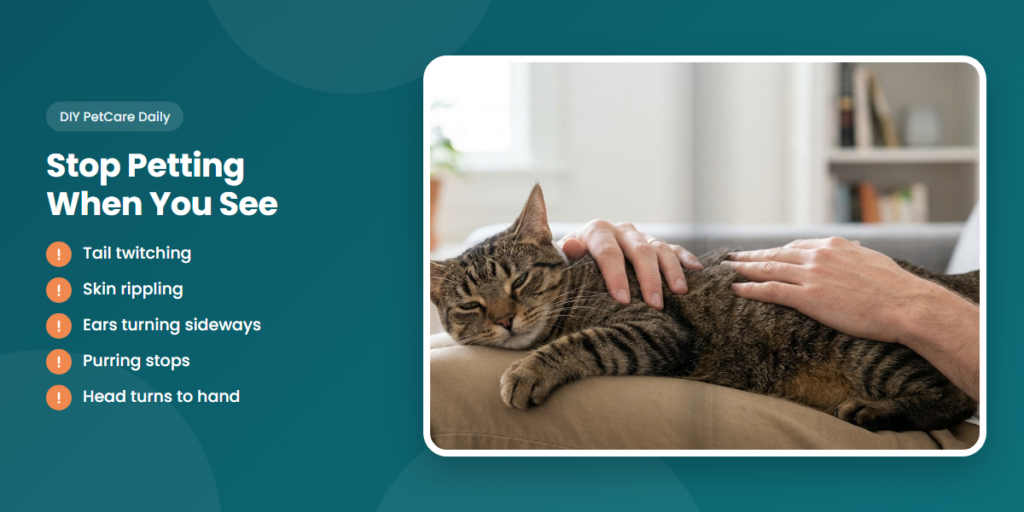
Before biting, most cats give signals like these:
- Tail twitching, flicking, or thumping
- Skin rippling or twitching along the back
- Ears turning sideways or flattening
- Stopping their purr
- Turning their head to look at your hand
- Shifting position or getting tense
If you see any of these, stop petting right away. Let your cat rest, or let them leave. To learn more about reading these signals, see our cat body language guide.
Where Cats Like to Be Petted
Most cats prefer gentle strokes around the cheeks, chin, and the base of the ears. Many dislike being touched on the belly, the base of the tail, or the paws. Short sessions in favorite spots help prevent overstimulation.
Other Reasons Cats Bite
Play
Young cats and kittens play by stalking, pouncing, and biting. If they were taught to play with hands as kittens, they may treat your fingers and toes like toys as adults.
Fear
A scared cat may bite to defend themselves, especially if they can’t escape. Common triggers include a trip to the vet, loud noises, being picked up, or meeting new people or pets.
Pain
A cat in pain may bite when touched, even if they’re usually gentle. Arthritis, dental disease, injuries, and other health problems can make certain spots sore. Our guide to signs of pain in cats explains what to look for.
Redirected Aggression
If your cat sees another cat through the window, they may get worked up but can’t reach it. Then they turn and bite the nearest target, which might be you. This is called redirected aggression. It can seem completely random.
Wanting Attention or Food
Some cats nip to get your attention, especially around mealtimes. If biting has ever earned them food or play, they may keep doing it.
Why Does My Cat Bite Me for No Reason?
It can feel like your cat bit you out of nowhere, but there’s almost always a reason. The most common hidden causes are:
- Early warning signs that were easy to miss, like a tail flick or skin twitch
- Redirected aggression from something outside
- Pain in a spot you touched
- Boredom and pent-up energy, especially in indoor cats
- A change at home, like a new pet, a move, or a different schedule
If biting starts suddenly in a cat that never used to bite, take them to the vet. Sudden aggression can be a sign of pain, thyroid problems, or other illness.
Kitten Biting: How to Teach Gentle Play
Kitten biting is normal. Kittens learn bite control from their mother and littermates. If they leave the litter early, they may never learn how hard is too hard. Teach your kitten good habits now:
- Never use your hands or feet as toys.
- Use wand toys, kicker toys, and balls so your kitten has something to bite.
- If your kitten bites, stop playing and go still. Then offer a toy.
- Plan two or three short play sessions a day to burn off energy.
- Never hit or yell. It can make your kitten fearful and more likely to bite.
How to Stop a Cat From Biting
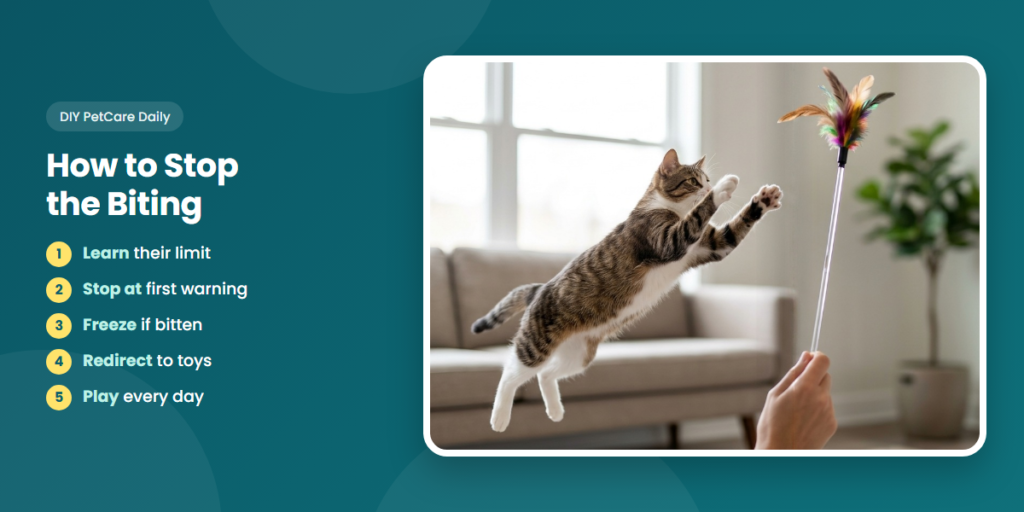
Here’s a simple plan that works for most cats.
- Learn your cat’s limits. Count how many strokes your cat enjoys before showing warning signs. Stop a few strokes before that number.
- Stop at the first warning. Don’t wait for the bite. Stop petting when you see tail flicks or ears turning sideways.
- Go still if bitten. Pulling away fast can trigger more biting, because it feels like prey moving. Freeze, then gently push your hand slightly toward the bite, which often makes the cat let go.
- Redirect to toys. Keep a wand or kicker toy nearby. When your cat looks ready to pounce, give them the toy instead.
- Play every day. Interactive play with a wand toy, 10 to 15 minutes twice a day, helps burn off hunting energy.
- Don’t punish. Yelling, hitting, or spraying water makes cats fearful, and fear causes more biting.
- Rule out pain. If biting is new, sudden, or happens when you touch one spot, see your vet.
When a Cat Bite Needs Medical Care
Cat bites can look small but are often deep. Cats’ sharp teeth push bacteria, like *Pasteurella multocida*, deep into the skin. A Mayo Clinic study of 193 people treated for cat bites on the hand found that about 1 in 3 needed to be hospitalized.
See a doctor right away if a cat bite:
- Breaks the skin on your hand, wrist, or near a joint
- Becomes red, swollen, warm, or painful
- Shows red streaks spreading from the wound
- Comes with fever or chills
- Came from a cat whose rabies vaccines aren’t up to date
For minor bites, wash the wound with soap and running water right away. Even then, watch it closely over the next few days. Make sure your own cat is current on their shots. Our guide to cat vaccines covers rabies and other core vaccines.
Frequently Asked Questions
Do cats bite to show affection?
Yes, some cats give gentle love bites while cuddling or grooming you. These soft nibbles usually don’t break the skin and come with purring and a relaxed body. Harder bites usually mean your cat wants you to stop.
Why does my cat bite me when I stop petting her?
Some cats nip to ask for more attention. If your cat bites when you stop, they may want you to keep going. Don’t reward the bite. Wait until they’re calm, then give attention.
Why does my cat grab my hand and bite it?
Grabbing and biting usually means play or overstimulation. If your cat grabs with the front paws and kicks with the back legs, they’re treating your hand like prey. Redirect them to a kicker toy instead.
How do I stop my kitten from biting my hands?
Never use your hands as toys. When your kitten bites, stop moving and offer a toy instead. Daily play with wand toys helps your kitten use up energy and learn that toys, not hands, are for biting.
Should I worry if my cat suddenly starts biting?
Yes, talk to your vet. Sudden biting in a cat that never used to bite can be a sign of pain or illness, like dental disease or arthritis. Once health problems are ruled out, look for stress or changes at home.