Table of Contents
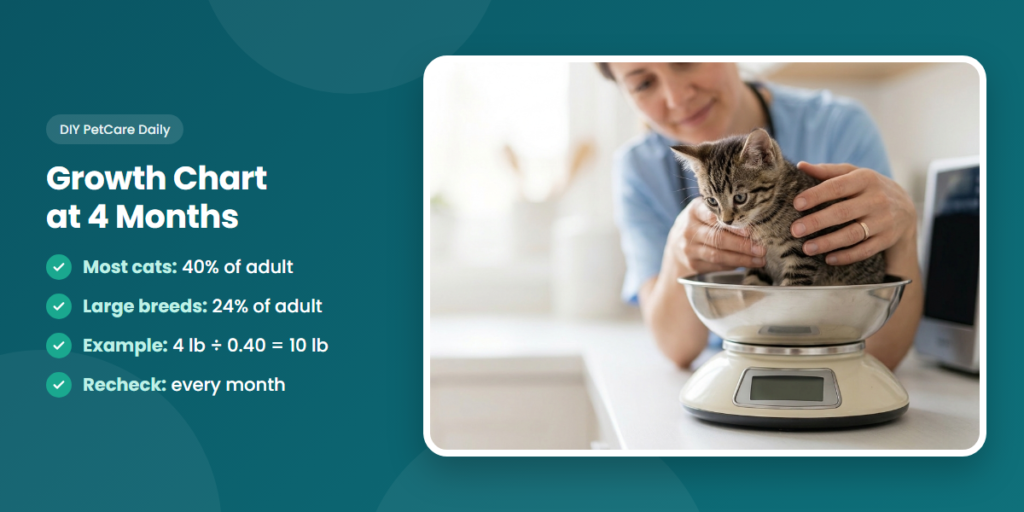
Quick answer: How big will my kitten get? To estimate, divide your kitten’s current weight by the share of adult weight expected at their age. A typical kitten at 4 months has reached about 40% of their adult weight, so 4 lb divided by 0.40 is about 10 lb. Most domestic cats end up at about 8 to 12 lb, while large breeds can weigh much more.
Kittens grow so fast that it can seem like they’re bigger every morning. It’s only natural to wonder when it will stop. Will your tiny fluffball stay small, or are you raising a 20 lb Maine Coon?
You can’t know for sure, especially with a rescue or a mixed-breed kitten. But a few simple methods can get you close. This guide gives you a growth chart, easy examples, typical sizes by breed, and tips to help your kitten grow up healthy.
Table of Contents
- How Big Will My Kitten Get? Ways to Estimate
- Do Big Paws Mean a Big Cat?
- When Do Kittens Stop Growing?
- Why Your Estimate Can Be Off
- How to Help Your Kitten Grow Up Healthy
- When to Call the Vet
- Frequently Asked Questions
How Big Will My Kitten Get? Ways to Estimate
No single method is perfect. Try a few and see if they land near the same number.
Way 1: Use a Growth Chart
This is the most useful method for most kittens. Regular cats grow quickly until about 6 months, then slow down and fill out through their first year. Large breeds take much longer.
| Age | Most Cats | Large Breeds (Maine Coon, Ragdoll, Norwegian Forest Cat) |
| 2 months | 20% | 12% |
| 3 months | 30% | 18% |
| 4 months | 40% | 24% |
| 6 months | 60% | 40% |
| 8 months | 72% | About 50% |
| 12 months | 95% | 65% |
| 18 months | 100% | 80% |
| 24 months | 100% | 90% |
| 36 months | 100% | 100% |
Here’s the formula: current weight divided by the percentage at their age = estimated adult weight.
| Example | Math | Estimated Adult Weight |
| Domestic kitten, 2 lb at 2 months | 2 divided by 0.20 | About 10 lb |
| Domestic kitten, 3 lb at 3 months | 3 divided by 0.30 | About 10 lb |
| Domestic kitten, 7 lb at 6 months | 7 divided by 0.60 | About 12 lb |
| Maine Coon kitten, 6 lb at 4 months | 6 divided by 0.24 | About 25 lb |
| Ragdoll kitten, 7 lb at 6 months | 7 divided by 0.40 | About 18 lb |
Don’t want to do the math? Our cat weight calculator does it for you and shows a likely range and growth curve.
Way 2: Check the 1 Pound a Month Rule
Many kittens gain about 1 pound a month for their first several months. That means a healthy 3-month-old often weighs about 3 lb, and a 5-month-old about 5 lb. It’s not a prediction of adult size, but it’s a handy way to check that things are on track.
A kitten who’s well above this line, especially at 3 to 4 months, may be headed for a larger adult size. One who’s well below may just be small, but it’s also worth asking your vet to make sure they’re healthy.
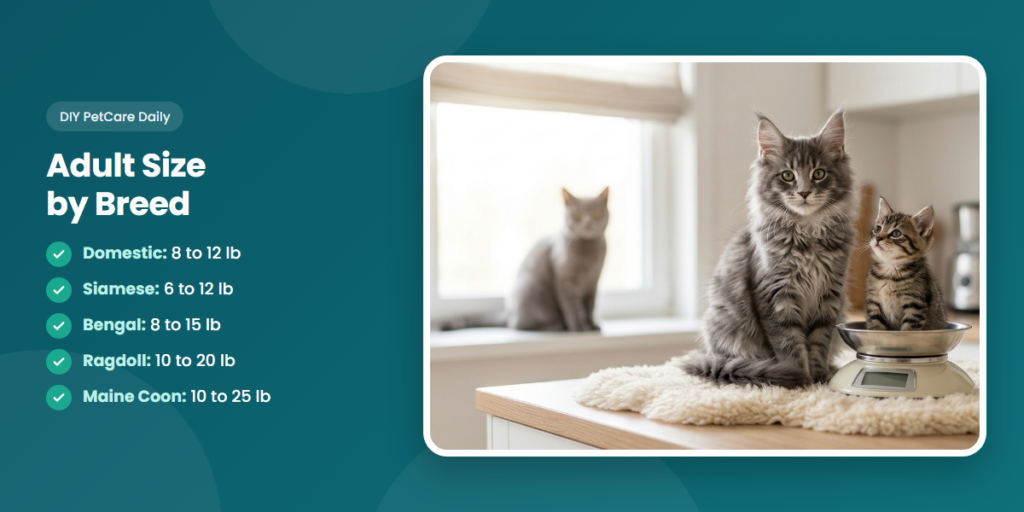
Way 3: Look at the Breed
If your kitten is a purebred, the breed’s typical range is a useful guide. Males are often at the higher end.
| Breed | Typical Adult Weight |
| Domestic or mixed breed | 8 to 12 lb |
| Abyssinian | 6 to 10 lb |
| Siamese | 6 to 12 lb |
| Sphynx | 6 to 12 lb |
| Scottish Fold | 6 to 13 lb |
| Persian | 7 to 12 lb |
| Russian Blue | 7 to 15 lb |
| British Shorthair | 7 to 17 lb |
| Bengal | 8 to 15 lb |
| Norwegian Forest Cat | 9 to 16 lb |
| Ragdoll | 10 to 20 lb |
| Maine Coon | 10 to 25 lb |
Most US pet cats aren’t any one breed, so the first row applies to most kittens. For more detail, see our guide on average cat weight.
Way 4: Look at the Parents
If you know the parents, they offer a great clue. Kittens often end up near the size of their same-sex parent. Breeders can usually tell you the parents’ weights and how earlier litters turned out. If you got your kitten from a shelter, ask if they have any information on the mother.
Way 5: Ask Your Vet
Your vet sees plenty of growing kittens. Kitten visits come every 3 to 4 weeks until their shots finish, so you can track growth at each one. Ask for a guess at about 4 to 6 months, when estimates start to get more useful. See our guide to cat vaccines to learn when those visits usually happen.
Do Big Paws Mean a Big Cat?
Not necessarily. Paw size is a popular guess, but it’s not reliable. Polydactyl kittens, who have extra toes, can look like they have huge paws without being large cats at all.
Here are some other common myths:
- Long tail or long legs: Some kittens are lanky and just never get very heavy.
- Big ears: Ears are more about breed than adult size.
- Fluffy coat: Long fur can make a kitten look much bigger than they really are.
- Eating a lot: All kittens eat a lot, since growing takes a lot of energy.
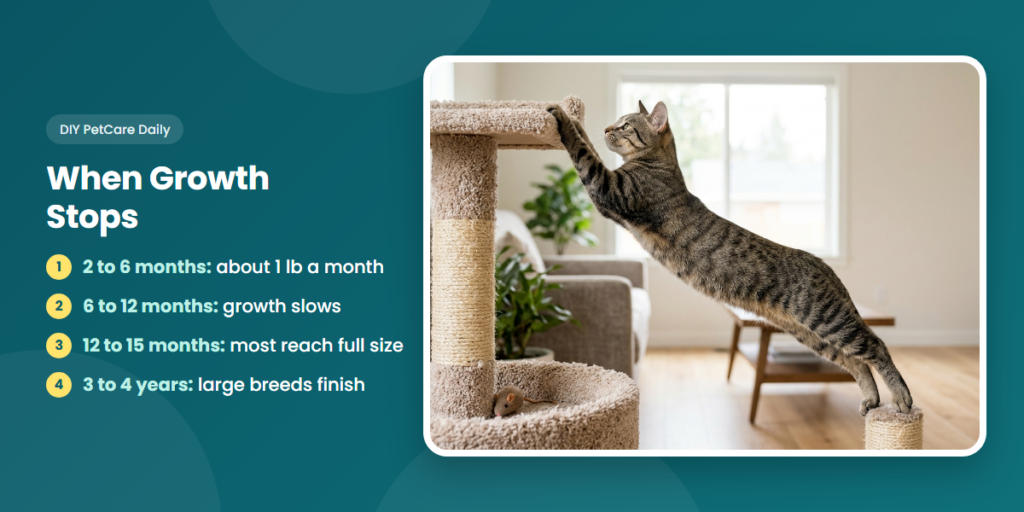
When Do Kittens Stop Growing?
Most cats reach adult size at about 12 to 15 months. Large breeds, like Maine Coons, can keep filling out until they are 3 or 4 years old.
| Age | What’s Happening |
| Birth to 2 months | Very fast growth; baby teeth come in |
| 2 to 6 months | Steady weight gain of about 1 lb a month |
| 6 to 12 months | Growth slows; adult teeth are in; sexual maturity |
| 12 to 18 months | Most cats reach full size |
| 2 to 4 years | Large breeds finish filling out |
Remember that this is only a timeline for growth. Adult cats who keep getting heavier after 2 years are probably gaining fat rather than growing. Our guide, is my cat overweight, can help you check. To see your kitten’s age in human years, try our cat age calculator.
Why Your Estimate Can Be Off
These estimates can be off by 15% or more, especially for mixed-breed kittens. Here’s what can throw them off:
- Mixed breeding: A domestic shorthair can have a large cat somewhere in their family tree.
- Wrong age: For rescue kittens, a guess at their age may be off by weeks. Our guide on how to tell how old a cat is can help.
- Poor nutrition: Strays who didn’t eat well as young kittens may grow more slowly or stay small.
- Parasites or illness: These can slow growth early in life.
- Spaying or neutering: It generally doesn’t stunt growth, but cats who are fixed may gain weight more easily afterward.
- Sex: Males usually end up bigger than females.
Tip: Recalculate each month. The estimate should settle down as your kitten grows.
How to Help Your Kitten Grow Up Healthy
You can’t make your kitten bigger than their genes allow. Overfeeding won’t create a bigger cat, just a heavier one. Here’s what really helps:
- Feed a kitten food. Look for an AAFCO statement for growth or for all life stages.
- Offer several meals. Kittens have small stomachs and need to eat more often than adults.
- Feed the right amount. Our cat calorie calculator includes a kitten setting, and our guide on how much to feed your cat has a feeding chart by age.
- Weigh often. Check your kitten every 1 to 2 weeks. A baby scale or kitchen scale works best.
- Keep up with vet care. Vaccines and deworming protect growing kittens.
- Make time for play. Daily play builds muscle, coordination, and a good relationship with you.
- Keep them lean. You should be able to feel the ribs easily and see a slight waist. Our guide to the cat body condition score shows what that looks like.
When to Call the Vet
Young kittens can get sick very quickly, so call your vet if your kitten:
- Stops gaining weight or loses weight
- Isn’t eating, or has stopped eating for more than a few hours (for very young kittens)
- Has diarrhea, vomiting, or a pot belly
- Seems weak, cold, or sleepy all the time
- Is much smaller than their littermates
- Has trouble walking or breathing
A pot belly with a thin body often points to worms, which are easy to treat. Our guide on how to tell if your cat is sick lists more signs to watch for.
For more guides on keeping your cat healthy, visit our Cat Health & Wellness section.
Frequently Asked Questions
How can I tell how big my kitten will get?
Divide your kitten’s current weight by the share of adult weight expected at their age. A typical kitten has reached about 40% at 4 months. Compare the result with their breed and parents’ size if you know them.
Do big paws mean a kitten will be a big cat?
Not reliably. Some kittens with large paws stay average size, and extra-toed cats can look like they have huge paws. Growth charts and parents’ size are much better guides.
At what age is a cat full grown?
Most cats reach adult size at about 12 to 15 months. Large breeds, like Maine Coons, can keep growing until they’re 3 or 4 years old.
How much should a 6-month-old kitten weigh?
Most 6-month-old kittens weigh about 5 to 7 lb. Large-breed kittens can weigh more, and a healthy body shape matters more than an exact number.
Does neutering affect how big a kitten will get?
It doesn’t usually have a big effect on height or frame. Some cats grow a little taller when spayed or neutered early. They may gain weight more easily afterward, so watch their portions.