Table of Contents
- Table of Contents
- Why Cats Hide Illness So Well
- 15 Signs Your Cat Is Sick
- Sick Cat Symptoms Chart: What It May Mean and How Urgent It Is
- Simple Health Checks You Can Do at Home
- Normal Cat Vital Signs
- When to Take Your Cat to the Vet
- How to Help a Sick Cat at Home While You Wait
- How to Help Your Cat Stay Healthy
- Frequently Asked Questions
Quick answer: How to tell if your cat is sick? Watch for small changes from your cat’s normal routine: eating less or not at all, hiding more, sleeping more, throwing up more than once in a while, peeing more or less, drinking more water, grooming less, or acting grumpy when touched. Cats hide illness well, so even one of these changes that lasts more than a day or two is worth a call to your vet. Some signs, like straining to pee or breathing with an open mouth, are emergencies.
Cats are experts at acting fine. In the wild, a cat that looks weak can become a target, so they evolved to hide pain and sickness until they can’t anymore. That instinct is still there in the cat sleeping on your couch.
This means the signs your cat is sick are often quiet. A cat with a bladder problem may not cry. A cat with a sore mouth may just eat a little slower. By the time a cat looks clearly unwell, the problem has often been going on for a while.
The good news is that you know your cat better than anyone. This guide walks you through the most common sick cat symptoms, simple checks you can do at home, and how to know when to take your cat to the vet.
Table of Contents
- Why Cats Hide Illness So Well
- 15 Signs Your Cat Is Sick
- Sick Cat Symptoms Chart: What It May Mean and How Urgent It Is
- Simple Health Checks You Can Do at Home
- Normal Cat Vital Signs
- When to Take Your Cat to the Vet
- How to Help a Sick Cat at Home While You Wait
- How to Help Your Cat Stay Healthy
- Frequently Asked Questions
Why Cats Hide Illness So Well
Cats are both hunters and prey animals. Looking weak could mean being attacked, so cats learned to keep pain and sickness to themselves. Many cats will keep eating a little, keep using the litter box, and keep greeting you at the door even when something is wrong.
That’s why vets say the best tool for spotting illness early is a change in routine, not a dramatic symptom. If your cat normally sleeps on your bed and suddenly sleeps under it, that matters. If your cat usually finishes breakfast and now leaves half, that matters too.
A good habit: take a quick mental note of your cat’s normal each week. How much do they eat? How many litter clumps do you scoop? Where do they nap? When you know normal, odd stands out fast.
15 Signs Your Cat Is Sick
Here are the sick cat symptoms owners most often miss. Some are mild on their own, but two or more together, or any one that lasts more than a day or two, deserve a vet visit.
1. Eating Less or Not Eating at All
A cat not eating is one of the clearest warning signs. Cats should never go more than a day without food. When a cat stops eating, the body starts breaking down fat quickly, and that fat can build up in the liver. This causes a serious illness called hepatic lipidosis (fatty liver disease), and overweight cats are at higher risk.
Watch for eating slowly, dropping food, chewing on one side, or walking up to the bowl and walking away. These can point to mouth pain, nausea, or something more serious. Our guide on cat not eating explains how long is too long and how to tempt a cat to eat.
2. Throwing Up More Than Usual
An occasional hairball can be normal. But a cat throwing up more than once or twice a month, vomiting food right after eating, or vomiting several times in one day is not normal. Vomiting can come from hairballs, eating too fast, food allergies, kidney disease, thyroid problems, swallowed objects, or toxins.
Our guide on cat throwing up explains vomit colors and when to worry. If hairballs are the main issue, our guide on how to prevent hairballs in cats has grooming and diet tips that help.
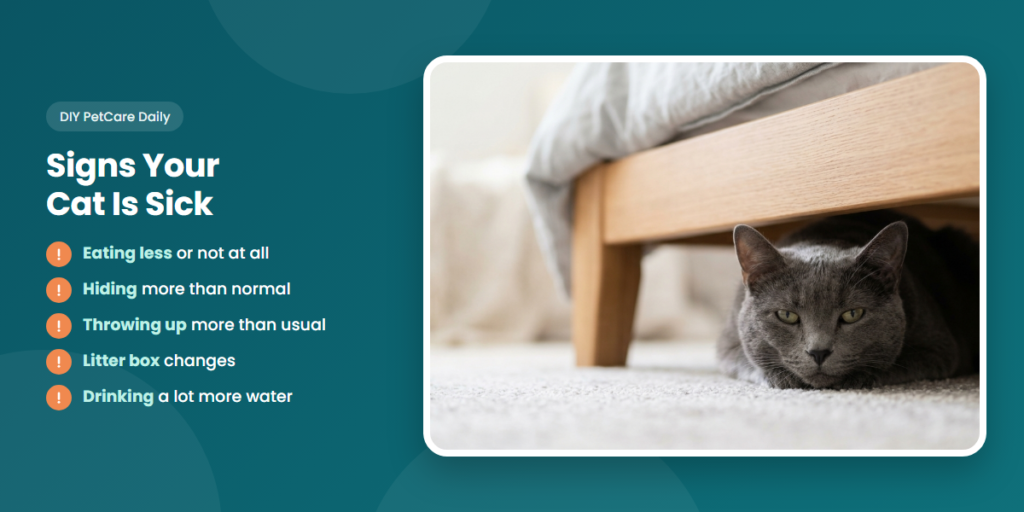
3. Hiding More Than Normal
A social cat who suddenly hides under the bed or in the closet may be feeling sick or sore. Hiding is a cat’s way of protecting themselves when they feel weak. Hiding is also a common pain sign, which we cover in our guide on signs of pain in cats.
4. Sleeping More or Seeming Tired (Lethargy)
Cats sleep a lot, often 12 to 16 hours a day. A lethargic cat is different. They may not get up to greet you, ignore toys they usually love, or seem dull and slow. Lethargy can come with fever, infection, pain, anemia, or many other illnesses.
5. Changes in the Litter Box
The litter box tells you a lot about your cat’s health. Look for:
- More or bigger urine clumps than usual (can point to diabetes or kidney disease)
- Fewer or tiny clumps, or no urine at all
- Straining, crying, or going in and out of the box often
- Blood in the urine or stool
- Diarrhea, very hard stool, or no stool for more than two days
- Peeing or pooping outside the box
A male cat straining to pee with little or nothing coming out is an emergency. A blocked urethra can become life-threatening within a day. If your cat has started going outside the box, our guide on cat peeing outside litter box explains the medical and behavior causes.
6. Drinking a Lot More Water
If you’re filling the water bowl more often, or your cat is drinking from sinks and glasses, take note. Increased thirst is a common sign of kidney disease, diabetes, and an overactive thyroid, especially in cats over 7 years old.
7. Weight Loss or Weight Gain
Slow weight loss is easy to miss under fur. Run your hands along your cat’s back and hips each week. If the spine and hip bones feel sharper, your cat may be losing weight. Weight loss with a big appetite is a classic sign of hyperthyroidism or diabetes in older cats. Our guide on how much should I feed my cat includes a simple body condition check.
8. Grooming Less or Grooming Too Much
Healthy cats are very tidy. A cat with a greasy, clumpy, or messy coat may feel too sick, sore, or stiff to groom. On the other hand, licking one spot until it’s bald can point to pain, allergies, skin problems, or stress.
9. Bad Breath or Drooling
Strong bad breath, drooling, or pawing at the mouth often means dental disease, which is very common in adult cats. It can also point to kidney disease. Read more in why does my cat’s breath smell and our checklist on signs of dental disease in cats.
10. Changes in Breathing
A healthy cat at rest breathes about 20 to 30 times a minute, quietly, with the chest moving gently. Fast breathing, belly breathing, wheezing, coughing, or breathing with an open mouth are serious. Cats almost never pant like dogs, so open-mouth breathing is a reason to go to the vet right away.
11. Eye or Nose Discharge and Sneezing
Watery or goopy eyes, a runny nose, and sneezing often point to an upper respiratory infection, which is common in kittens and shelter cats. Mild cases can clear up, but a cat who stops eating because they can’t smell their food needs care quickly.
12. Mood and Behavior Changes
A sweet cat who suddenly hisses, swats, or doesn’t want to be touched may be in pain. A cat who is suddenly clingy, yowls at night, or seems confused can also be unwell. Older cats can develop thyroid disease, high blood pressure, or cognitive changes that show up as new behavior.
13. Changes in How They Move
Not jumping onto the couch anymore, using the stairs slowly, limping, or walking stiffly can point to arthritis, injury, or pain. Many older cats have arthritis and owners never notice because the cat just stops jumping. Sudden weakness or dragging the back legs is an emergency.
14. Hunched Posture
A cat sitting hunched in a tight “loaf” with their head low, eyes half closed, and not relaxing into sleep is often feeling sick or sore, especially with belly pain or nausea.
15. Fever or Feeling Cold
You can’t always tell a fever by touch, but a cat with hot ears, a dry nose, and low energy may have one. A normal cat temperature is about 100.4°F to 102.5°F. Over 103°F is a fever. Under 99°F is also a concern.
Sick Cat Symptoms Chart: What It May Mean and How Urgent It Is
Use this chart as a quick guide. It doesn’t replace a vet exam, but it helps you decide how fast to act.
| Sign | What It May Mean | How Urgent |
| Straining to pee, little or no urine | Urinary blockage (especially males), bladder infection | Emergency, go now |
| Open-mouth breathing, fast or labored breathing | Heart disease, asthma, fluid in the chest | Emergency, go now |
| Sudden back-leg weakness or crying in pain | Blood clot (saddle thrombus), injury | Emergency, go now |
| Pale, white, gray, or blue gums | Shock, anemia, low oxygen | Emergency, go now |
| Ate a lily, medicine, or another toxin | Poisoning | Emergency, go now |
| Not eating for 24 hours | Many causes, risk of fatty liver | See your vet today |
| Throwing up several times in one day | Toxin, blockage, illness | See your vet today |
| Hiding and lethargy for more than a day | Pain, fever, infection | Within 24 hours |
| Drinking and peeing more | Kidney disease, diabetes, thyroid | Book a visit this week |
| Slow weight loss | Thyroid, diabetes, kidney disease, dental pain | Book a visit this week |
| Bad breath, drooling | Dental disease, kidney disease | Book a visit soon |
| Messy coat, less grooming | Pain, arthritis, obesity, illness | Book a visit soon |
Simple Health Checks You Can Do at Home
You don’t need special tools for most of these. Do them when your cat is calm and relaxed.
Check the Gums
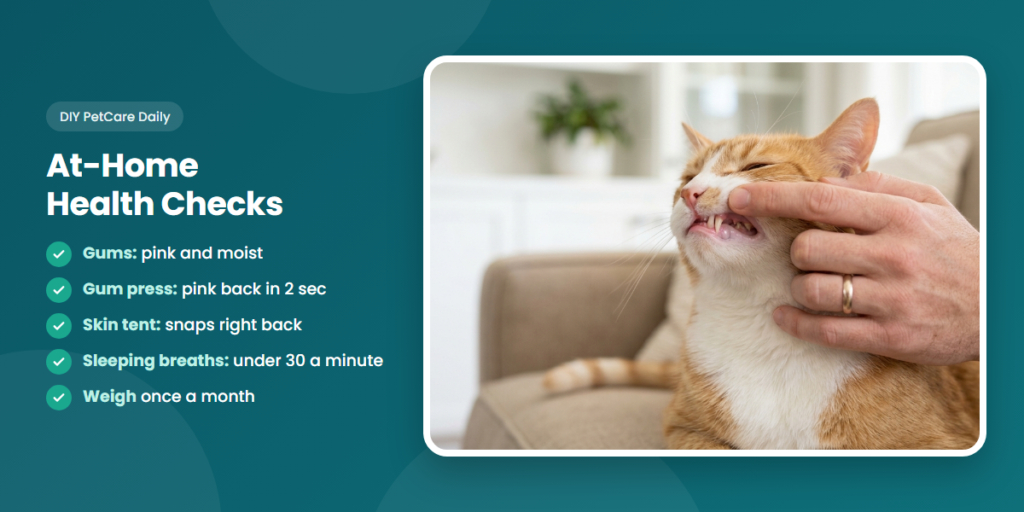
Gently lift your cat’s lip. Healthy gums are pink and moist. Press a finger on the gum until it turns pale, then let go. The pink color should come back in under 2 seconds. Pale, white, blue, gray, bright red, or yellow gums need a vet.
Check for Dehydration
Gently lift the skin between the shoulder blades and let go. In a well-hydrated cat, it snaps right back. If it slowly sinks back or stays up like a tent, your cat may be dehydrated. Sticky gums are another sign.
Count Breathing While Your Cat Sleeps
Watch your cat’s chest while they sleep. Count each rise and fall for 30 seconds, then double it. Under 30 breaths a minute is normal for a sleeping cat. Repeated counts over 40 are a reason to call your vet.
Weigh Your Cat
Weigh yourself, then weigh yourself holding your cat, and subtract. Write it down once a month. For a 10-pound cat, losing even half a pound is a meaningful change.
Check the Eyes, Ears, and Coat
Eyes should be clear and bright, with no squinting or discharge. Ears should be clean and not smelly. The coat should be smooth and clean, with no bald spots, scabs, or mats. If you find mats, our guide on how to remove mats from cat fur shows a safe way to handle them.
Normal Cat Vital Signs
Knowing your cat’s normal numbers helps you explain what you see when you call the vet.
| Vital Sign | Normal Range for Adult Cats |
| Temperature | 100.4°F to 102.5°F |
| Heart rate | 140 to 220 beats per minute |
| Breathing rate (at rest) | 20 to 30 breaths per minute |
| Breathing rate (asleep) | Under 30 breaths per minute |
| Gum color | Pink and moist |
| Capillary refill time | Under 2 seconds |
Only take a cat’s temperature at home if your cat is calm and you’ve been shown how. A digital pet thermometer with a little petroleum jelly is the safest choice. Never use a glass thermometer.
When to Take Your Cat to the Vet
Not sure if it can wait? Here’s a simple way to decide.
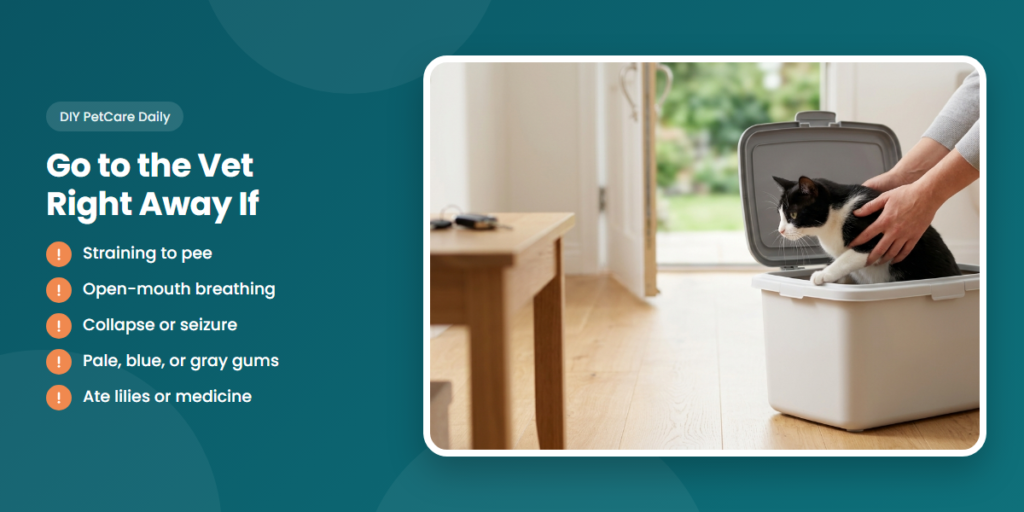
Go to the vet or an emergency clinic right away if your cat:
- Is straining to pee with little or nothing coming out
- Is breathing with an open mouth or struggling to breathe
- Has collapsed, had a seizure, or can’t stand
- Has pale, blue, or gray gums
- Ate something toxic, like lilies, human medicine, or antifreeze
- Has been hit by a car or fallen from a height, even if they seem fine
- Is vomiting over and over or trying to vomit with nothing coming up
Call your vet the same day if your cat:
- Hasn’t eaten in 24 hours
- Has had diarrhea or vomiting for more than a day
- Is hiding and lethargic and won’t come out
- Has a fever over 103°F
Book a regular appointment if your cat:
- Is drinking or peeing more than normal
- Is slowly losing weight
- Has bad breath, a messy coat, or stiffness
- Has small behavior changes that last more than a week
Healthy adult cats should see the vet at least once a year, and senior cats (age 11 and up) every 6 months. Many problems like kidney disease and thyroid disease can be found early on bloodwork before your cat shows signs. Keeping your cat up to date on cat vaccines is part of that yearly visit.
How to Help a Sick Cat at Home While You Wait
These tips are for comfort only, not treatment. Always talk to your vet first.
- Give them a quiet spot. A warm, soft bed in a calm room away from kids and other pets.
- Keep water close. Put a water bowl near their resting spot.
- Offer tempting food. Slightly warmed wet food smells stronger and may help a cat with a stuffy nose eat.
- Keep the litter box nearby. A sick cat may not want to walk far.
- Write down what you see. When the signs started, what your cat ate, how many times they vomited, and litter box changes. Photos and videos help your vet a lot.
- Don’t give human medicine. Acetaminophen (Tylenol), ibuprofen, and aspirin can be deadly to cats. Never give any medicine unless your vet says so.
- Check for toxins. Look for chewed plants, open medicine bottles, or spilled chemicals. Our list of foods toxic to cats covers common kitchen dangers.
How to Help Your Cat Stay Healthy
- Schedule yearly checkups, or every 6 months for seniors
- Keep core vaccines up to date
- Feed measured meals so you notice appetite changes quickly
- Scoop the litter box daily and pay attention to what you see
- Brush your cat’s teeth or use vet-approved dental care
- Keep toxic plants, especially all true lilies, out of the house (poinsettias and holiday greenery too; see our Christmas tree safety for cats guide)
- Use enough litter boxes and keep them clean; see how many litter boxes per cat
For more guides on keeping your cat healthy, visit our Cat Health & Wellness section.
Frequently Asked Questions
How do I know if my cat is sick?
Look for changes from your cat’s normal routine. The most common signs your cat is sick are eating less, hiding, sleeping more, vomiting, litter box changes, drinking more water, weight loss, and grooming less. If a change lasts more than a day or two, or your cat seems to be getting worse, call your vet.
What are the most common sick cat symptoms?
The most common sick cat symptoms are a poor appetite, lethargy, vomiting, diarrhea, hiding, changes in urination, and weight loss. Many illnesses share the same signs, so a vet exam is the only way to find the cause.
When should I take my cat to the vet?
Take your cat to the vet right away if they are straining to pee, breathing with an open mouth, have collapsed, or ate something toxic. Call the same day if your cat hasn’t eaten for 24 hours or has been vomiting. Book a regular visit for slower changes like weight loss or drinking more.
Can a cat get better on its own?
Some mild problems, like a single hairball or a light cold, can pass on their own. But cats hide illness, so by the time you notice signs, the problem may be further along than it looks. It’s safer to call your vet and ask, especially if your cat stops eating.
Why is my cat suddenly hiding and not eating?
Hiding and not eating together often mean your cat feels sick, sore, or stressed. Causes can include pain, fever, an infection, dental disease, a urinary problem, or a recent change at home. Since cats shouldn’t go more than a day without food, call your vet if this lasts 24 hours.