Table of Contents
- Table of Contents
- What Is Feline Leukemia Virus (FeLV)?
- How Does FeLV Spread?
- Does My Cat Need the Feline Leukemia Vaccine?
- Test Before You Vaccinate
- FeLV Vaccine Schedule for Kittens and Adults
- Types of FeLV Vaccines
- Feline Leukemia Vaccine Side Effects
- Does the Vaccine Fully Protect My Cat?
- Living With an FeLV-Positive Cat
- How Much Does the Feline Leukemia Vaccine Cost?
- Frequently Asked Questions
Quick answer: The feline leukemia vaccine (FeLV vaccine) protects cats against feline leukemia virus (FeLV), a contagious virus that weakens the immune system and can cause cancer. US vet guidelines recommend it for all kittens, because young cats are most likely to get infected. Kittens get two doses 3 to 4 weeks apart starting at 8 weeks or older, and a booster 1 year later. After that, only cats at risk, like outdoor cats or cats living with an FeLV-positive cat, need boosters every 1 to 2 years.
Feline leukemia virus is one of the most serious infectious diseases in cats. There’s no cure, and many cats who become permanently infected live only a few years after diagnosis.
But unlike FVRCP or rabies, the feline leukemia vaccine isn’t needed by every adult cat. Whether your cat needs it depends on their age and lifestyle. This guide explains what FeLV is, how it spreads, who needs the vaccine, the schedule, side effects, and what to ask your vet.
Table of Contents
- What Is Feline Leukemia Virus (FeLV)?
- How Does FeLV Spread?
- Does My Cat Need the Feline Leukemia Vaccine?
- Test Before You Vaccinate
- FeLV Vaccine Schedule for Kittens and Adults
- Types of FeLV Vaccines
- Feline Leukemia Vaccine Side Effects
- Does the Vaccine Fully Protect My Cat?
- Living With an FeLV-Positive Cat
- How Much Does the Feline Leukemia Vaccine Cost?
- Frequently Asked Questions
What Is Feline Leukemia Virus (FeLV)?
FeLV is a virus that only infects cats. It can’t spread to people, dogs, or other pets. In North America, roughly 2 to 3 percent of cats tested carry it, with higher rates in outdoor, stray, and sick cats. Our full guide to feline leukemia covers symptoms, testing, and life expectancy.
FeLV attacks the immune system and bone marrow. Over time, it can cause:
- A weak immune system, leading to repeated infections
- Anemia (low red blood cells)
- Cancers such as lymphoma
- Mouth and gum infections
- Weight loss, poor coat, and fever
- Reproductive problems in female cats
Three Ways a Cat Can Respond to FeLV
Not every exposed cat ends up sick. After exposure, a cat may:
| Type of Infection | What Happens |
| Abortive | The immune system clears the virus. The cat stays healthy. |
| Regressive | The immune system controls the virus, but some of it stays hidden in the body. Most of these cats stay healthy, but the virus can reactivate during stress or illness. |
| Progressive | The virus spreads through the body. These cats can spread FeLV to others, and many develop FeLV-related disease within a few years. |
Kittens are far more likely than adults to develop a progressive infection, which is why vaccinating kittens matters so much.
How Does FeLV Spread?
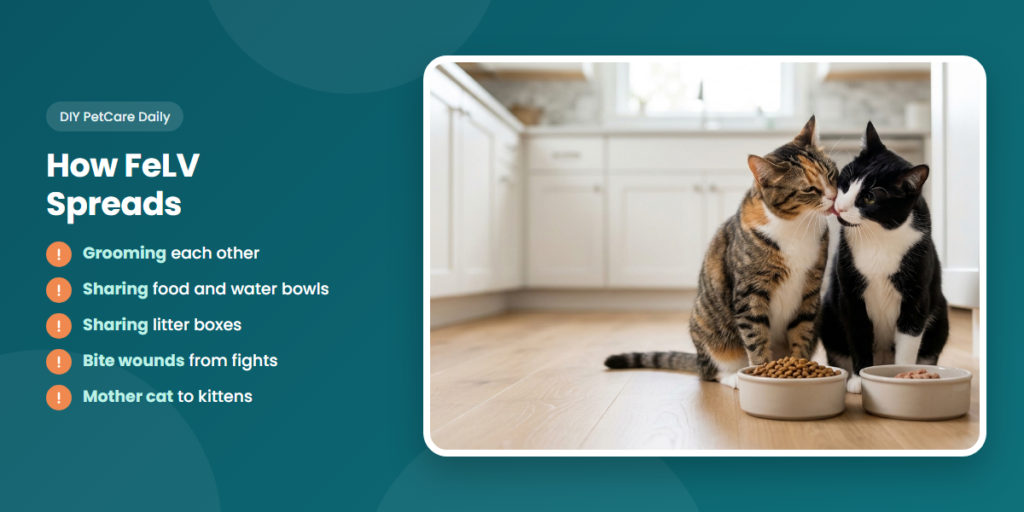
FeLV spreads through close contact with an infected cat’s saliva, nasal discharge, urine, feces, and milk. Common ways include:
- Grooming each other
- Sharing food and water bowls
- Sharing litter boxes
- Bite wounds from fights
- From mother to kittens, before birth or through nursing
The virus doesn’t live long outside a cat’s body and is killed by most household cleaners. That’s why it mostly spreads through long, close contact or fights, not from your shoes or clothes.
Does My Cat Need the Feline Leukemia Vaccine?
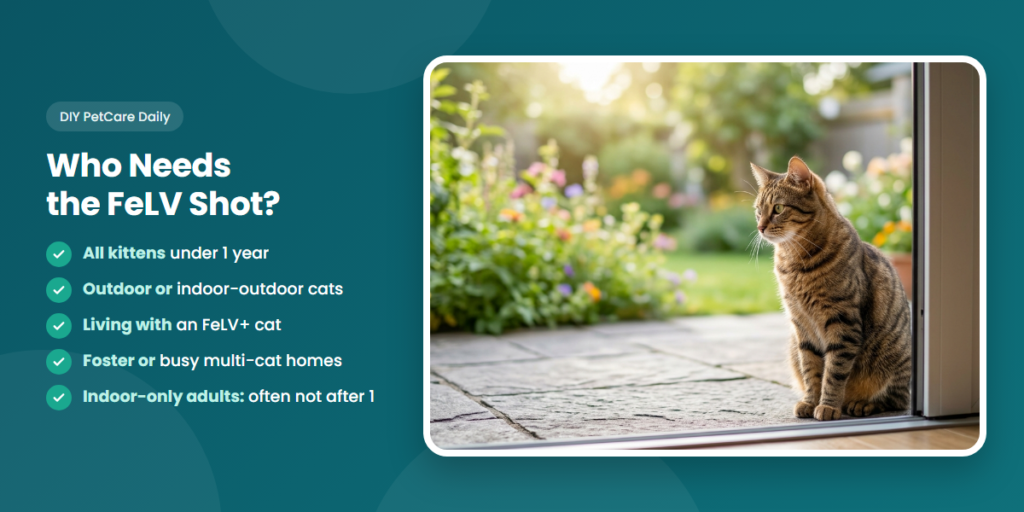
Use this table as a guide, then talk with your vet about your cat’s lifestyle.
| Your Cat | Feline Leukemia Vaccine? |
| Kitten under 1 year old | Yes, recommended for all kittens |
| Indoor-outdoor or outdoor cat | Yes, boosters recommended |
| Lives with an FeLV-positive cat | Yes, boosters recommended |
| Lives in a foster home, shelter, or multi-cat home with new cats coming in | Yes, usually recommended |
| Often escapes, or goes on outdoor walks or a “catio” where other cats visit | Often recommended; ask your vet |
| Strictly indoor adult, living alone or with other FeLV-negative indoor cats | Often not needed after the first-year booster |
| Already FeLV-positive | No, the vaccine won’t help an infected cat |
Why Kittens Need It Even if They’ll Live Indoors
Plans change. A kitten who’s meant to be indoor-only may end up going outside, moving to a new home, or living with new cats. Since kittens are most at risk, US feline guidelines treat the FeLV vaccine as core for every kitten. After the first-year booster, your vet can decide whether to continue based on your cat’s adult life.
Test Before You Vaccinate
Every cat should be tested for FeLV, usually along with FIV, before getting the vaccine. This is especially important for:
- Newly adopted cats and kittens
- Strays and rescues
- Cats with unknown history
- Sick cats
- Cats going into a home with other cats
The test is usually a quick blood test done in the clinic, with results in about 10 minutes. Cats who were recently exposed may test negative at first, so your vet may suggest retesting in 30 days or more. The vaccine doesn’t cause a positive test result.
FeLV Vaccine Schedule for Kittens and Adults
Kittens
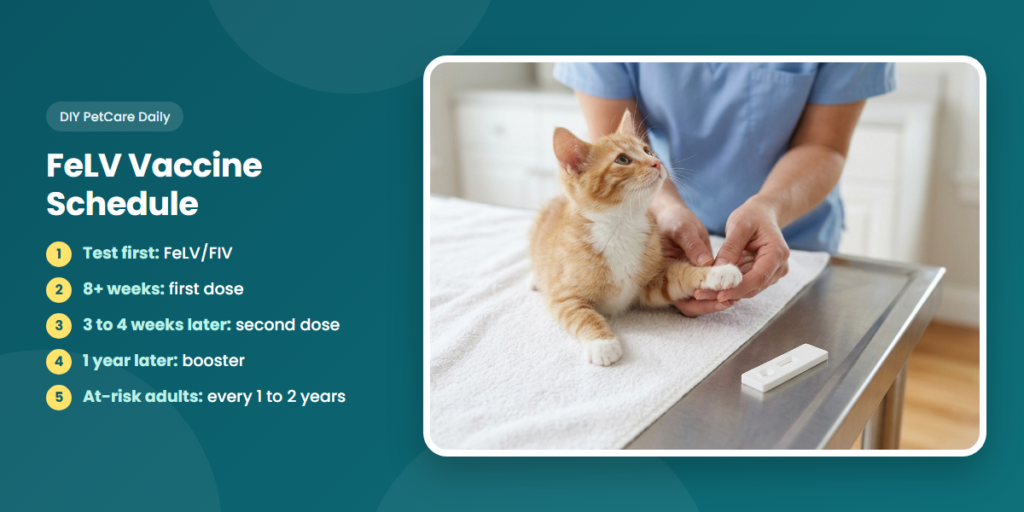
| Age | Dose |
| 8 weeks or older (after a negative FeLV test) | First dose |
| 3 to 4 weeks later | Second dose |
| 1 year after the second dose | Booster |
Your kitten needs both of the first two doses to be protected. Many vets give FeLV at the same visits as the FVRCP vaccine. Read more about that shot in our guide to the FVRCP vaccine.
Adult Cats
| Situation | Schedule |
| Adult with no FeLV vaccine history, at risk | 2 doses, 3 to 4 weeks apart, then a booster in 1 year |
| Higher-risk adults (outdoor, living with FeLV-positive cats) | Booster every year |
| Lower-risk adults with some outdoor access | Booster every 2 years |
| Strictly indoor adults with no exposure | Often no further boosters after age 1 |
Adult cats become more resistant to FeLV with age, which is one reason low-risk adults may not need ongoing boosters.
Types of FeLV Vaccines
There are two main kinds used in the US:
- Killed (inactivated) vaccines: contain an inactivated virus plus an ingredient (adjuvant) that helps boost the immune response.
- Recombinant vaccines: use only a small piece of the virus carried by a harmless “carrier” virus. These usually don’t contain an adjuvant, and some vets prefer them for this reason.
Both work well. Your vet will choose based on your cat’s needs and what the clinic carries.
Where the Shot Is Given
US vets usually give the feline leukemia vaccine low on the left back leg. A simple way to remember it is “left for leukemia, right for rabies.” This placement makes it easier to treat the rare tumor that can form at an injection site.
Feline Leukemia Vaccine Side Effects
Most cats have mild or no side effects.
Common, mild side effects (usually gone in 1 to 2 days):
- Tiredness
- Mild fever
- Eating a bit less
- Soreness or a small lump where the shot was given
Rare, serious reactions (call your vet or go to an emergency clinic now):
- Vomiting or diarrhea soon after the shot
- Swelling of the face or around the eyes
- Hives or itchy skin
- Trouble breathing
- Collapse
Watch the injection site. Call your vet if a lump is still there after 3 months, is bigger than about 3/4 inch, or keeps growing a month after the shot. Injection site tumors are rare, estimated at about 1 to 10 in every 10,000 vaccinated cats, but early checks matter.
Does the Vaccine Fully Protect My Cat?
No vaccine is 100 percent effective, but the feline leukemia vaccine greatly lowers the risk of a progressive infection. To protect your cat even more:
- Test new cats before bringing them home
- Keep FeLV-positive cats separate from negative cats, or vaccinate negative cats who live with them
- Keep your cat indoors or in a safe, enclosed outdoor space
- Spay or neuter to reduce roaming and fighting
- Keep up with yearly checkups
Living With an FeLV-Positive Cat
An FeLV diagnosis doesn’t always mean the end. Many cats with regressive infections live normal lives. Even cats with progressive infections can have good years with the right care:
- Keep them indoors to protect them from infections and to protect other cats
- Schedule vet checkups every 6 months
- Feed a complete, cooked diet. Avoid raw food, which can carry germs
- Watch closely for signs of illness, like weight loss, fever, or a poor appetite. See how to tell if your cat is sick
- Keep up with dental care, as mouth infections are common. See signs of dental disease in cats
How Much Does the Feline Leukemia Vaccine Cost?
| Service | Typical US Cost |
| FeLV vaccine (per dose) | $25 to $50 |
| FeLV/FIV combo test | $40 to $75 |
| Vet exam | $50 to $90 |
| Low-cost clinic FeLV vaccine | $15 to $30 |
Shelters and rescues often test and vaccinate kittens before adoption, so ask for your kitten’s records. For the full list of shots cats need, see our main guide to cat vaccines.
For more guides on keeping your cat healthy, visit our Cat Health & Wellness section.
Frequently Asked Questions
Is the feline leukemia vaccine necessary?
It’s recommended for all kittens and for adult cats at risk, such as outdoor cats, indoor-outdoor cats, and cats living with an FeLV-positive cat. Strictly indoor adult cats with no contact with other cats often don’t need boosters after their first year.
How often do cats need the feline leukemia vaccine?
Kittens need two doses 3 to 4 weeks apart, then a booster 1 year later. After that, higher-risk adult cats need a booster every year, and lower-risk cats every 2 years. Low-risk indoor cats may stop after age 1.
Do indoor cats need the feline leukemia vaccine?
Indoor kittens should still get it, because their lifestyle may change and kittens are most at risk. Indoor-only adults who don’t meet other cats often don’t need ongoing boosters. Talk with your vet about your cat’s situation.
Can a vaccinated cat still get feline leukemia?
It’s possible but much less likely. The vaccine greatly lowers the risk of a lasting infection, but no vaccine is perfect. Testing new cats and limiting contact with unknown cats adds extra protection.
Can humans catch feline leukemia?
No. Feline leukemia virus only infects cats. It can’t spread to people, dogs, or other pets.