Table of Contents
- Table of Contents
- What Is a Cat Body Condition Score?
- The 9-Point Cat BCS Chart
- How to Score Your Cat at Home
- What Your Cat’s Score Means
- How to Estimate Your Cat’s Ideal Weight
- What If the Score and the Scale Don’t Match?
- Muscle Condition: The Other Score
- How Often to Check Your Cat’s Score
- Frequently Asked Questions
Quick answer: A cat body condition score (BCS) is a 1 to 9 rating of how much fat your cat is carrying, based on their ribs, waist, and belly. A score of 4 or 5 is ideal. Scores of 1 to 3 are too thin, and scores of 6 to 9 are overweight. Each point above 5 is about 10% extra body weight.
Weighing your cat gives you a number, but it doesn’t tell you if that number is right. A big-boned 14 lb cat may be perfectly fit, while a small-framed 10 lb cat could be carrying extra fat.
That’s where a body score comes in. It looks at your cat’s actual shape, and it’s what vets use in the exam room. With a little practice, you can do it at home in about a minute. This guide explains what each score means, how to rate your own cat, and what to do with your result.
Table of Contents
- What Is a Cat Body Condition Score?
- The 9-Point Cat BCS Chart
- How to Score Your Cat at Home
- What Your Cat’s Score Means
- How to Estimate Your Cat’s Ideal Weight
- What If the Score and the Scale Don’t Match?
- Muscle Condition: The Other Score
- How Often to Check Your Cat’s Score
- Frequently Asked Questions
What Is a Cat Body Condition Score?
A cat body condition score is a simple way to estimate body fat by looking at and feeling your cat. Most US vets use a 9-point scale, though some use a 5-point scale. On the 9-point scale, 1 is severely underweight, 9 is severely obese, and 4 to 5 is the target.
It works because it judges each cat by their own body. A slender Siamese and a big Maine Coon can have very different weights and the same healthy score. Studies show that a trained person’s score lines up well with body fat measured by DEXA scan, a medical test used to measure body composition.
Body Score vs Weight
Both are useful, and they answer different questions.
| Measure | What It Tells You | Limits |
| Scale weight | The exact weight today and whether it’s changing | Doesn’t tell you if it’s right for your cat’s frame |
| Body condition score | If your cat is thin, ideal, or heavy for their frame | It’s an estimate, and long fur makes it harder |
| Muscle condition | If your cat is losing muscle, separate from fat | Takes practice; your vet can check it |
Use them together. Weigh your cat, score your cat, then track both over time.
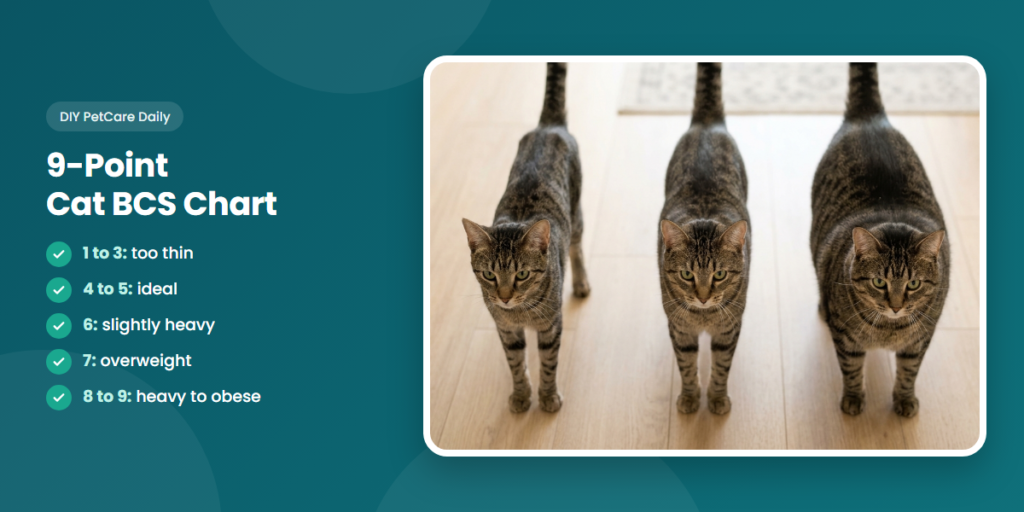
The 9-Point Cat BCS Chart
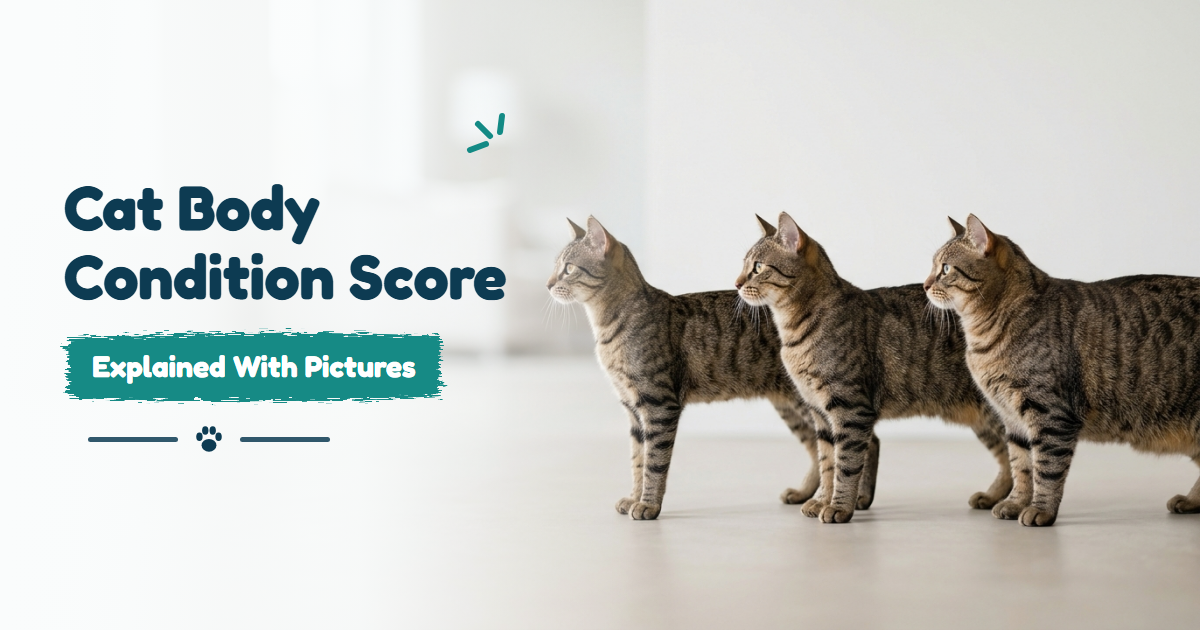
Here’s what you should notice at each score. The pictures on this page show the shape from above and from the side.
| Score | Rating | Ribs | Waist From Above | Belly | Weight vs Ideal |
| 1 | Very thin | Visible, no fat you can feel | Severe | Severe tuck, hips and spine show | About 30% or more under |
| 2 | Thin | Easy to see | Very sharp | Clear tuck, no belly fat | About 20% under |
| 3 | Lean | Easy to feel, little fat | Clear | Slight tuck, very little belly fat | About 10% under |
| 4 | Ideal | Easy to feel, thin fat layer | Clear | Slight tuck, small belly pad | On target |
| 5 | Ideal | Lightly covered | Nice waist | Small belly pad | On target |
| 6 | Slightly heavy | Felt under some fat | Less clear | Belly a little rounded | About 10% over |
| 7 | Overweight | Hard to feel | Hardly visible | Rounded, medium pad | About 20% over |
| 8 | Heavy | Can’t be felt without pressing | None | Clearly rounded, larger pad | About 30% over |
| 9 | Obese | Under heavy fat | Back looks wide | Large pad; fat on face, legs, and spine | About 40% or more over |

How to Score Your Cat at Home
Choose a quiet moment when your cat is relaxed. Having a few pieces of kibble handy helps. Long-haired cats need extra hands-on checking, since fur can hide both fat and bones.
- Feel the ribs. Glide your fingers along your cat’s side with light pressure. In a healthy cat, they feel like the back of your hand.
- Look from above. Check for a gentle waist behind the ribs.
- Look from the side. There should be a slight tuck, with a small belly pad.
- Feel the spine and hips. The bones should be easy to feel, but not sharp.
- Feel the belly. A small, soft pad is fine. A big one that swings when they walk is a sign of extra fat.
- Choose the closest score. If your cat falls between two, use the one that fits best or a half point.
Write it down along with the date. A monthly picture from above can help too.
Common Scoring Mistakes
- Judging by looks alone: Fur can fool you, so always use your hands.
- Mistaking the belly flap for fat: Many cats have a loose flap of skin between the back legs called a primordial pouch. It’s normal, even in lean cats.
- Comparing with other cats: So many cats are overweight that a heavy cat can seem normal.
- Scoring while they’re lying down: Cats look quite different when curled up, so check while they’re standing.
- Ignoring a sudden belly: A swollen belly that appears quickly may not be fat. Call your vet.
What Your Cat’s Score Means
Scores 1 to 3: Too Thin
Weight loss is a common sign of illness in cats, especially older cats. Thyroid disease, diabetes, kidney disease, and dental pain are all common causes. Start with a vet visit. Read our guides on why a cat may be so skinny and cat losing weight to learn more.
Scores 4 and 5: Ideal
Nice work. Keep the same routine and repeat these checks every couple of months. Update portions if your cat’s activity changes or they’ve just been spayed or neutered. Our guide on how much to feed your cat can help you stay on track.
Scores 6 and 7: Overweight
Your cat has some extra weight, but small changes can make a big difference. Measure food, cut back on treats, and add a bit more play. Our guide on how to help a cat lose weight has a safe plan.
Scores 8 and 9: Heavy to Obese
Talk to your vet before you make any changes. These cats have a higher risk of diabetes and joint pain, and they’re also at greater risk of a dangerous liver problem if they lose weight too quickly. Read more about obesity in cats to understand the risks.
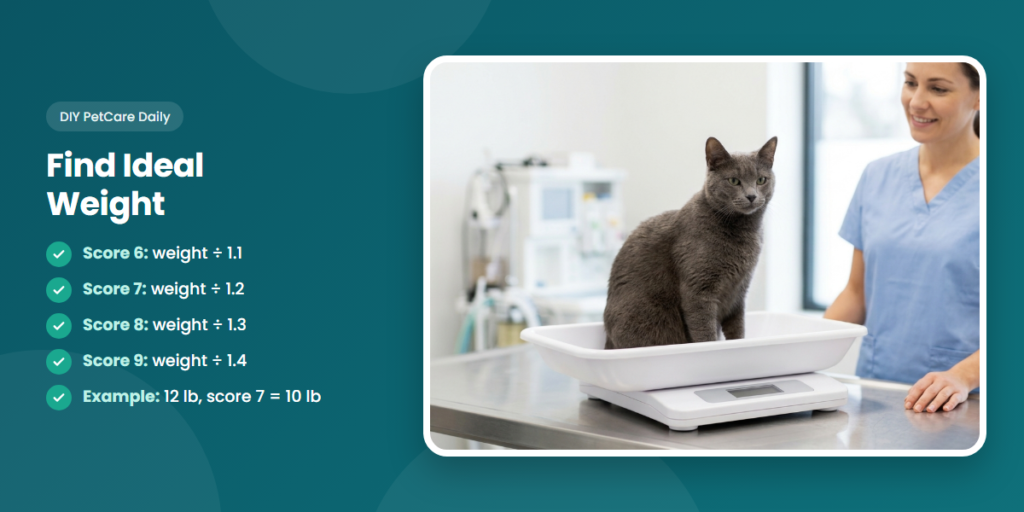
How to Estimate Your Cat’s Ideal Weight
Vets often use a simple rule: each point above 5 equals about 10% extra weight. To estimate ideal weight, divide current weight by the matching number.
| Score | Divide Current Weight By | Example: 12 lb Cat | Weight to Lose |
| 6 | 1.1 | About 10.9 lb | About 1.1 lb |
| 7 | 1.2 | About 10 lb | About 2 lb |
| 8 | 1.3 | About 9.2 lb | About 2.8 lb |
| 9 | 1.4 | About 8.6 lb | About 3.4 lb |
This estimate gets less exact at very high scores, and your vet can refine it. Our cat BMI calculator combines a body score with a tape-measure estimate of body fat. Once you have a goal, use our cat weight calculator for a timeline and our cat calorie calculator for a daily calorie number.
What If the Score and the Scale Don’t Match?
This happens quite often. Here’s how to think about it:
- Normal weight, but a high score: Your cat may have a small frame. They may also be losing muscle while gaining fat, so ask your vet to check.
- Heavy, but an ideal score: Your cat may have a large frame or be a big breed. Maine Coons, Ragdolls, and Norwegian Forest Cats can weigh a lot and still be lean.
- Stable weight, but a changed shape: Older cats can lose muscle and gain fat. The number stays the same, but their health may not.
When in doubt, trust your hands over the scale, and get your vet’s opinion. Our guide on average cat weight has typical ranges by breed for comparison.
Muscle Condition: The Other Score
Fat isn’t the whole story. Vets also check muscle along the spine, shoulders, hips, and head. Muscle loss is common in older cats and those with illness, and it can happen even in overweight cats.
Watch for:
- A bony spine or hips, even with a soft belly
- Thinner back legs
- A sunken look along the top of the head
- Trouble jumping
Mention these to your vet. Older cats may need a different diet, more protein, or treatment for an underlying problem. Our senior cat care checklist has more on helping cats as they age.
How Often to Check Your Cat’s Score
- Healthy adult cats: Every couple of months
- Kittens: At each vet visit, since they change so quickly
- Cats on a weight plan: Every 2 weeks, along with a weigh-in
- Older cats: Monthly, since weight and muscle can change quickly
- After a big change: Spay or neuter surgery, a new food, or a new pet in the house
Ask your vet to score your cat at each visit, then compare it with your own. It’s the quickest way to get better at it.
For more guides, visit our Cat Health & Wellness section.
Frequently Asked Questions
What is a good body condition score for a cat?
On the 9-point scale, 4 or 5 is ideal. You should be able to feel the ribs easily and see a gentle waist from above, with only a small belly pad.
What does a body condition score of 7 mean in cats?
A score of 7 means your cat is overweight, about 20% above their ideal weight. The ribs are hard to feel, the waist is hardly visible, and the belly looks rounded.
Is the cat BCS scale 5 or 9 points?
Both exist, but the 9-point scale is more common. On a 5-point scale, 3 is ideal. Ask your vet which scale they use when they give you a number.
Can I check the body condition of a long-haired cat?
Yes, but use your hands. Feel the ribs, waist, spine, and hips under the fur. You may also notice your cat’s real shape when their coat is wet.
Is a primordial pouch the same as fat?
No. It’s a loose flap of skin and some fat on the lower belly, and many healthy cats have one. Check your cat’s ribs and waist to find out if they’re overweight.