Table of Contents
Quick answer: To learn how to help a cat lose weight, start with a vet check and a goal weight. Then measure every meal, cut back on treats, and add short play sessions every day. A safe pace for most cats is only about 0.5% to 1% of body weight per week. Never withhold food, since a fast weight drop can cause a life-threatening liver problem.
Helping a cat lose weight isn’t quite like helping a dog. You can’t take a cat for a long jog, many cats have strong opinions about their food, and cutting calories too quickly can be downright dangerous.
But it can absolutely be done, usually without any fancy products. The key is to go slowly and make small changes that fit your cat’s habits. This guide gives you a safe plan, with a goal weight, calorie targets, feeding tips, and easy ways to get your cat moving.
Table of Contents
- Why Cats Must Lose Weight Slowly
- Before You Start: See Your Vet
- How to Help a Cat Lose Weight in 7 Steps
- Tips for Multi-Cat Homes
- How to Handle Begging and Early Morning Wake-Ups
- When Weight Loss Stalls
- When to Call the Vet
- Frequently Asked Questions
Why Cats Must Lose Weight Slowly
If you remember only one thing from this guide, make it this: never put a cat on a crash diet.
When an overweight cat stops eating or loses weight too quickly, the body sends fat to the liver faster than the liver can handle it. This can lead to hepatic lipidosis, also called fatty liver disease. It can become life-threatening within days.
Call your vet right away if your cat stops eating for more than a day. Our guide on cat not eating explains what to do. A slower plan is safer, and it’s much easier for you and your cat to keep up.
Before You Start: See Your Vet
A vet visit is worth it before you make any changes, especially for very heavy cats. Your vet can:
- Check for health problems like diabetes or arthritis
- Run blood work, if needed, to catch hidden conditions
- Confirm your cat’s body score and goal weight
- Recommend a suitable food
- Adjust the plan for cats with kidney disease, diabetes, or other conditions
If you’re not sure whether your cat needs to lose weight at all, try the home checks in our guide on is my cat overweight, or get an estimate from our cat BMI calculator.
How to Help a Cat Lose Weight in 7 Steps
Step 1: Set a Goal Weight
Vets often use a simple rule: each body condition point above 5 means about 10% extra weight. To estimate a goal, divide your cat’s weight by the matching number.
| Body Score | Divide Current Weight By | Example: 12 lb Cat |
| 6 | 1.1 | Goal: about 10.9 lb |
| 7 | 1.2 | Goal: about 10 lb |
| 8 | 1.3 | Goal: about 9.2 lb |
| 9 | 1.4 | Goal: about 8.6 lb |
Learn how to score your cat in our guide to the cat body condition score. If your cat has a lot to lose, set smaller goals along the way. Reaching the first pound is worth celebrating.
Step 2: Work Out a Daily Calorie Target
A common starting point is 0.8 x RER, based on your cat’s goal weight rather than their current weight. RER is the energy a cat burns at rest. Here are the numbers for common goal weights.
| Goal Weight | Daily Calorie Target (About) | Treat Budget (10%) |
| 7 lb | 133 | 13 |
| 8 lb | 147 | 15 |
| 9 lb | 161 | 16 |
| 10 lb | 174 | 17 |
| 11 lb | 187 | 19 |
| 12 lb | 200 | 20 |
| 14 lb | 224 | 22 |
Your vet may suggest a different number, especially for a cat who needs to lose a lot. Our cat calorie calculator does the math and converts it into cans or cups. Our guide on how many calories a cat needs explains how it works.
Step 3: Stop Free Feeding
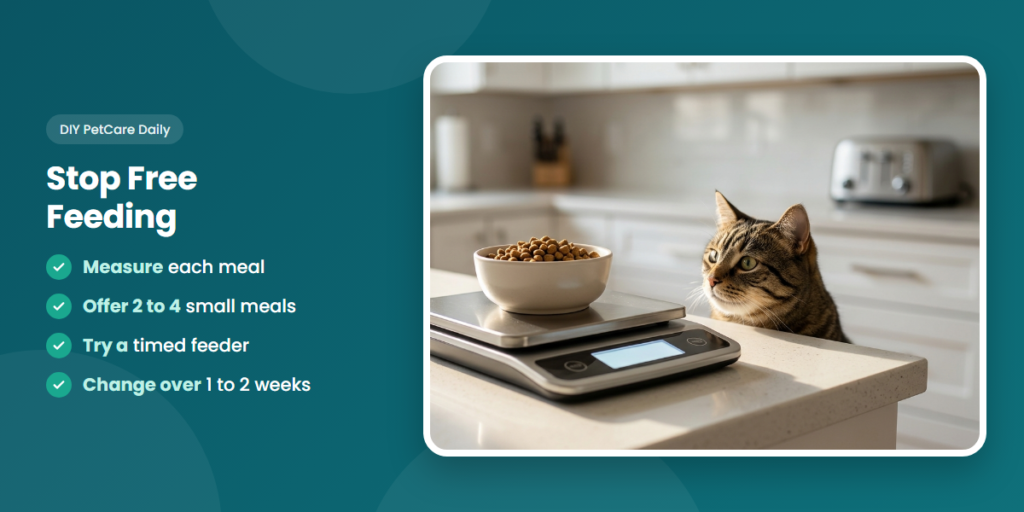
A bowl that’s always full is one of the most common reasons cats gain weight. Switching to measured meals is often the single biggest change you can make.
- Measure each meal. A kitchen scale is the most accurate. Even a slightly heaped scoop can add 10% or more.
- Offer 2 to 4 small meals a day. Many cats do better with several small meals.
- Use a timed feeder. It can help if your cat wakes you up at 5 a.m.
- Pick up leftovers. Wet food shouldn’t sit out for long anyway.
Change gradually if your cat is used to grazing. Move from a full bowl to several measured meals over a week or two, and make sure they’re still eating well. Our guide on how much to feed your cat has more on portions.
Step 4: Choose the Right Food
Wet food has fewer calories per bite, so many cats feel fuller on it. Dry food has about 400 calories per cup, so it’s easy to overfeed. Our guide to wet vs dry cat food compares them.
If your cat needs far fewer calories, ask your vet about a weight loss food. These foods are made to stay balanced at lower calories, and many are higher in protein to help protect muscle. Cutting a regular food too much can leave your cat short on nutrients.
Change foods slowly over 7 to 10 days. Some cats refuse a new food if it’s changed too fast, and it’s dangerous for a heavy cat to stop eating.
Step 5: Cut Back on Treats
Treats should be no more than 10% of your cat’s daily calories. For a cat on a diet, that’s often only about 15 to 20 calories.
- Pick small treats, or break them into pieces.
- Check creamy lickable treats, since many have 10 calories or more per tube.
- Skip the cheese, cream, and table scraps.
- Use some of your cat’s measured kibble as a treat.
- Reward with attention. Many cats enjoy a good chin scratch as much as a snack.
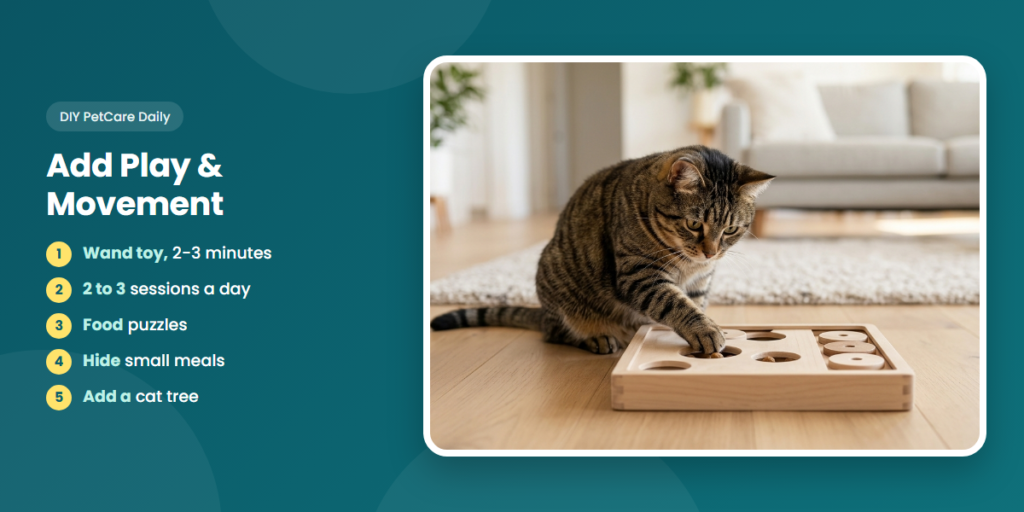
Step 6: Add Play and Movement
You don’t need long workouts. Two or three short sessions a day can make a real difference.
- Use a wand toy. Let your cat stalk and pounce, then “catch” the toy at the end so they don’t get frustrated.
- Start small. Heavy cats tire quickly. Begin with just 2 to 3 minutes.
- Use food puzzles. They slow down eating and give your cat a reason to move.
- Hide meals. Put small portions of kibble around the house so they have to hunt.
- Encourage climbing. Add cat trees and steps, especially for cats who have trouble jumping.
- Place food upstairs. If your cat can handle stairs, walking to meals adds gentle exercise.
- Rotate toys. Bring out a “new” toy every few days, so they stay interested.
If your cat seems sore or isn’t willing to move, talk to your vet. Arthritis is common and treatable, and pain relief can help cats become more active.
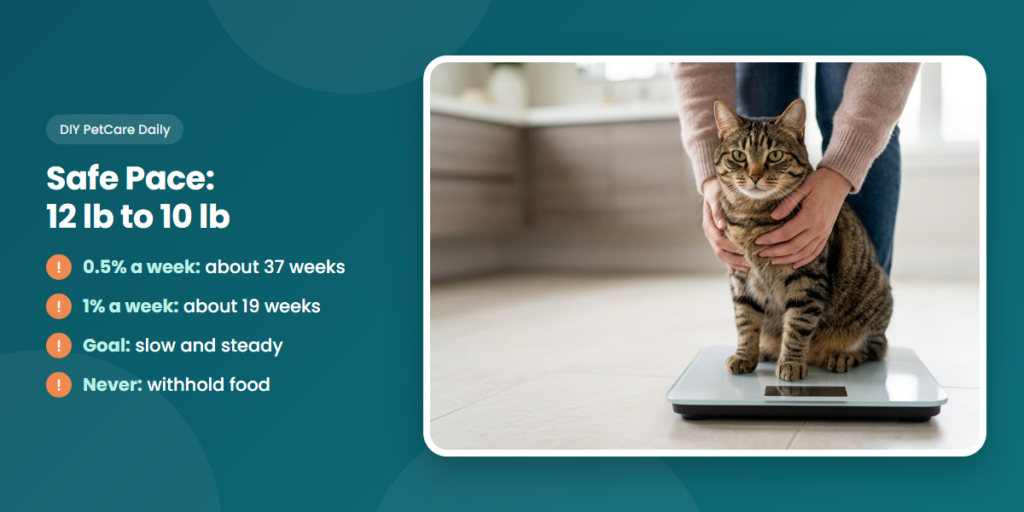
Step 7: Weigh Every 2 Weeks
Use a baby scale if you can, since small changes matter. Aim for about 0.5% to 1% of body weight per week. Here’s what that looks like for a 12 lb cat with a goal of 10 lb.
| Pace Per Week | Loss in Week 1 | Estimated Time to Goal |
| 0.5% | 1.0 oz | About 37 weeks |
| 1% | 1.9 oz | About 19 weeks |
| 1.5% (upper limit; ask your vet) | 2.9 oz | About 13 weeks |
Our cat weight calculator can build a timeline for your cat. Keep a simple log, and take a monthly photo too.
Tips for Multi-Cat Homes
It’s hard to put one cat on a diet when another one eats freely. Try these ideas:
- Feed in separate rooms. Close the door until mealtime is over.
- Use a microchip feeder. It opens only for the right cat.
- Feed the slim cat up high. Many heavy cats can’t jump to a counter or shelf.
- Set timed meals. Pick up any food when the session ends.
- Measure for each cat. A slim cat and a heavy cat need different amounts.
How to Handle Begging and Early Morning Wake-Ups
Cats can be very persuasive. Here’s what often helps:
- Don’t feed on demand. Feeding a yowling cat teaches them to yowl more.
- Use a timed feeder. Your cat will learn to go to the feeder rather than to you.
- Add a small meal at bedtime. A portion of the day’s food can help them sleep through the night.
- Play before meals. It lets your cat hunt, eat, groom, and sleep, in that natural order.
- Offer attention. Some begging is really about wanting company.
When Weight Loss Stalls
Progress often slows down as your cat gets lighter. If your cat hasn’t lost weight in about a month:
- Weigh the food again. Portions often creep up over time.
- Count every extra. Include treats, tuna water, and anything from family or guests.
- Check whether another pet’s food is being eaten.
- Ask your vet about a small calorie cut. Don’t make big changes by yourself.
- Add one more play session.
Once your cat reaches their goal, raise calories slowly and keep weighing them every few weeks. Most cats don’t need as much food as they did before they lost weight.
When to Call the Vet
Call your vet right away if your cat:
- Stops eating for more than a day
- Is losing more than about 1% to 1.5% of their weight per week
- Vomits often or seems tired
- Has yellow gums, ears, or eyes
Book a visit soon if your cat:
- Isn’t losing weight despite measured meals
- Drinks or pees more than usual
- Seems sore or doesn’t want to move
If your cat is losing weight when you haven’t changed anything, read our guide on cat losing weight. For long-term risks, see our guide on obesity in cats. You can find more guides in our Cat Health & Wellness section.
Frequently Asked Questions
How fast should a cat lose weight?
A common target is about 0.5% to 1% of body weight per week. For a 12 lb cat, that’s about 1 to 2 ounces a week. Your vet can help you set a safe plan.
Can I just feed my cat less to help them lose weight?
Small cuts are often fine, but large cuts can cause nutrient shortfalls and put your cat at risk of hepatic lipidosis. Talk with your vet first, especially if your cat needs to lose a lot.
Is wet food better for cats to lose weight?
Often, yes. Wet food has fewer calories per bite, and the water can help cats feel full. But it’s not magic, so measure portions and count total calories.
How can I exercise a fat cat?
Start with 2 to 3 minutes of wand toy play, two or three times a day. Food puzzles and hidden meals add movement too. See your vet if your cat seems sore.
How long does it take a cat to lose 2 pounds?
At a safe pace, a 12 lb cat usually needs about 19 to 37 weeks to lose 2 pounds. It may feel slow, but going slowly is what keeps your cat safe.