Table of Contents
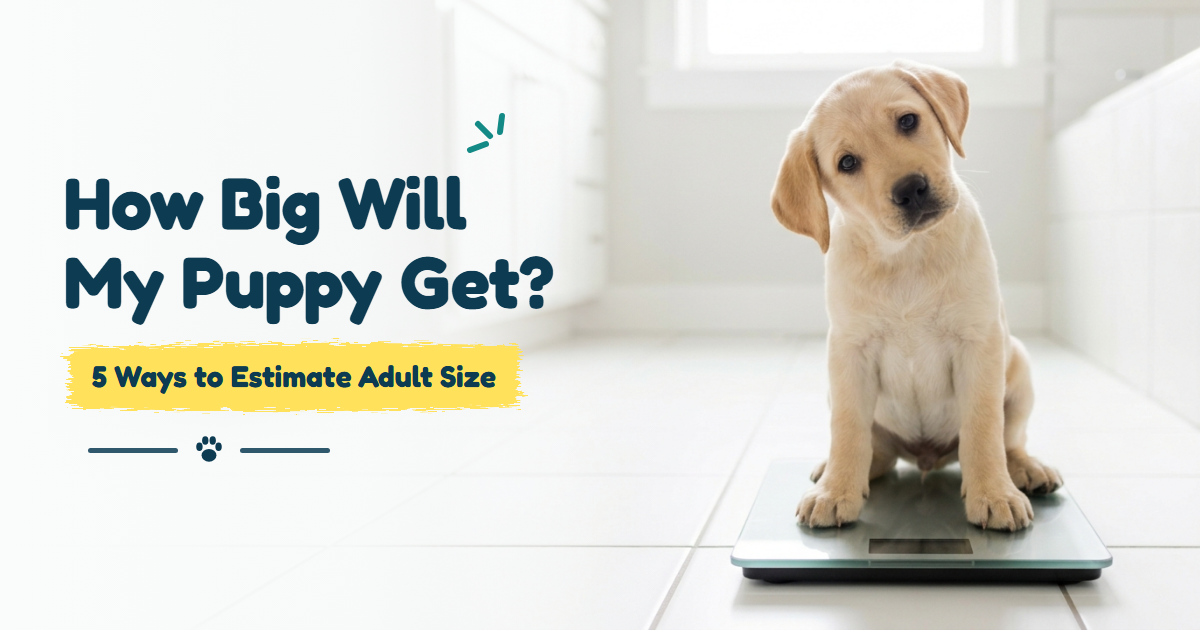
Quick answer: How big will my puppy get? The most useful way to estimate is to divide your puppy’s current weight by the share of adult weight expected at their age. A large-breed puppy at 4 months has reached about 35% of their adult weight, so 25 lb divided by 0.35 is about 71 lb. Breed averages, the parents’ size, and a DNA test can help refine that guess.
It’s one of the first questions every new puppy owner asks. And it’s more than just curiosity. Your puppy’s adult size affects the crate you buy, the amount of food you need, the size of your car, and even your rental agreement.
Nobody can give you an exact answer, especially with a mixed breed. But you can get surprisingly close. This guide gives you five ways to estimate, simple examples you can follow, and tips to help your puppy grow at a healthy pace.
Table of Contents
- How Big Will My Puppy Get? 5 Ways to Estimate
- Do Paw Size and Other Tricks Really Work?
- When Will My Puppy Stop Growing?
- Why Your Estimate Can Be Off
- How to Help Your Puppy Grow at a Healthy Pace
- When to Call the Vet
- Frequently Asked Questions
How Big Will My Puppy Get? 5 Ways to Estimate
No method is perfect, so use a few of these together. If they all land near the same number, you can feel pretty good about the estimate.
Way 1: Use a Growth Chart
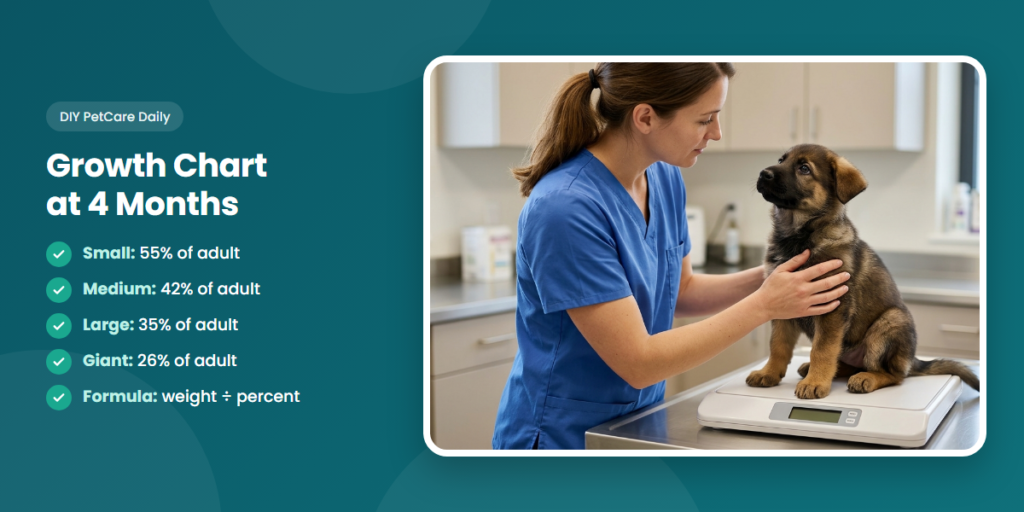
This is the best option for most puppies. Small dogs finish growing much sooner than giant dogs, so you’ll need to know your puppy’s likely size group first. This chart shows the rough share of adult weight most puppies reach by each age.
| Age | Small (20 lb or less) | Medium (21 to 50 lb) | Large (51 to 90 lb) | Giant (over 90 lb) |
| 2 months | 25% | 18% | 15% | 10% |
| 3 months | 40% | 30% | 25% | 17% |
| 4 months | 55% | 42% | 35% | 26% |
| 6 months | 78% | 65% | 56% | 44% |
| 8 months | 90% | 82% | 72% | 60% |
| 10 months | 97% | 92% | 85% | 73% |
| 12 months | 100% | 98% | 93% | 83% |
| 18 months | 100% | 100% | 100% | 98% |
Here’s the formula: current weight divided by the percentage at their age = estimated adult weight.
| Example | Math | Estimated Adult Weight |
| Small puppy, 6 lb at 4 months | 6 divided by 0.55 | About 11 lb |
| Medium puppy, 15 lb at 4 months | 15 divided by 0.42 | About 36 lb |
| Large puppy, 25 lb at 4 months | 25 divided by 0.35 | About 71 lb |
| Giant puppy, 40 lb at 4 months | 40 divided by 0.26 | About 154 lb |
Don’t want to do the math? Our dog weight calculator does it for you and shows a likely range and growth curve.
Way 2: Check the Breed Average
If your puppy is a purebred, the breed’s normal adult range is a good guide. Males are often at the higher end, and females at the lower end. See healthy ranges for popular breeds in our dog weight chart.
Keep in mind that even within one breed, a puppy from a large line can end up well above average, and a puppy from a small line can end up below it.
Way 3: Look at the Parents
Parents are one of the best clues. Most puppies end up somewhere near their parents’ size, and it’s common to land close to the same-sex parent. If you buy from a breeder, ask to see the parents or get their weights. It’s also worth asking how big dogs from earlier litters turned out.
If you adopted your puppy, you may not have this information. Shelters sometimes have a photo or size estimate of the mother, so it’s worth asking.
Way 4: Try a Dog DNA Test
For mixed-breed puppies, a DNA test can help. These at-home kits use a cheek swab to identify likely breeds. Some also estimate adult weight based on the breeds and genes found.
They aren’t perfect, and they cost more than the other methods. Still, they can solve a big mystery. If you find out your “small mix” is part Lab, you can plan accordingly. Remember that genes influence size, but they don’t decide everything. Food and overall health matter too.
Way 5: Ask Your Vet
Your vet sees lots of growing puppies. At each vaccine visit, they’ll weigh your puppy and can compare them with growth patterns they’ve seen before. Ask for their guess at about 4 to 6 months, when the estimate tends to get more useful.
Those early visits on your dog vaccination schedule make it easy to track your puppy’s weight. Keep a simple note on your phone with the date and weight from each visit.
Do Paw Size and Other Tricks Really Work?
You’ve probably heard a few of these. Here’s how they hold up.
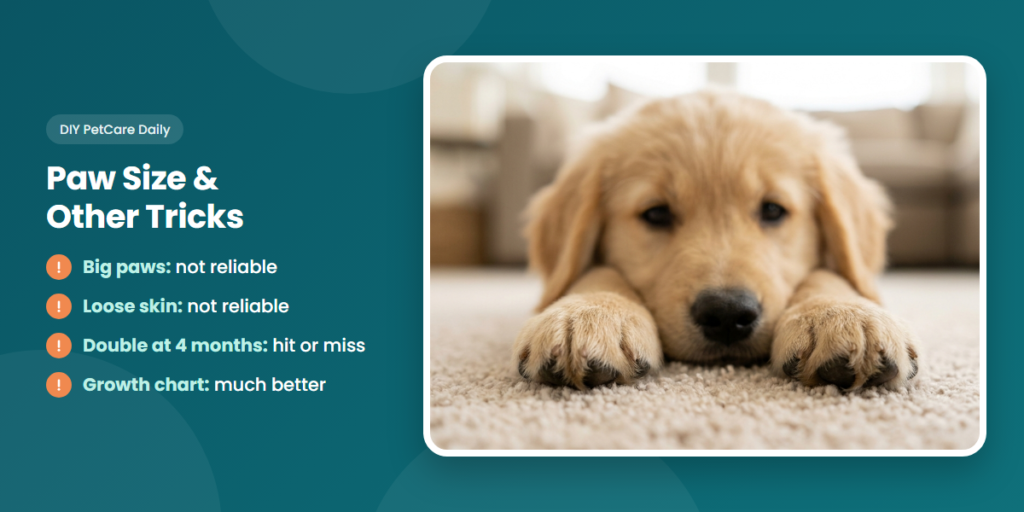
| Old Trick | The Idea | How Reliable? |
| Big paws | Big paws mean a big dog | Not reliable. Puppies grow into their paws at different rates |
| Loose skin | Extra skin means more growth to come | A fun clue, but not reliable |
| “Double at 4 months” | Double the 4-month weight | Works for some medium dogs, but it’s too low for large dogs and too high for small ones |
| Height at 6 months | Multiply height by a set number | Loosely useful at best, and it varies by breed |
Big paws can suggest a bigger dog in general, but plenty of big-pawed puppies end up medium-sized. A growth chart will almost always get you closer.
When Will My Puppy Stop Growing?
Puppies grow fast at first, then slow down well before they reach their adult size. Bigger dogs take longer.
| Size Group | Adult Height | Adult Weight |
| Small | Around 8 to 10 months | About 10 to 12 months |
| Medium | Around 10 to 12 months | About 12 to 14 months |
| Large | Around 12 to 15 months | About 18 months |
| Giant | Around 15 to 18 months | Up to about 2 years |
Many dogs keep filling out, adding muscle and chest depth, even after they stop getting taller. So don’t worry if a long-legged teenager looks a bit gangly. If you’re curious about the human age of your dog, try our dog age calculator.
Why Your Estimate Can Be Off
Every puppy grows differently, and estimates can be off by 15% or more. These things can throw off the math:
- Mixed breeding: Mixes can grow quite differently from what you’d expect, especially when the parents are very different sizes.
- Wrong size group: If you think your puppy is medium but they’re really large, the number will come out too low.
- Body condition: An overfed puppy may look like they’re headed for a bigger adult size, and a thin one may look smaller. Our dog body condition score guide shows what a healthy shape looks like.
- Parasites or illness: These can slow growth, especially in rescue puppies.
- Early age: Estimates are less reliable at 8 weeks than at 4 or 6 months. Check again as your puppy grows.
Tip: Recalculate every month. Your estimate should settle down as your puppy gets older.

How to Help Your Puppy Grow at a Healthy Pace
You can’t really make a puppy bigger than their genes allow, but you can help them grow well. Overfeeding won’t make a bigger dog, just a heavier one, and it can harm growing joints.
- Feed a puppy food. Look for an AAFCO statement for growth or for all life stages.
- Choose a large-breed puppy food for big puppies. These foods control calcium and calories, which helps protect growing bones and joints.
- Measure meals. Follow our guide on how much to feed a puppy, and update portions as they grow.
- Keep your puppy lean. You should be able to feel the ribs easily and see a waist.
- Exercise wisely. Short play sessions are better than long runs, especially for large and giant breeds. Ask your vet when it’s safe to add longer exercise.
- Keep up with vet visits. Vaccines, deworming, and regular weigh-ins all support healthy growth.
When to Call the Vet
Puppies change quickly, so contact your vet if your puppy:
- Stops gaining weight or loses weight
- Has diarrhea, vomiting, or a pot belly
- Limps, has swollen joints, or cries when moving
- Seems weak, tired, or isn’t eating
- Is much thinner or heavier than a healthy puppy their age
Young puppies can get sick quickly, so don’t wait long. If stool looks unusual, our guide on what to give a dog for diarrhea can help you know when it’s time to go in.
For more guides, visit our Dog Health & Wellness section.
Frequently Asked Questions
How can I tell how big my puppy will get?
Divide your puppy’s current weight by the share of adult weight expected at their age. A large-breed puppy at 4 months has reached about 35%. Compare the result with their breed average and parents’ size.
Do bigger paws mean a bigger dog?
Not reliably. Some puppies with big paws grow into medium dogs, while some with small paws grow quite large. The parents’ size and a growth chart are better guides.
How big will my mixed-breed puppy get?
Estimate using a growth chart, then compare it with the size of the parents if you know them. A DNA test can also help you find out what breeds may be in the mix.
At what age is a dog full grown?
Small dogs usually reach adult size at about 10 to 12 months, medium dogs at 12 to 14 months, large dogs at about 18 months, and giant dogs at up to 2 years.
Does neutering affect how big my puppy will get?
It usually doesn’t change adult weight a lot, but early spay or neuter can cause slightly longer legs, since the bones close later. Timing matters for large breeds, so ask your vet.