Table of Contents
- Table of Contents
- Why Dog Vaccines Matter
- Core Vaccines for Dogs
- Lifestyle (Non-Core) Dog Vaccines
- Puppy Vaccination Schedule
- Adult Dog Vaccination Schedule
- How Often Do Dogs Need Shots?
- Dog Vaccine Side Effects
- How Much Do Dog Vaccines Cost in the USA?
- Tips for a Smooth Vaccine Visit
- Frequently Asked Questions
Quick answer: A typical dog vaccination schedule in the US starts at 6 to 8 weeks with the DHPP combo shot, repeated every 2 to 4 weeks until your puppy is at least 16 weeks old. Rabies is given at 12 to 16 weeks, and most vets now also recommend leptospirosis. Adult dogs get a DHPP booster every 3 years, rabies every 1 or 3 years depending on state law, and leptospirosis yearly. Lifestyle vaccines like Bordetella, canine flu, and Lyme are added based on where your dog goes and lives.
Vaccines protect dogs from some of the most serious diseases they can catch, including parvovirus, distemper, and rabies. A few rounds of puppy shots and regular boosters later can save your dog’s life and spare you from huge vet bills.
But dog vaccine names and schedules can feel confusing. This guide lays out the full puppy shots schedule, explains which dog vaccines are core and which depend on lifestyle, and answers the common question of how often dogs need shots.
Table of Contents
- Why Dog Vaccines Matter
- Core Vaccines for Dogs
- Lifestyle (Non-Core) Dog Vaccines
- Puppy Vaccination Schedule
- Adult Dog Vaccination Schedule
- How Often Do Dogs Need Shots?
- Dog Vaccine Side Effects
- How Much Do Dog Vaccines Cost in the USA?
- Tips for a Smooth Vaccine Visit
- Frequently Asked Questions
Why Dog Vaccines Matter
Several dog diseases are hard or impossible to treat once a dog is sick:
- Parvovirus causes severe vomiting and bloody diarrhea. It’s often fatal in puppies without intensive care, and the virus can survive in soil for months.
- Distemper affects the lungs, gut, and brain, and many dogs who survive have lasting nerve damage.
- Rabies is almost always fatal and can spread to people.
- Leptospirosis damages the kidneys and liver and can also spread to people.
Vaccines teach your dog’s immune system to fight these diseases before they’re exposed. US vet groups, including the American Animal Hospital Association (AAHA), publish canine vaccination guidelines that most vets follow. This guide is based on those general recommendations, and your vet will tailor them to your dog.
Core Vaccines for Dogs
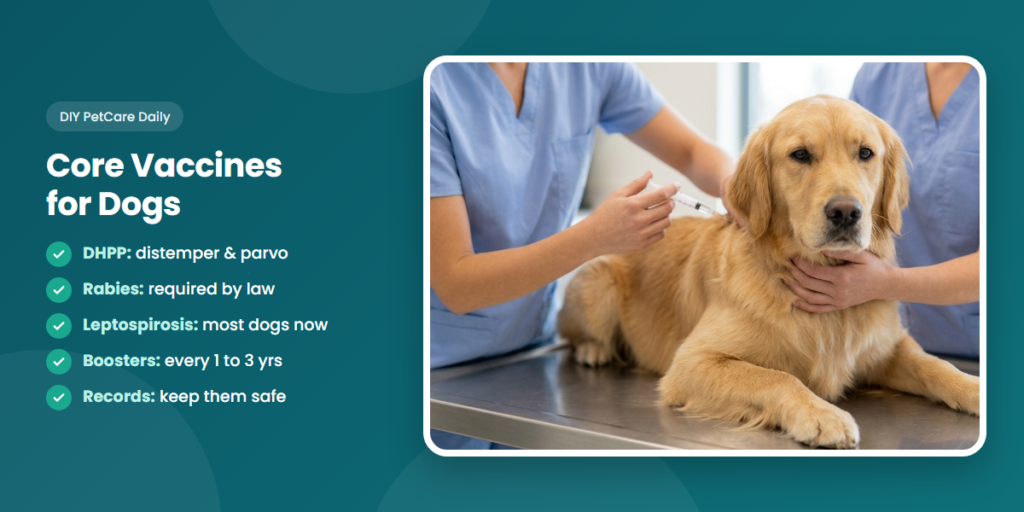
Core vaccines for dogs are recommended for every dog, no matter where they live.
| Vaccine | Protects Against | Notes |
| DHPP (also called DAPP or DA2PP) | Distemper, adenovirus (hepatitis), parvovirus, parainfluenza | The main puppy combo shot |
| Rabies | Rabies virus | Required by law in nearly every state |
| Leptospirosis | Leptospira bacteria | Now recommended for nearly all dogs in North America |
DHPP (the Main Combo Shot)
The DHPP vaccine is the main combo shot for puppies and adult dogs. It covers distemper, adenovirus type 2 (which also protects against infectious hepatitis), parvovirus, and parainfluenza. You may see it on your dog’s records as DHPP, DAPP, DA2PP, or DHLPP (when leptospirosis is added). Our full guide to the DHPP vaccine covers each disease and the puppy schedule in detail.
Rabies
The rabies vaccine for dogs is required by law in almost every US state. Puppies get their first rabies shot at 12 to 16 weeks old, depending on the vaccine label and state law. They get a booster 1 year later, then every 1 or 3 years based on the vaccine used and local rules. Keep your rabies certificate and tag. You’ll need them for licensing, boarding, travel, and if your dog ever bites someone. See our guide to the rabies vaccine for dogs for state laws and what to do after a bite.
Leptospirosis
Leptospirosis spreads through the urine of infected wildlife, such as raccoons, skunks, rats, and deer, often in puddles, ponds, and wet soil. It used to be considered a “country dog” disease, but cases are now common in cities and suburbs too, including in small dogs. That’s why AAHA now recommends the leptospirosis vaccine for nearly all dogs. It takes two doses 2 to 4 weeks apart at first, then a yearly booster.
Lifestyle (Non-Core) Dog Vaccines
These vaccines are given based on your dog’s lifestyle and where you live. Your vet will ask where your dog goes and who they meet.
| Vaccine | Protects Against | Who May Need It | How Often |
| Bordetella | Kennel cough | Dogs who board, go to daycare, groomers, dog parks, or training classes | Yearly (some facilities ask for every 6 months) |
| Canine influenza (H3N2/H3N8) | Dog flu | Social dogs, boarding and daycare dogs, dogs in outbreak areas | Yearly, after 2 starter doses |
| Lyme disease | Lyme bacteria from ticks | Dogs in tick areas, such as the Northeast and Upper Midwest | Yearly, after 2 starter doses |
Bordetella (Kennel Cough)
The Bordetella vaccine helps protect against kennel cough, a contagious cough that spreads where dogs gather. Most boarding kennels, daycares, and groomers require it. It comes as nose drops, a liquid placed in the mouth, or an injection. Nose and mouth versions often work faster.
Kennel cough is caused by several germs, so the vaccine lowers the risk and severity but can’t prevent every case. Read more in our guide to the Bordetella vaccine.
Lyme Vaccine
Lyme disease spreads through tick bites. If you live in or travel to an area with lots of deer ticks, your vet may recommend this vaccine along with year-round tick prevention. The vaccine doesn’t replace tick prevention; both work best together.

Puppy Vaccination Schedule
Puppies get antibodies from their mother’s milk, which protect them early on but also block vaccines from working. These antibodies fade at different times in different puppies. That’s why puppies need a series of shots, spaced a few weeks apart, until they’re old enough that the last dose is sure to work.
| Puppy’s Age | Vaccines Usually Given |
| 6 to 8 weeks | DHPP #1 (Bordetella if your puppy will be around other dogs early) |
| 10 to 12 weeks | DHPP #2, leptospirosis #1, optional canine flu #1, optional Lyme #1 |
| 12 to 16 weeks | DHPP #3, rabies, leptospirosis #2, optional canine flu #2, optional Lyme #2 |
| 16 to 20 weeks | Final DHPP (needed if the series started early or for high-risk breeds) |
| 6 to 12 months after the last puppy dose | DHPP booster |
| 1 year after the first doses | Rabies booster, leptospirosis booster, lifestyle boosters |
Puppy Shots Schedule Rules to Remember
- Keep giving DHPP every 2 to 4 weeks until your puppy is at least 16 weeks old. Stopping early is one of the most common reasons puppies get parvo.
- Some breeds, like Rottweilers, Doberman Pinschers, and Pit Bull-type dogs, may be at higher risk for parvo, and your vet may suggest a final dose at 18 to 20 weeks.
- Rabies timing depends on your state’s law and the vaccine label.
- Leptospirosis and other two-dose vaccines need both doses to protect your puppy.
Your puppy’s vet visits are also a good time for deworming, starting flea and heartworm prevention, and checking growth. Our guide on how much to feed a puppy has a feeding chart by age and weight.
Keeping Your Puppy Safe Before Shots Are Done
Puppies aren’t fully protected until about 1 to 2 weeks after their final DHPP dose. Until then:
- Avoid dog parks, pet store floors, and areas where many unknown dogs go
- Carry your puppy in public places like the vet’s waiting room
- Do allow play with healthy, fully vaccinated dogs you know
- Join a puppy class that requires at least one round of shots and cleans its space well
Early, safe socialization matters a lot for behavior, so don’t keep your puppy fully isolated. Just choose places and dogs carefully.
Adult Dog Vaccination Schedule
| Vaccine | How Often for Adult Dogs |
| DHPP | Every 3 years after the first adult booster |
| Rabies | Every 1 or 3 years, depending on the vaccine and state law |
| Leptospirosis | Every year |
| Bordetella | Every year (every 6 months for some boarding facilities) |
| Canine influenza | Every year, if recommended |
| Lyme | Every year, if recommended |
Adult Dogs With Unknown History
If you adopt an adult dog and don’t know their vaccine history, your vet will usually:
- Give one or two doses of DHPP, 2 to 4 weeks apart.
- Give one dose of rabies vaccine, then a booster in a year.
- Give two doses of leptospirosis, 2 to 4 weeks apart.
- Add lifestyle vaccines as needed.
Senior Dogs
Older dogs still need core protection. Your vet may suggest a titer test, a blood test that measures your dog’s protection against distemper and parvovirus, to decide if a DHPP booster is needed. Rabies is still required by law in most areas, unless your vet writes a medical exemption where your state allows it.
How Often Do Dogs Need Shots?
Here’s the short version:
- Puppies: every 2 to 4 weeks from 6 to 8 weeks old until at least 16 weeks.
- Young adults: boosters 6 to 12 months after the puppy series.
- Adults: DHPP every 3 years, rabies every 1 to 3 years, and leptospirosis plus lifestyle vaccines yearly.
Most adult dogs end up with at least one vaccine due every year, which lines up nicely with their yearly checkup.
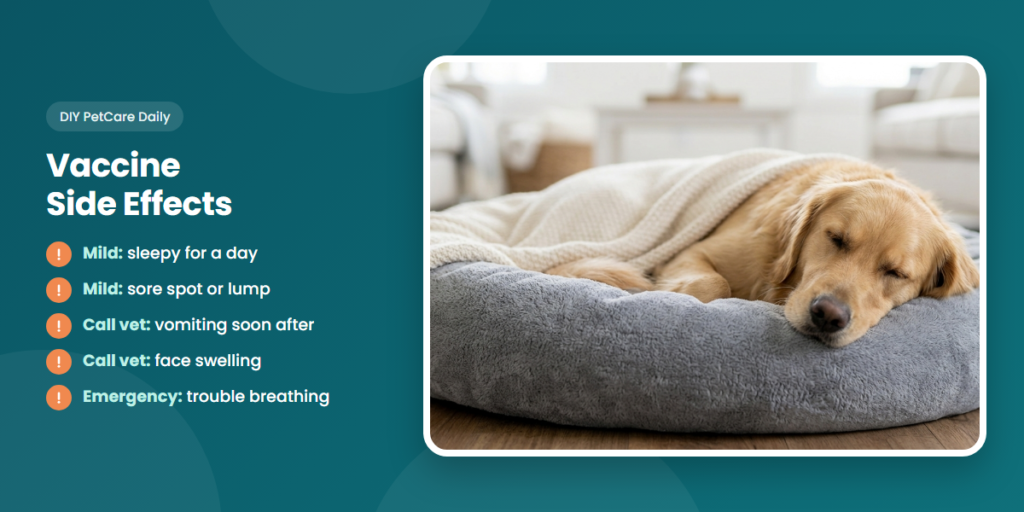
Dog Vaccine Side Effects
Most dogs have no side effects or only mild ones that pass in a day or two.
Common, mild side effects:
- Tiredness or a quieter mood
- A mild fever
- Eating a little less for a day
- Soreness or a small lump where the shot was given
- Sneezing or a mild cough for a few days after nose-drop Bordetella vaccines
Rare, serious reactions (call your vet or go to an emergency clinic now):
- Vomiting or diarrhea soon after the shot
- Swelling of the face, muzzle, or around the eyes
- Hives or very itchy skin
- Trouble breathing
- Collapse
Small dogs who get several vaccines at once may be at slightly higher risk of a reaction. If your dog has reacted before, tell your vet. They may give an antihistamine first or split vaccines across separate visits.
If your dog has loose stool for a day after vaccines, our guide on what to give dog for diarrhea covers safe home care.
How Much Do Dog Vaccines Cost in the USA?
Prices vary by state and clinic. Here are typical ranges:
| Service | Typical Cost |
| Vet exam | $50 to $90 |
| DHPP | $20 to $50 |
| Rabies | $15 to $35 |
| Leptospirosis | $20 to $40 |
| Bordetella | $20 to $45 |
| Canine influenza | $35 to $50 per dose |
| Lyme | $35 to $60 per dose |
| Full puppy series (all visits) | About $150 to $450 |
Many shelters, humane societies, and pet stores run low-cost vaccine clinics. Many cities and counties also hold free or low-cost rabies clinics every year.
Tips for a Smooth Vaccine Visit
- Bring your dog’s vaccine records, especially for a new vet
- Feed a small meal beforehand, unless your vet says otherwise
- Bring high-value treats to keep your dog happy
- Ask about splitting vaccines into separate visits for small or sensitive dogs
- Keep the rest of the day calm
- Watch your dog closely for a few hours after the visit
For more guides on keeping your dog healthy, visit our Dog Health & Wellness section. You can also learn how to check your dog’s normal heart rate for dogs, breathing, and temperature at home.
Frequently Asked Questions
What is the dog vaccination schedule?
Puppies start DHPP at 6 to 8 weeks and get it every 2 to 4 weeks until at least 16 weeks old. Rabies is given at 12 to 16 weeks, and leptospirosis in two doses. Adult dogs get DHPP every 3 years, rabies every 1 to 3 years, and leptospirosis and lifestyle vaccines yearly.
What are the core vaccines for dogs?
The core vaccines for dogs are DHPP (distemper, adenovirus, parvovirus, and parainfluenza) and rabies. AAHA now also recommends the leptospirosis vaccine for nearly all dogs in North America.
How often do dogs need shots?
Puppies need shots every 2 to 4 weeks until at least 16 weeks old. Adult dogs usually need DHPP every 3 years, rabies every 1 or 3 years, and leptospirosis plus lifestyle vaccines like Bordetella every year.
What shots do puppies need before going outside?
Puppies need their full DHPP series, ending at 16 weeks or later, before going to busy dog areas like parks. Until 1 to 2 weeks after their final shot, carry them in public and only let them play with healthy, vaccinated dogs you know.
Are dog vaccines required by law?
Rabies is the only dog vaccine required by law in nearly every US state. Other vaccines aren’t legally required, but boarding kennels, groomers, daycares, and training classes often require DHPP and Bordetella.