Table of Contents
- Table of Contents
- Dog Vital Signs at a Glance
- Normal Heart Rate for Dogs
- How to Check Your Dog’s Heart Rate
- Normal Breathing Rate for Dogs
- Dog Breathing Fast: Common Causes
- Normal Dog Temperature
- How to Take a Dog’s Temperature
- Other Quick Checks: Gums and Hydration
- When to Call the Vet
- Tips for Tracking Your Dog’s Vital Signs
- Frequently Asked Questions
Quick answer: The normal heart rate for dogs is about 60 to 140 beats per minute at rest. Large dogs are on the lower end (60 to 100), and small dogs on the higher end (100 to 140). Puppies can reach 160 or more. A normal dog temperature is 101.0°F to 102.5°F. A healthy resting dog takes about 10 to 30 breaths per minute, and fewer than 30 while asleep. You can check all three at home with a watch, your hand, and a digital thermometer.
Knowing your dog’s normal vital signs is one of the most useful things you can learn as a pet owner. When something seems off, you can check your dog’s heart rate, breathing, and temperature in a few minutes and give your vet clear, helpful information over the phone.
This guide explains the normal ranges for dogs of all sizes, shows you step by step how to check each one at home, and tells you which numbers mean it’s time to call the vet.
Table of Contents
- Dog Vital Signs at a Glance
- Normal Heart Rate for Dogs
- How to Check Your Dog’s Heart Rate
- Normal Breathing Rate for Dogs
- Dog Breathing Fast: Common Causes
- Normal Dog Temperature
- How to Take a Dog’s Temperature
- Other Quick Checks: Gums and Hydration
- When to Call the Vet
- Tips for Tracking Your Dog’s Vital Signs
- Frequently Asked Questions
Dog Vital Signs at a Glance
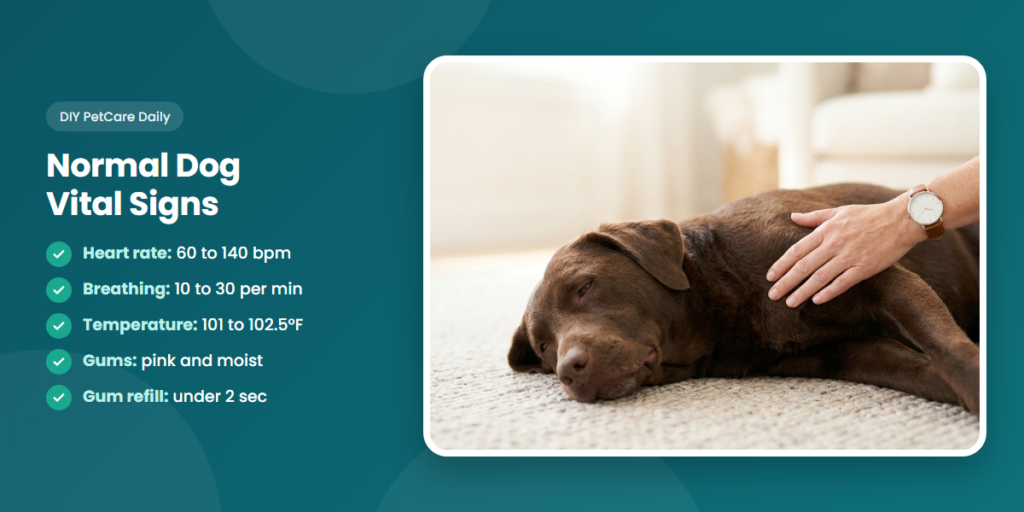
| Vital Sign | Normal Range for Adult Dogs | Call Your Vet If |
| Heart rate (large dogs over 50 lbs) | 60 to 100 beats per minute | Over 140 at rest, or under 50 |
| Heart rate (medium dogs) | 70 to 120 beats per minute | Over 160 at rest, or under 60 |
| Heart rate (small and toy dogs) | 100 to 140 beats per minute | Over 180 at rest, or under 70 |
| Heart rate (puppies) | 120 to 160 beats per minute (higher in newborns) | Your vet sets the range by age |
| Breathing rate (resting) | 10 to 30 breaths per minute | Over 40 at rest, or labored breathing |
| Breathing rate (asleep) | Under 30 breaths per minute | Repeatedly over 35 to 40 |
| Temperature | 101.0°F to 102.5°F | Over 103°F or under 99°F |
| Gum color | Pink and moist | Pale, white, blue, gray, bright red, or yellow |
| Capillary refill time | Under 2 seconds | Over 2 seconds |
These are general ranges. Fit, athletic dogs often have slower heart rates, and excited or nervous dogs will read higher. The best reference is your own dog’s normal, so check them a few times when they’re calm and healthy and write the numbers down.
Normal Heart Rate for Dogs
A dog’s heart rate depends mostly on size and age. Smaller dogs have faster heartbeats, and bigger dogs have slower ones.
Dog Heart Rate by Size
| Dog Size | Example Breeds | Normal Resting Heart Rate |
| Toy (under 10 lbs) | Chihuahua, Yorkie | 100 to 140 bpm |
| Small (10 to 25 lbs) | Beagle, French Bulldog | 90 to 130 bpm |
| Medium (25 to 50 lbs) | Border Collie, Cocker Spaniel | 70 to 120 bpm |
| Large (50 to 90 lbs) | Labrador, German Shepherd | 60 to 100 bpm |
| Giant (over 90 lbs) | Great Dane, Mastiff | 60 to 90 bpm |
| Puppies | All breeds | 120 to 160 bpm (up to 220 in newborns) |
A Little Irregular Is Often Normal
Many healthy dogs have a heartbeat that speeds up when they breathe in and slows down when they breathe out. This is called sinus arrhythmia, and it’s normal in dogs. A heartbeat that skips randomly, races, or feels very irregular is different and should be checked by a vet.
How to Check Your Dog’s Heart Rate
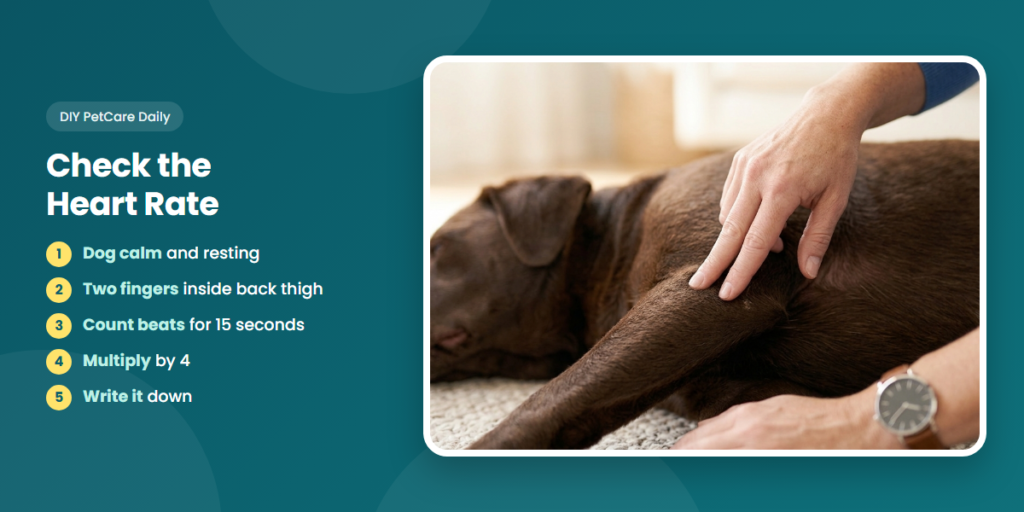
You’ll need a watch or phone timer. Pick a time when your dog is calm and resting, not right after play.
Method 1: Feel the Pulse Inside the Back Leg
- Have your dog stand or lie on their side.
- Place two fingers (not your thumb) on the inside of the back thigh, near where the leg meets the body. You’re feeling for the femoral artery.
- Press gently until you feel a pulse.
- Count the beats for 15 seconds.
- Multiply by 4 to get beats per minute.
Method 2: Feel the Heartbeat on the Chest
- With your dog standing or lying on their right side, place your hand on the left side of the chest, just behind the front leg at elbow level.
- Feel for the heartbeat.
- Count for 15 seconds and multiply by 4.
This method is often easier with small dogs and puppies. A stethoscope makes it even easier if you have one.
Tip: practice both methods when your dog is healthy, so you know where to feel and what’s normal before you ever need it.
Normal Breathing Rate for Dogs
The normal respiratory rate for dogs at rest is about 10 to 30 breaths per minute. When asleep, most healthy dogs breathe fewer than 30 times a minute.
Your dog’s resting breathing rate (especially while sleeping) is one of the best ways to watch for early heart and lung problems at home. Vets often ask owners of dogs with heart disease to count sleeping breaths daily.
How to Count Your Dog’s Breathing Rate
- Wait until your dog is relaxed or asleep, in a cool room.
- Watch the chest or belly rise and fall. One rise plus one fall equals one breath.
- Count the breaths for 30 seconds.
- Multiply by 2.
Don’t count while your dog is panting, sniffing, dreaming, or after exercise. Those numbers will be much higher and aren’t useful.
Panting vs Fast Breathing
Panting is normal after exercise, in warm weather, or when your dog is excited. It’s how dogs cool down. It should slow down within a few minutes of rest in a cool place.
Fast breathing that happens at rest, in a cool room, or during sleep is different and needs attention.
Dog Breathing Fast: Common Causes
If you notice your dog breathing fast while resting, here are some possible reasons:
- Heat or overheating. Heatstroke is an emergency.
- Pain or anxiety. Dogs often breathe faster when they hurt or feel stressed.
- Fever or infection.
- Heart disease. Fluid in or around the lungs makes breathing faster.
- Lung or airway problems, like pneumonia, a collapsing trachea, or asthma-like conditions.
- Anemia, where there aren’t enough red blood cells to carry oxygen.
- Medicines, such as steroids like prednisone.
- Short-nosed breeds. Bulldogs, Pugs, and other flat-faced dogs often breathe harder and are more likely to overheat.
Go to the vet right away if your dog is breathing fast and:
- Has blue, gray, or pale gums
- Is breathing with their belly, neck stretched out, or elbows held wide
- Is making loud, noisy, or wheezing sounds
- Won’t lie down or keeps changing positions
- Is coughing, weak, or collapsed
- Has a resting rate over 40 breaths per minute that doesn’t settle
Normal Dog Temperature
A normal dog temperature is 101.0°F to 102.5°F. That’s higher than ours, so a dog can feel warm to the touch even when healthy.
| Dog Temperature | What It Means |
| Under 99°F | Too low (hypothermia); call your vet |
| 99°F to 100.9°F | A little low; recheck and keep your dog warm |
| 101.0°F to 102.5°F | Normal |
| 102.6°F to 103°F | Slightly high; can happen with exercise or excitement |
| Over 103°F | Fever; call your vet |
| 104°F or higher | High fever; see a vet today |
| 106°F or higher | Life-threatening (heatstroke risk); emergency |
A warm or dry nose doesn’t mean a fever. Nose temperature changes with the weather, sleep, and activity. The only reliable way to know your dog’s temperature is with a thermometer.
How to Take a Dog’s Temperature
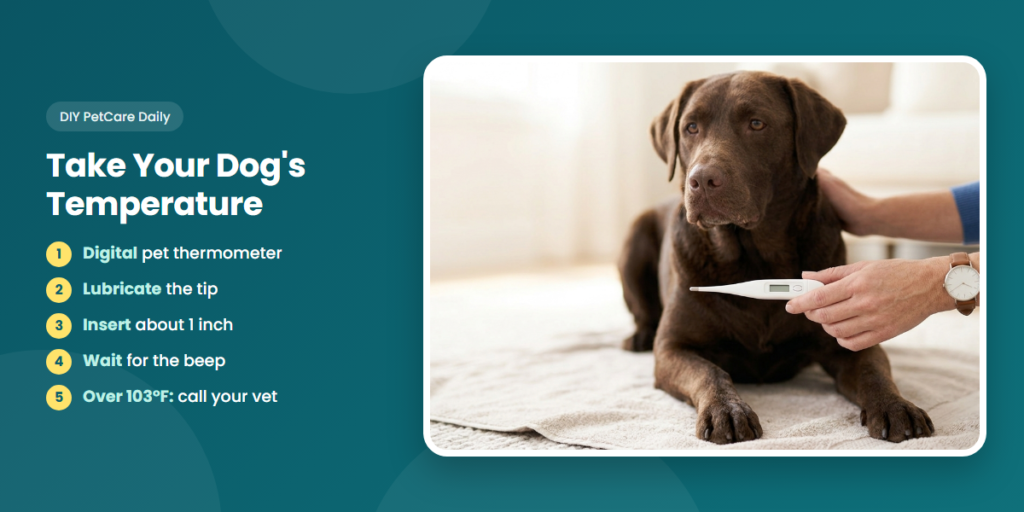
A rectal temperature with a digital thermometer is the most accurate way. It’s quick and usually takes less than a minute.
What You’ll Need
- A digital thermometer (keep one just for your dog and label it)
- Petroleum jelly or a water-based lubricant
- A helper, if possible, to hold and comfort your dog
- Treats
- Alcohol wipes or soap for cleaning
Steps
- Have a helper hold your dog standing, with one arm under the belly and one around the chest. Small dogs can lie on their side.
- Turn the thermometer on and coat the tip with lubricant.
- Lift the tail gently and slowly insert the tip into the rectum about 1 inch for medium and large dogs, or about 1/2 inch for small dogs. Never force it.
- Hold it steady until it beeps.
- Remove, read, and clean the thermometer.
- Reward your dog with praise and a treat.
What About Ear Thermometers?
Ear thermometers made for pets can work if used correctly, but they’re often less accurate, especially with ear infections or a lot of ear hair. Forehead and no-touch thermometers made for people aren’t reliable for dogs.
Other Quick Checks: Gums and Hydration
- Gum color: lift your dog’s lip. Healthy gums are pink and moist (some dogs have black patches, which are normal). Pale, white, blue, gray, bright red, or yellow gums are a reason to call your vet. Our guide on signs of gum disease in dogs shows what healthy gums look like.
- Capillary refill time: press a finger on a pink part of the gum until it turns pale, then let go. The pink should return in under 2 seconds.
- Hydration: gently lift the skin at the back of the neck. It should snap back quickly. If it stays up or sinks back slowly, your dog may be dehydrated. Dehydration is common with diarrhea; see what to give dog for diarrhea.
When to Call the Vet
Emergency, go now if your dog has:
- A temperature of 104°F or higher, or 106°F or higher in hot weather
- Trouble breathing, blue or gray gums, or collapse
- A very fast heart rate at rest along with weakness or fainting
- A temperature under 99°F with weakness
Call your vet the same day if:
- Your dog has a fever over 103°F
- The resting or sleeping breathing rate stays over 35 to 40
- The heart rate at rest is much higher or lower than your dog’s normal
- These changes come with not eating, vomiting, or low energy
Tips for Tracking Your Dog’s Vital Signs
- Check your dog’s normal numbers 2 or 3 times when they’re calm and healthy
- Write them down, or save them in a note on your phone
- Count sleeping breaths once a week for senior dogs or dogs with heart disease
- Bring your notes to vet visits
- Keep a pet thermometer in your first-aid kit
For more guides on keeping your dog healthy, visit our Dog Health & Wellness section. You can also learn what your dog’s poop says about their health in our dog poop color chart.
Frequently Asked Questions
What is a normal heart rate for dogs?
A normal heart rate for dogs at rest is about 60 to 140 beats per minute. Large dogs usually fall between 60 and 100, small dogs between 100 and 140, and puppies can reach 160 or more.
What is a normal dog temperature?
A normal dog temperature is between 101.0°F and 102.5°F. Over 103°F is considered a fever, and 104°F or higher needs a vet visit. Under 99°F is too low.
How many breaths per minute is normal for a dog?
A healthy dog at rest breathes about 10 to 30 times per minute. While sleeping, most dogs breathe fewer than 30 times per minute. A resting rate that stays over 35 to 40 should be checked by your vet.
Why is my dog breathing fast while resting?
Your dog may be too warm, stressed, or in pain. But fast breathing at rest can also point to fever, heart disease, lung problems, or anemia. If it doesn’t settle in a cool, quiet room, or your dog’s gums look pale or blue, see a vet.
How can I check my dog’s heart rate without a stethoscope?
Place two fingers on the inside of your dog’s back thigh, where the leg meets the body, to feel the pulse. Or put your hand on the left side of the chest behind the front leg. Count the beats for 15 seconds and multiply by 4.