Table of Contents
- Table of Contents
- Before You Build: Will Your Cat Like an Enclosed Box?
- How Big Should a Litter Box Enclosure Be?
- Hidden Litter Box Ideas
- Project 1: Convert a Cabinet Into a Litter Box Enclosure
- Project 2: Build a Litter Box Bench
- Project 3: Plywood Box With a Planter Top
- How to Keep a DIY Litter Box Enclosure Smelling Fresh
- Cutting Down on Litter Tracking
- Where to Put the Enclosure
- When to See the Vet
- Frequently Asked Questions
Quick answer: A DIY litter box enclosure is a cabinet, bench, or plywood box that hides the litter box while giving your cat a clear way in. Pick a cabinet at least 6 inches wider and taller than the box, cut a 7 to 8-inch entry hole, drill vent holes for airflow, line the floor with a waterproof surface, and add a door or lid so you can scoop every day.
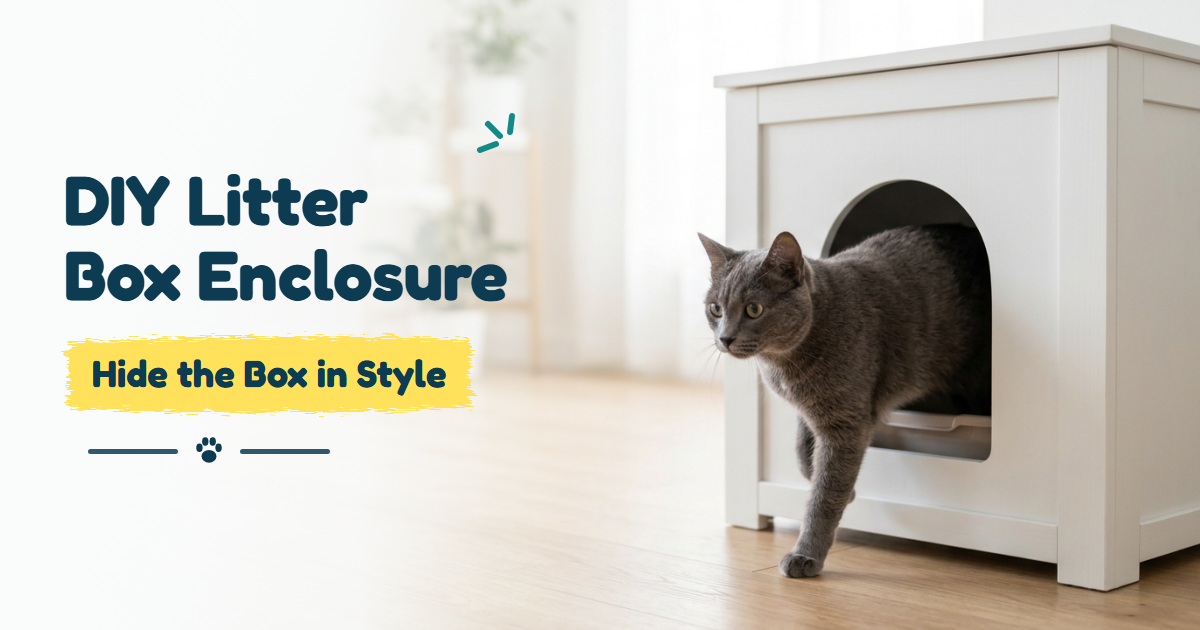
Let’s be honest. Nobody wants the litter box to be the first thing guests see. A litter box enclosure turns that plastic tray into a piece of furniture, like a side table, a bench, or a cabinet that blends in with your home. It also cuts down on scattered litter and gives some cats a little more privacy.
But there’s a catch. If the enclosure is too small, too dark, or too smelly inside, your cat may stop using the box. This guide shows you how to build or convert an enclosure the right way, so it works for you and your cat.
Table of Contents
- Before You Build: Will Your Cat Like an Enclosed Box?
- How Big Should a Litter Box Enclosure Be?
- Hidden Litter Box Ideas
- Project 1: Convert a Cabinet Into a Litter Box Enclosure
- Project 2: Build a Litter Box Bench
- Project 3: Plywood Box With a Planter Top
- How to Keep a DIY Litter Box Enclosure Smelling Fresh
- Cutting Down on Litter Tracking
- Where to Put the Enclosure
- When to See the Vet
- Frequently Asked Questions
Before You Build: Will Your Cat Like an Enclosed Box?
Some cats love privacy. Others feel trapped in a closed space, especially if they share a home with other cats or a dog. A cat who can’t see who’s coming may feel ambushed when they step out.
Signs your cat may not like an enclosed box:
- They hesitate or sniff around the entrance a long time
- They go in but leave fast, without covering
- They start peeing or pooping just outside the enclosure
If you see any of these, take the door off, make the opening bigger, or go back to an open box. Litter box problems are a top reason cats get surrendered to shelters, so it’s not worth the risk. Our guide on cat peeing outside the litter box covers other causes to rule out.
Tip: Test your cat first. Put a large cardboard box with a hole cut in it over their current litter box for a week. If they use it with no problems, they’ll likely be fine with a permanent enclosure.
How Big Should a Litter Box Enclosure Be?
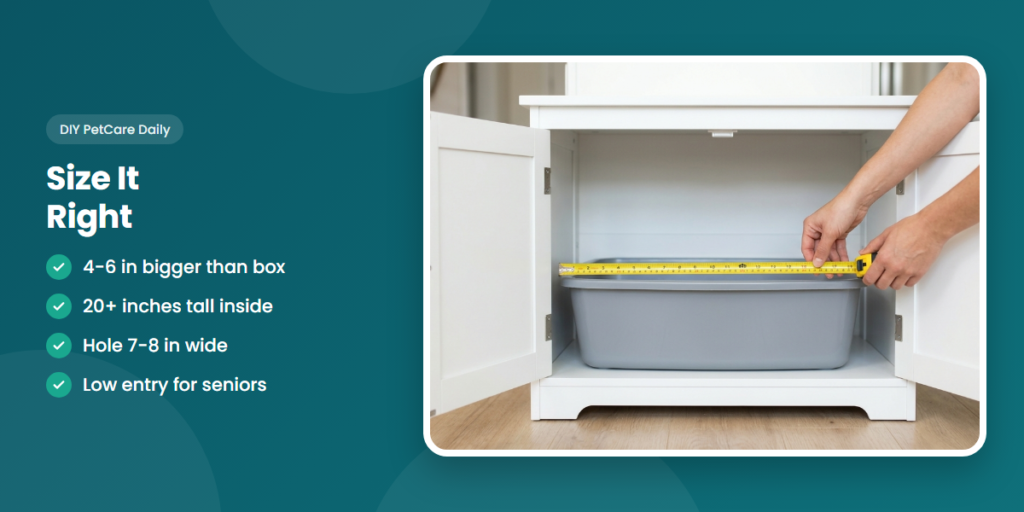
Start with the litter box, not the cabinet. Most cats do best with a box about 1.5 times their body length (nose to base of tail). For an average cat, that means a box around 24 inches long. Many standard boxes are smaller than cats prefer.
Then size the enclosure around it.
| Measurement | Guide |
| Inside width and depth | At least 4 to 6 inches more than the litter box on each side you need for access |
| Inside height | At least 20 inches, so your cat can stand, turn, and squat comfortably |
| Entry hole | 7 to 8 inches wide, 8 to 9 inches tall (bigger for large cats) |
| Hole height off the floor | About 2 to 4 inches, lower for senior cats |
Large breeds like Maine Coons need more room in every direction. Our guide to average cat weight by breed can help you plan.
There’s more than one way to disguise a litter box. Pick the one that fits your space and skill level.
| Idea | Skill level | Best for |
| Convert a storage cabinet or sideboard | Easy | Living rooms, entryways |
| Bench with a lift-up seat | Medium | Mudrooms, hallways, foot of the bed |
| Plywood box with a planter on top | Medium | Corners, small apartments |
| Bathroom vanity or under-sink cabinet | Easy to medium | Bathrooms with space |
| Washer/dryer side cabinet | Easy | Laundry rooms (if quiet) |
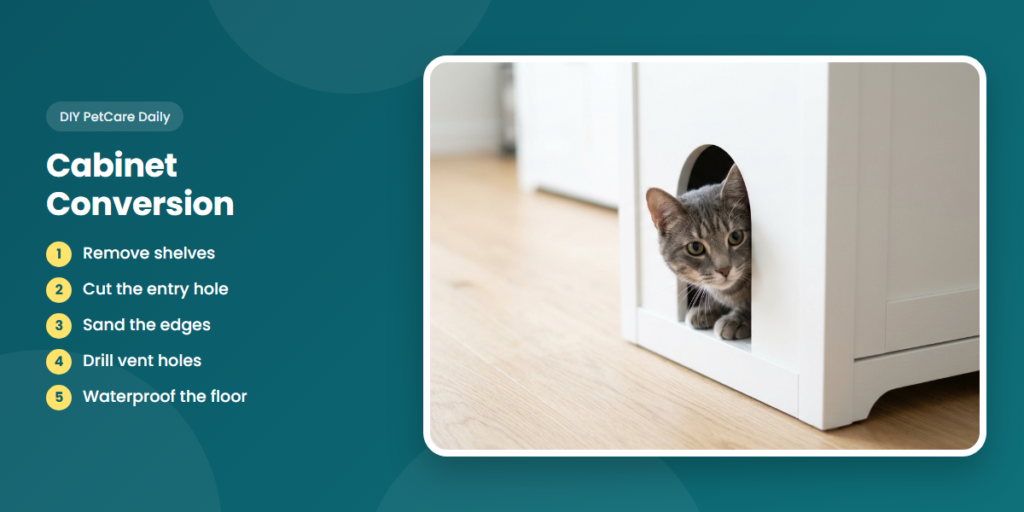
Project 1: Convert a Cabinet Into a Litter Box Enclosure
This is the most popular project. You can use a new or secondhand storage cabinet, a TV stand, or a sideboard.
What You Need
- A cabinet with doors, at least 30 inches wide, 18 inches deep, and 20 inches tall inside
- Jigsaw
- Drill with a large spade bit or hole saw (for vent holes and to start your cut)
- Sandpaper or a file
- Waterproof shelf liner, vinyl flooring scrap, or a boot tray
- Pencil and a bowl or plate to trace the hole
- Optional: a small USB fan or carbon filter for odor
Steps
- Remove shelves. Take out any inside shelves so there’s one open space.
- Choose the entrance side. Pick a side panel your cat can reach easily, not the back against a wall.
- Trace the hole. Use a large bowl or draw an arch 7 to 8 inches wide and 8 to 9 inches tall. Keep the bottom about 2 to 4 inches above the floor.
- Cut the hole. Drill a starter hole inside your line, then cut it out with a jigsaw.
- Sand the edges. Smooth the cut edges well so your cat doesn’t catch fur or skin. You can cover the edge with a rubber U-channel trim for a neat look.
- Drill vent holes. Add several 1-inch holes high on the back or sides for airflow. This keeps odor and ammonia from building up inside.
- Waterproof the floor. Lay vinyl, a boot tray, or waterproof liner on the bottom so spills and stray pee don’t soak into the wood.
- Add the litter box. Slide it in with the entry side facing the hole.
- Use the doors for scooping. The front doors give you full access to clean.
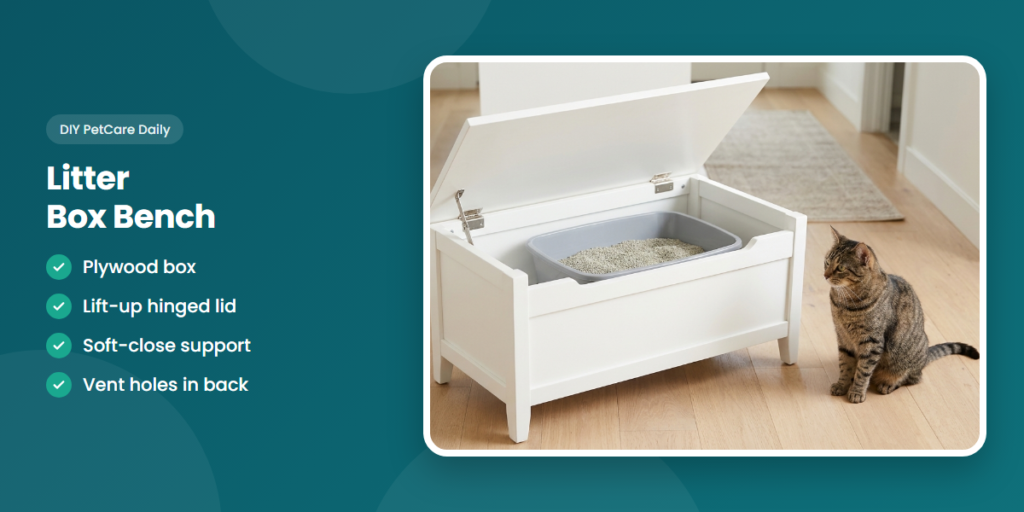
Project 2: Build a Litter Box Bench
A bench gives you extra seating and a hidden box underneath.
Basic Plan
- Build a box from 3/4-inch plywood, about 36 inches long, 20 inches deep, and 20 inches tall.
- Cut an entry hole in one end panel.
- Attach the top with a piano hinge so it lifts up like a toy chest.
- Add a lid support (a soft-close hinge or lid stay) so it doesn’t slam on your fingers or your cat.
- Drill vent holes in the back panel.
- Paint or stain to match your room, and let it cure fully before your cat uses it.
- Add a cushion on top.
Safety tip: Always make sure your cat isn’t inside before you close the lid.
Project 3: Plywood Box With a Planter Top
This one looks like a plant stand, so nobody guesses what’s inside.
- Build a simple plywood box sized for your litter box.
- Cut an entry hole in one side and vent holes in the back.
- Add a removable top panel or a front door for cleaning.
- Set a large faux plant or a cat-safe live plant on top.
Avoid real plants that are toxic to cats, especially lilies. Fake plants are the safest choice on top of a litter box enclosure.
How to Keep a DIY Litter Box Enclosure Smelling Fresh
An enclosure can trap smell inside, which is unpleasant for your cat’s nose, since it’s far more sensitive than yours. A few habits keep it fresh:
- Scoop at least once a day. Twice is better.
- Change all the litter every 1 to 2 weeks for clumping litter, more often for non-clumping.
- Wash the box with mild, unscented soap and warm water when you change litter.
- Keep the vent holes clear.
- Skip strong scented sprays and plug-ins near the box. Many cats dislike them and may avoid the box.
- Wipe the inside walls of the enclosure weekly.
Cutting Down on Litter Tracking
One bonus of an enclosure is less litter on the floor. To trap even more:
- Put a litter mat just outside the entry hole.
- Make the entrance lead to a short “hallway” inside the cabinet before the box, so paws shed litter on the way out.
- Use a box with high sides, or a top-entry box inside the enclosure (only if your cat is young and agile).
Where to Put the Enclosure
Even the nicest enclosure won’t help if it’s in the wrong place. Cats want a litter spot that’s:
- Quiet: not next to a loud washer, furnace, or a busy doorway
- Easy to reach: not behind closed doors or down steep stairs for older cats
- Away from food and water: cats don’t like to eat near their bathroom
- Familiar: if you’re moving the box, do it slowly, a few feet a day
If you have more than one cat, you’ll need more than one box. The general rule is one box per cat, plus one extra. Our guide on how many litter boxes per cat explains why and where to put them.
When to See the Vet
Sometimes litter box changes have nothing to do with the enclosure. Call your vet if your cat:
- Strains in the box or goes in and out often with little urine
- Has blood in the urine
- Cries while using the box
- Suddenly avoids the box after using it well for a long time
A male cat straining with no urine is an emergency. It can mean a urinary blockage.
For more home projects for cats, browse our DIY Cat Projects section, or add a DIY cat scratcher nearby, since many cats like to scratch after using the box.
Frequently Asked Questions
Do cats like enclosed litter boxes?
Some do and some don’t. Many cats like the privacy, but others feel trapped or dislike the trapped smell. Test with a cardboard box first, keep the enclosure well vented, and scoop daily.
How big should the hole be in a litter box enclosure?
About 7 to 8 inches wide and 8 to 9 inches tall for most cats. Large cats need a bigger opening. Keep the bottom of the hole 2 to 4 inches off the floor, lower for senior cats.
How do you ventilate a litter box cabinet?
Drill several 1-inch holes high on the back or side panels so air can move through. For extra help, add a small USB-powered fan or a carbon filter made for litter cabinets.
Can I put a litter box in a closet?
You can, as long as the door stays open or has a cat flap, and the space is easy for your cat to reach. A closed closet traps odor and can keep your cat from getting to the box when they need it.
How do I get my cat to use a new litter box enclosure?
Put their current litter box inside with the same litter, leave the door open at first, and place a few treats near the entrance. If your cat avoids it, take the door off or make the hole bigger until they’re comfortable.