Table of Contents
Quick answer: A DIY catio is a fully enclosed outdoor space that lets your cat enjoy fresh air without the risks of roaming. The simplest build is a wooden frame wrapped in 16-gauge welded wire mesh with 1-inch openings, with a solid or mesh roof and a cat flap into the house. Window box catios cost under $150 to build; larger freestanding ones run a few hundred dollars.
Indoor cats tend to live longer, safer lives than cats who roam outside. They avoid cars, fights, predators, and many diseases. But a lot of indoor cats spend hours staring out the window at birds and bugs they can’t reach.
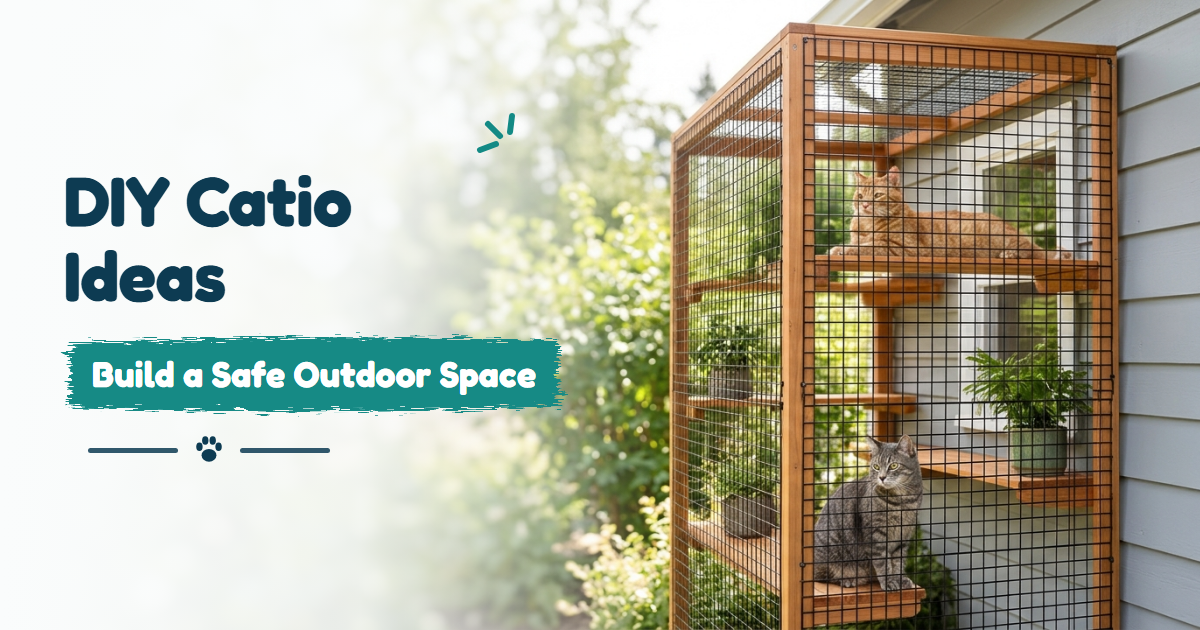
A catio gives them the best of both. It’s a screened-in patio just for cats, where they can feel the sun, smell the air, and watch the world, all without danger. It also protects birds and other wildlife from your cat.
This guide covers the main catio types, how to plan one, how to build a simple design, and how to make it safe and fun.
Table of Contents
- Why Build a DIY Catio?
- Types of Catios
- How to Plan Your Catio
- Materials for a Simple Lean-To Catio
- How to Build a Catio Step by Step
- Fill Your Catio With Fun
- Catio Safety Tips
- How to Get Your Cat to Use the Catio
- Frequently Asked Questions
Why Build a DIY Catio?
- Safety: Your cat stays away from traffic, dogs, coyotes, and fights with other cats.
- Enrichment: New sights, sounds, and smells help keep indoor cats from getting bored.
- Exercise: Shelves and ramps encourage climbing and jumping.
- Less stress: Bored cats sometimes develop problem behaviors. Outdoor time can help.
- Wildlife protection: Free-roaming pet cats kill large numbers of birds and small animals every year in the US. A catio keeps everyone safe.
Types of Catios
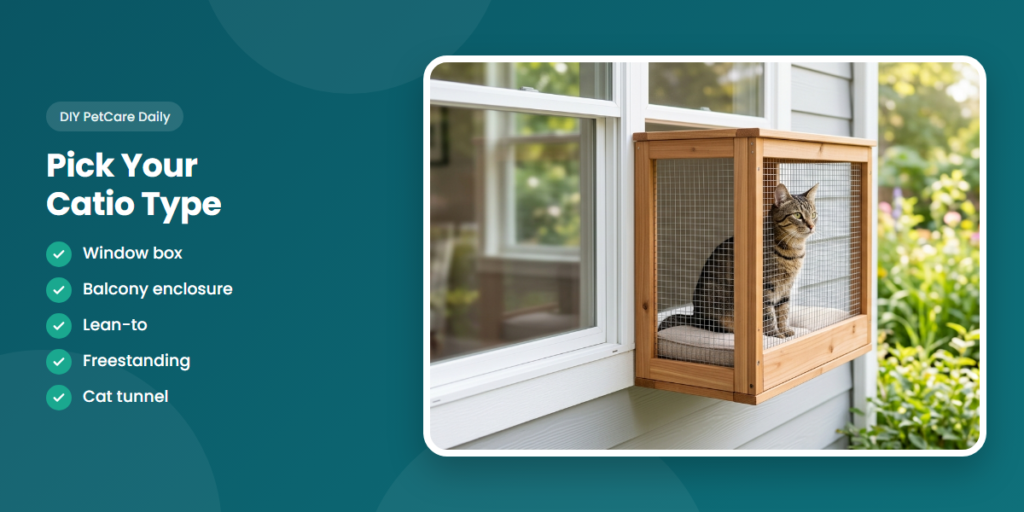
Before you buy any wood, pick the style that fits your home.
| Catio type | Best for | Approx. size | Typical DIY cost |
| Window box | Apartments, small homes, renters | 2 to 3 ft wide | $50 to $150 |
| Balcony enclosure | Apartments with a balcony | Fits the balcony | $100 to $300 |
| Lean-to (against a wall) | Houses with a side yard | 4 x 6 ft and up | $200 to $500 |
| Freestanding | Large yards | 6 x 8 ft and up | $300 to $900 |
| Cat tunnel or run | Connecting house to a catio or garden | Varies | $100 to $400 |
Costs depend on lumber prices, size, and how fancy you go. Reusing old furniture, shelves, or leftover lumber cuts the cost a lot.
How to Plan Your Catio
Check the Rules First
- Renters: Ask your landlord before attaching anything to the building. A freestanding or window box catio that doesn’t need screws into walls is often easier to get approved.
- HOAs: Many homeowner associations have rules about outdoor structures. Check before you build.
- Permits: Small catios usually don’t need one, but large or roofed structures might. A quick call to your city or county helps.
Pick the Right Spot
- Access: The catio needs to connect to a window or door your cat can use. A cat flap in a window insert or door panel is the easiest setup.
- Sun and shade: Aim for a mix. Cats love sunbathing, but they need a shady spot to cool off.
- Shelter: A spot against the house gets some protection from wind and rain.
- View: Face it toward something interesting, like a bird feeder (placed far enough away to be fair to the birds) or a garden.
Decide on Size
Even a small catio is a big win. A window box gives one or two cats a perch. If you have several cats, plan for more room, with at least one shelf or perch per cat so no one has to fight for space.
Materials for a Simple Lean-To Catio
This list covers a basic 4 x 6 ft catio, about 6 ft tall, built against the side of a house.
Frame
- 2×4 lumber for the base and corner posts
- 2×2 lumber for the wall and roof frame
- Exterior wood screws
- Metal corner brackets
Mesh
- Galvanized or vinyl-coated welded wire mesh, 16-gauge, with 1 x 1 inch or 1 x 2 inch openings
- Heavy-duty staples or screws with washers to hold the mesh
Roof
- More wire mesh, or clear polycarbonate roof panels for rain cover
Door and access
- Hinges and a secure latch for a people door
- A cat flap or window insert with a cat door
Finish
- Pet-safe exterior stain or sealer (let it cure fully before your cat goes in)
Why Not Chicken Wire?
Chicken wire is thin and twisted. Cats can push through weak spots, and raccoons and dogs can tear it open. Welded wire is much stronger and holds its shape. Vinyl-coated mesh also looks nicer and is gentler on paws and claws.
How to Build a Catio Step by Step
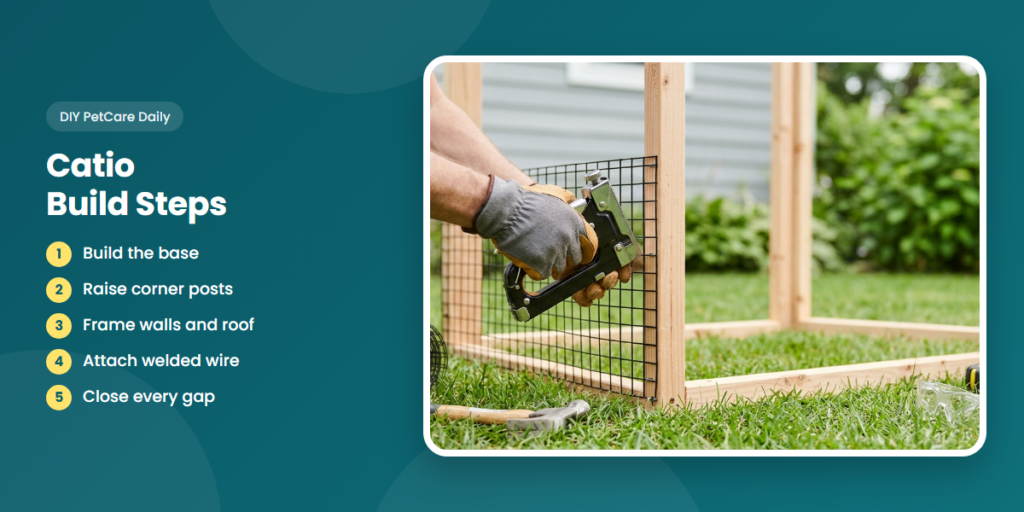
Step 1: Build the Base
Make a rectangle from 2x4s for the floor frame. Set it on a level patio, pavers, or deck. If you build on soil, lay pavers or gravel under it so the wood stays dry.
Step 2: Raise the Corner Posts
Screw 2×4 posts to each corner of the base. If the catio sits against the house, attach the back posts to the wall frame or use a freestanding back panel if you’re renting.
Step 3: Frame the Walls and Roof
Add 2×2 crosspieces between the posts at the top, middle, and bottom. Build a simple flat or slightly sloped roof frame. A slight slope helps rain run off if you’re adding solid panels.
Step 4: Attach the Mesh
Unroll the wire mesh across each wall and the roof. Staple or screw it to every frame piece, every 3 to 4 inches. Pull it tight so there are no bulges. Overlap the mesh at the seams and fasten both layers.
Don’t skip the roof. Cats are excellent climbers and will get out of an open-top enclosure. A roof also keeps out hawks and owls, which can be a threat to small cats.
Step 5: Add a People Door
Build a small door frame, cover it with mesh, and hang it with hinges. Use a latch that clicks shut on its own, plus a hook or lock. This lets you get in to clean and refill water.
Step 6: Connect It to the House
Install a cat flap in a window insert, a door panel, or a wall. If you’re renting, a window insert with a built-in pet door slides into a window track without permanent changes.
Step 7: Inspect for Gaps
Run your hand along every edge, corner, and seam. A cat can squeeze through any gap big enough for their head. Check where the mesh meets the house, the ground, and the door. Close every gap.
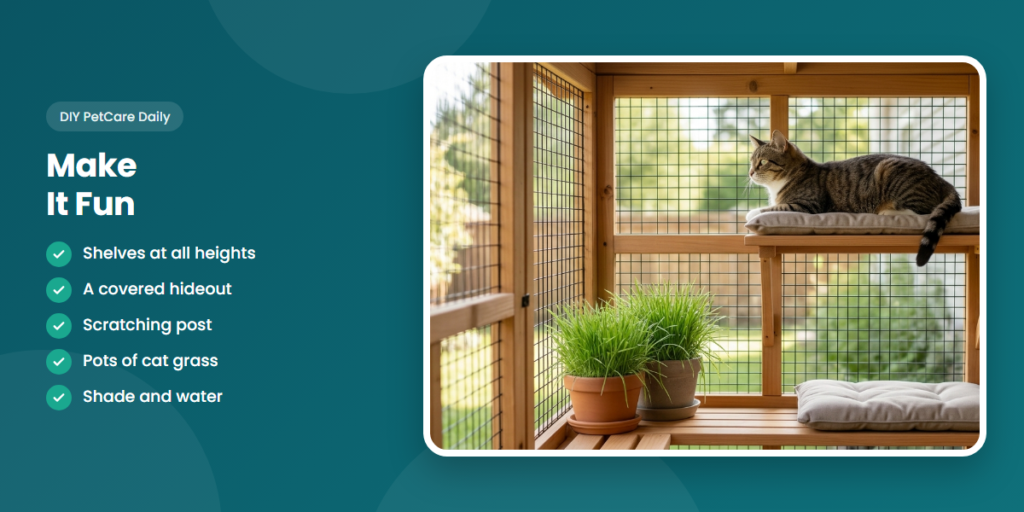
Fill Your Catio With Fun
An empty cage isn’t much fun. Here’s how to make your catio a place your cat wants to be.
- Shelves and perches at different heights, including one high spot
- A ramp or cat steps for older cats
- A covered hideout so your cat can rest out of view
- Scratching posts, which also help keep claws off your furniture. Our guide to a DIY cat scratcher is a quick add-on project
- Pots of cat grass; see how to grow cat grass
- A water bowl in the shade
- Outdoor rugs or cushions that can handle damp weather
Cat-Safe Plants
If you want plants inside or around your catio, choose safe ones like cat grass, catnip, spider plants, or Boston ferns. Never grow lilies near cats. All parts of the lily plant are highly toxic to cats and can cause kidney failure. Our list of foods toxic to cats covers other dangers to keep out.
Catio Safety Tips
- Watch the weather. On hot days, make sure there’s shade and water, and bring your cat in when it’s very hot. Cats can overheat faster than you’d think in a sunny enclosure. Bring them in on cold, wet, or windy days too.
- Supervise at first. Stay close for the first few visits until you’re sure the catio is escape-proof.
- Keep vaccines current. Your cat may meet bugs, wildlife, or other cats through the mesh. Check our guide to cat vaccines to make sure they’re protected.
- Use flea prevention. Fleas and ticks can find their way in.
- Check the catio often. Look for loose staples, rust, rot, or chewed spots.
- Lock the people door. Kids and guests may leave it open.
How to Get Your Cat to Use the Catio
Some cats run straight out. Others need a few days.
- Prop the cat flap open at first so your cat can see through it.
- Put treats, a favorite blanket, or a toy in the catio.
- Sit in the catio yourself so your cat feels safe.
- Keep early visits short and positive.
- Teach the cat flap by holding it open and luring your cat through with treats.
Love building for your cat? Browse more ideas in our DIY Cat Projects section. If you also care for outdoor cats, see our guide to a DIY outdoor cat house.
Frequently Asked Questions
How much does it cost to build a DIY catio?
A small window box catio costs about $50 to $150 in materials. A lean-to catio against a house usually runs $200 to $500, and a large freestanding catio can cost $300 to $900 or more. Reusing old lumber and furniture keeps costs down.
What is the best mesh for a catio?
Galvanized or vinyl-coated welded wire mesh, 16-gauge, with 1 x 1 inch or 1 x 2 inch openings. It’s strong enough to keep cats in and predators out. Avoid chicken wire, which is weak and easy to tear.
Do catios need a roof?
Yes. Cats climb well and can escape an open-top enclosure. A roof also protects small cats from hawks and owls. Use mesh for an open feel, or clear panels if you want rain cover.
Can I build a catio if I rent?
Often, yes. Window box catios and freestanding designs that don’t attach to the building are good choices for renters. Window inserts with a built-in cat flap fit into the window track without drilling. Always ask your landlord first.
Is a catio good for indoor cats?
Yes. A catio gives indoor cats fresh air, sunshine, and new things to watch, which helps prevent boredom and stress. It does this without the dangers cats face when they roam outside.