Table of Contents
- Table of Contents
- Why Trim Your Cat’s Nails?
- How Often Should You Trim Cat Nails?
- Tools You’ll Need
- Get to Know Your Cat’s Nails
- How Do You Cut a Cat’s Nails? Step by Step
- Tips to Avoid Getting Scratched
- How to Trim the Nails of a Cat Who Hates It
- What to Do If You Cut the Quick
- Give Your Cat Good Places to Scratch
- What About Nail Caps and Declawing?
- Check the Paws While You’re There
- Frequently Asked Questions
Quick answer: To trim cat nails, wait until your cat is calm or sleepy, hold a paw gently, and press on the toe pad to push the nail out. Find the pink quick inside the nail and cut only the sharp, clear tip, about 2 millimeters in front of the quick. Use sharp cat nail clippers, do a few nails at a time, and give a treat after each one. Most indoor cats need a trim every 2 to 3 weeks.
If you’ve ever tried to trim your cat’s nails and ended up with scratches up your arm, you’re not alone. Many cats act like nail trims are the worst thing that could ever happen to them. The good news is that most of the fight comes from timing, grip, and going too fast, and all three are easy to fix.
So how do you trim a cat’s nails without the fight? This guide shows you how to trim cat nails at home, step by step, without getting scratched. You’ll also learn how often to do it, what to do if you cut too short, and how to help a cat who really hates it.
Table of Contents
- Why Trim Your Cat’s Nails?
- How Often Should You Trim Cat Nails?
- Tools You’ll Need
- Get to Know Your Cat’s Nails
- How Do You Cut a Cat’s Nails? Step by Step
- Tips to Avoid Getting Scratched
- How to Trim the Nails of a Cat Who Hates It
- What to Do If You Cut the Quick
- Give Your Cat Good Places to Scratch
- What About Nail Caps and Declawing?
- Check the Paws While You’re There
- Frequently Asked Questions
Why Trim Your Cat’s Nails?
Cats keep their nails in shape by scratching, but indoor cats often need extra help. Trimming the tips:
- Protects your furniture, rugs, and your skin
- Stops nails from catching in carpet or blankets and tearing
- Prevents ingrown nails, which are common in older cats who scratch less
- Makes it easier to spot paw problems early
Ingrown nails happen when a nail curls around and grows into the paw pad. It’s painful and can get infected. Senior cats and cats with extra toes (polydactyl cats) are more likely to have this problem, so check their nails more often.
How Often Should You Trim Cat Nails?
Most indoor cats need a trim every 2 to 3 weeks. Some cats grow nails faster, and older cats often need trims more often because they scratch less. The back nails usually grow slower than the front ones and may need trimming less often.
An easy way to tell it’s time: you hear clicking on the floor, or the nails catch on fabric when your cat walks across the couch.
Tools You’ll Need
- Cat nail clippers. Small scissor-style clippers are the easiest for most people. Human nail clippers can work on small, thin nails, but they can crush thicker ones.
- Styptic powder. This stops bleeding if you cut the quick. Cornstarch works too.
- Treats. Something your cat loves, like a lickable treat or bits of cooked chicken.
- A towel. Useful if your cat squirms a lot.
- Good light. You need to see the quick clearly.
Keep your clippers sharp. Dull blades squeeze the nail, which hurts and can make the nail split.
Get to Know Your Cat’s Nails
Cat nails are retractable, which means they stay tucked inside the paw until your cat pushes them out. When you gently press on the toe pad, the nail slides out.
Look at the nail from the side in good light. Most cat nails are clear or white, so you’ll see a pink area near the base. That’s the quick. It holds a blood vessel and a nerve. You only want to cut the clear, curved tip in front of it.
Cats with dark nails are trickier. In that case, trim only the very tip that curves into a sharp hook, and take tiny bits at a time.
How Do You Cut a Cat’s Nails? Step by Step
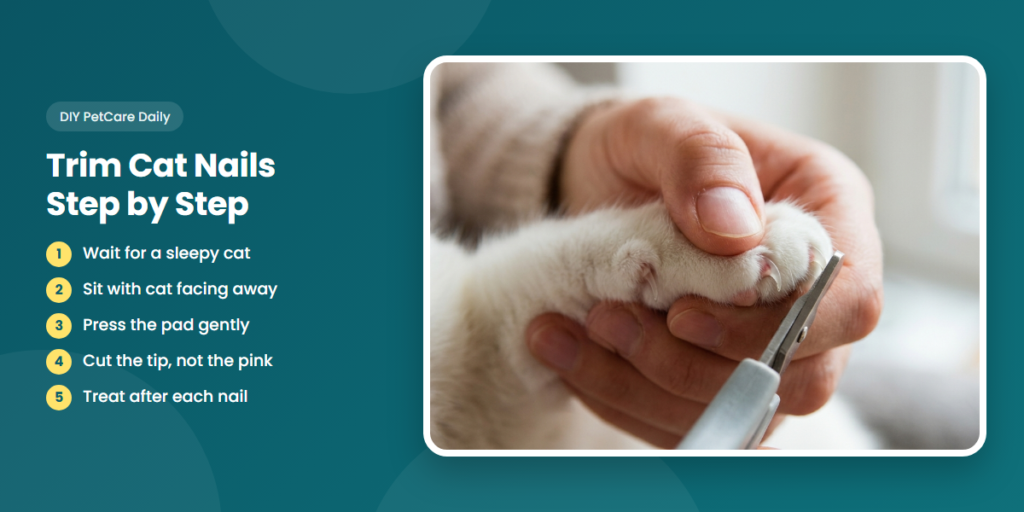
Step 1: Pick the Right Moment
Timing makes a huge difference. Trim nails when your cat is sleepy, relaxed, or curled up on your lap after a meal. Don’t try right after playtime, when your cat is wound up, or right after something stressful like a vet trip.
Step 2: Get in a Good Position
Hold your cat on your lap with its back toward you.. Their back can rest against your belly. This position keeps their back legs away from your arms and makes it harder for them to twist around. If your cat likes to lie on their side, that works too.
Step 3: Hold the Paw Gently
Pick up one front paw. Hold it softly with your fingers on top and your thumb on the bottom. Don’t squeeze. A firm but relaxed hold feels much safer to a cat than a tight grip.
Step 4: Push the Nail Out
Press gently on the top of the toe and the pad underneath. The nail will slide out so you can see it clearly.
Step 5: Cut Just the Tip
Find the pink quick. Cut the clear tip about 2 millimeters in front of it. Hold the clippers so they cut from top to bottom, not side to side, which helps prevent splitting. One quick, clean snip is better than a slow squeeze.
Step 6: Reward and Move On
Give a treat after each nail, or after each paw if your cat is calm. Then move to the next toe. Don’t forget the dewclaw, which sits higher up on the inside of each front leg.
Step 7: Stop Before Your Cat Gets Upset
You don’t have to do all the nails in one session. If your cat starts flicking their tail, flattening their ears, or pulling away hard, stop. Trim two or three nails a day if that’s what works. A short, calm session beats a long fight every time.
Tips to Avoid Getting Scratched
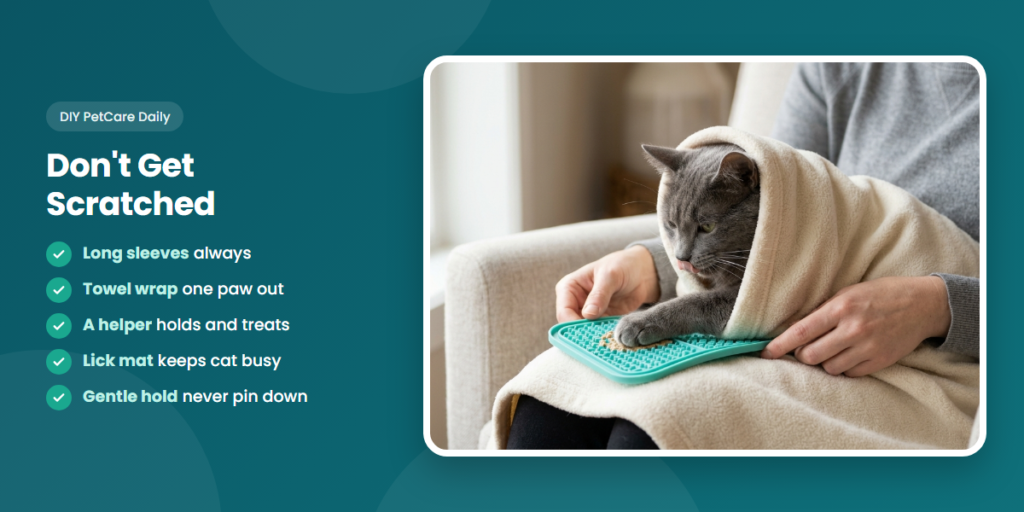
- Wear long sleeves. It’s simple, but it saves your arms.
- Use the “burrito” wrap. Wrap your cat snugly in a towel with just one paw out. Many cats calm down when they’re wrapped, and you’re protected from the other paws.
- Ask a helper. One person holds and gives treats while the other trims.
- Use a lick mat. Spread a lickable treat on a mat or plate. Many cats are so busy licking that they barely notice the trim.
- Don’t hold your cat down hard. Cats panic when they feel trapped. A gentle hold works better.
- Keep calm. If you’re tense, your cat will notice.
How to Trim the Nails of a Cat Who Hates It
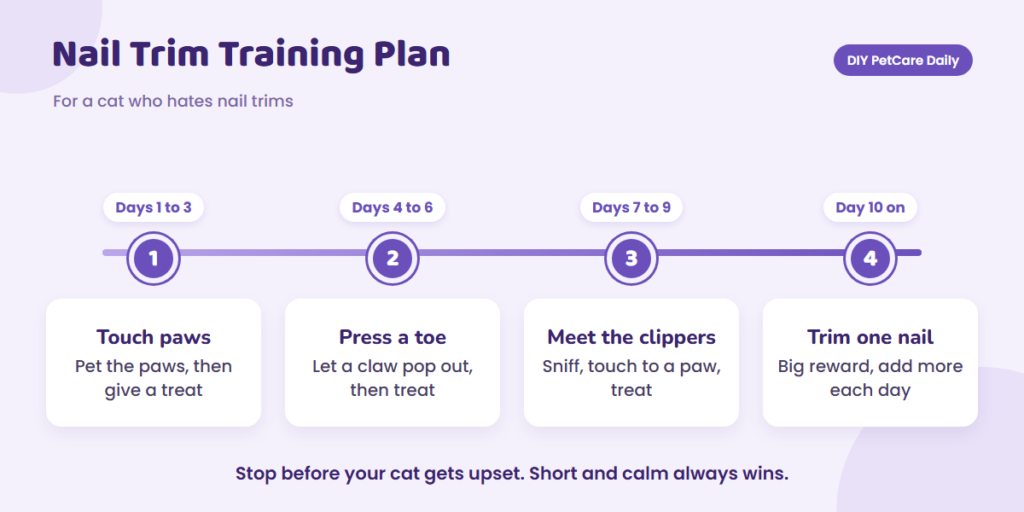
Some cats need to learn that nail trims aren’t scary. This slow plan works for most cats over a week or two:
- Days 1 to 3: Touch your cat’s paws during cuddle time, then give a treat. That’s it.
- Days 4 to 6: Gently press a toe so the nail pops out, then treat.
- Days 7 to 9: Let your cat sniff the clippers. Touch the clippers to a paw, then treat.
- Day 10 and on: Trim one nail and give a great treat. Slowly do more nails each day.
If your cat also fights brushing, our guide on how to brush a cat that hates it uses the same slow, treat-based approach.
If your cat hisses, bites, or panics even with slow training, ask your vet or a groomer for help. Some cats do better with a quick trim at the clinic.
What to Do If You Cut the Quick
Accidents happen. If you cut too close and the nail bleeds:
- Stay calm.
- Press a pinch of styptic powder or cornstarch onto the nail tip.
- Hold gentle pressure for about 30 seconds to a minute.
- Check that the bleeding has stopped, then let your cat rest.
The bleeding usually stops quickly. Call your vet if it doesn’t stop after 5 to 10 minutes or if the toe looks swollen or infected later.
Give Your Cat Good Places to Scratch
Trimming handles the sharp tips, but cats still need to scratch. Scratching helps them shed old nail layers, stretch, and mark their space.
- Offer a tall, sturdy scratching post that doesn’t wobble.
- Try both upright posts and flat cardboard scratchers.
- Put scratchers near where your cat sleeps and near furniture they like to scratch.
- Sprinkle catnip or use a toy to draw them to the post.
What About Nail Caps and Declawing?
Soft nail caps are small vinyl covers glued over the nails. They can protect furniture, but they need to be replaced every 4 to 6 weeks as the nails grow, and some cats don’t tolerate them.
Declawing is not a nail trim. It’s surgery that removes the last bone of each toe. Many vets in the US no longer do it, and several states, including New York and Maryland, have banned it. Regular trims and good scratching posts are a kinder choice.
Check the Paws While You’re There
Nail time is a great chance to check your cat’s paws. Look for redness, swelling, cuts, or a nail growing into a pad. If your cat suddenly doesn’t want their paws touched, they may be in pain. Our guide to signs of pain in cats covers the subtle clues to watch for.
For more guides on nails and litter boxes, visit our Cat Nail & Litter Care section.
Frequently Asked Questions
How often should I trim my cat’s nails?
Most indoor cats need a trim every 2 to 3 weeks. Senior cats may need trims more often because they scratch less and are more likely to get ingrown nails.
Can I use human nail clippers on my cat?
Yes, for small, thin nails. But human clippers can crush or split thicker nails. Small scissor-style clippers made for cats are the safer choice.
How much of a cat’s nail should I cut?
Only the clear, sharp tip. Stop about 2 millimeters before the pink quick. If you can’t see the quick, take off just the curved hook at the end.
Do outdoor cats need nail trims?
Usually not as often, because outdoor cats wear down their nails and need sharp nails to climb and defend themselves. Check their nails anyway, especially as they get older.
What if my cat won’t let me trim their nails?
Go slow. Train your cat to accept paw handling with treats over a week or two, trim one or two nails at a time, and try the towel wrap. If it’s still a fight, ask your vet or a groomer to help.