Table of Contents
- Table of Contents
- What Makes a Bed Cats Actually Use?
- Bed 1: No-Sew Fleece Cat Bed
- Bed 2: T-Shirt Cat Tent
- Bed 3: Upcycled Sweater Bed
- Bed 4: Drawer or Crate Bed
- Bed 5: Cardboard Box Bed
- Bed 6: DIY Cat Hammock
- Where to Put Your DIY Cat Bed
- Beds for Senior Cats
- Safety and Cleaning Tips
- Frequently Asked Questions
Quick answer: An easy DIY cat bed can be made without sewing by tying two pieces of fleece together around a pillow, stretching an old T-shirt over two wire hangers to make a cat tent, or adding a soft cushion to an old drawer or box. Cats like beds that are warm, snug, a little enclosed, and placed somewhere quiet and raised. Use washable fabric and skip buttons or loose threads.
Cats sleep a lot, often 12 to 16 hours a day. So it makes sense that they’re picky about where they do it. Many owners buy a fancy cat bed only to watch their cat curl up in a laundry basket or an empty box instead.
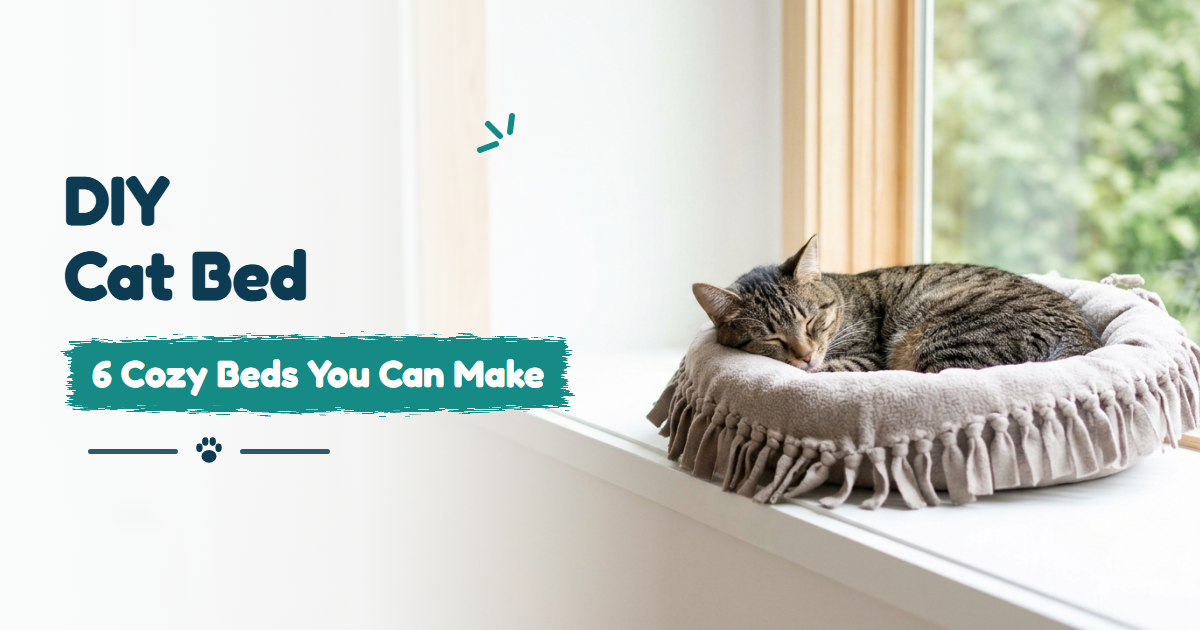
The trick is to build a bed that matches what cats actually want: warmth, a snug fit, and a sense of safety. And homemade beds are a great way to use old sweaters, T-shirts, and fleece blankets. This guide walks you through six easy beds, from a 10-minute T-shirt tent to a DIY cat hammock.
Table of Contents
- What Makes a Bed Cats Actually Use?
- Bed 1: No-Sew Fleece Cat Bed
- Bed 2: T-Shirt Cat Tent
- Bed 3: Upcycled Sweater Bed
- Bed 4: Drawer or Crate Bed
- Bed 5: Cardboard Box Bed
- Bed 6: DIY Cat Hammock
- Where to Put Your DIY Cat Bed
- Beds for Senior Cats
- Safety and Cleaning Tips
- Frequently Asked Questions
What Makes a Bed Cats Actually Use?
| Cats love | Cats usually avoid |
| Warm, soft fabric like fleece and wool | Cold, slick fabrics |
| Raised sides or a cozy enclosed space | Flat beds out in the open |
| A snug fit (they like to feel held) | Huge, roomy beds |
| Quiet, high, or sunny spots | Busy hallways, near loud appliances |
| Familiar smells (yours and theirs) | Strong detergent or perfume smells |
Cats run warmer than we do and love heat. That’s why they sprawl in sunbeams and on laptops. A bed with sides holds in their body heat.
Many cats also knead soft bedding before settling down, a habit left over from kittenhood. Our guide on why cats make biscuits explains this cute behavior.
Bed 1: No-Sew Fleece Cat Bed
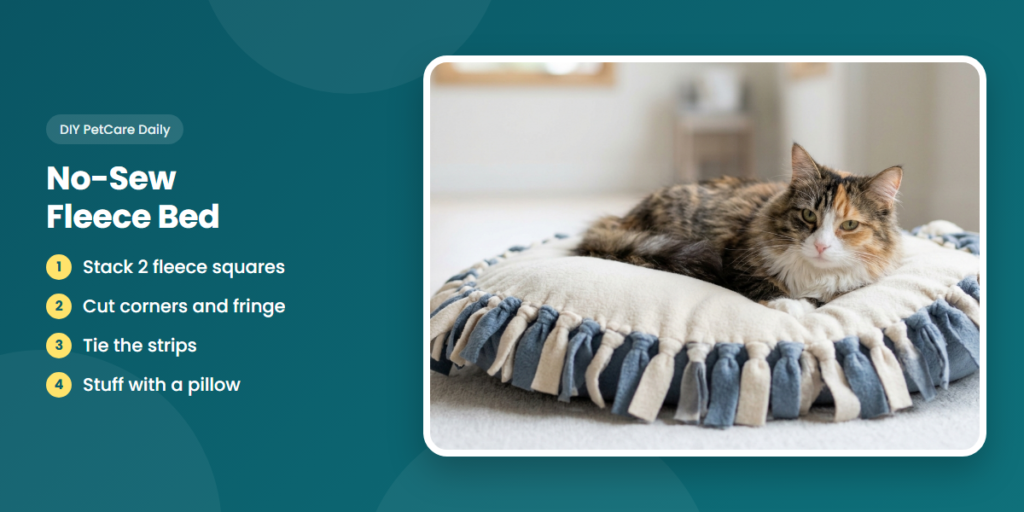
This is the easiest soft bed you can make, and it needs no sewing at all.
You need:
- 2 pieces of fleece, each about 30 x 30 inches (contrasting colors look great)
- A small pillow or fiberfill
- Scissors and a ruler
How to make it:
- Lay the two fleece pieces on top of each other, edges lined up.
- Cut a 4 x 4-inch square out of each corner, through both layers.
- Cut strips along all four sides, about 1 inch wide and 4 inches deep, through both layers. These make the fringe.
- Tie each top strip to the matching bottom strip in a double knot. Work around three sides.
- Stuff the pillow or fiberfill inside.
- Tie the last side closed.
For a bed with sides, roll the edges inward and tie the corners together to form a bowl.
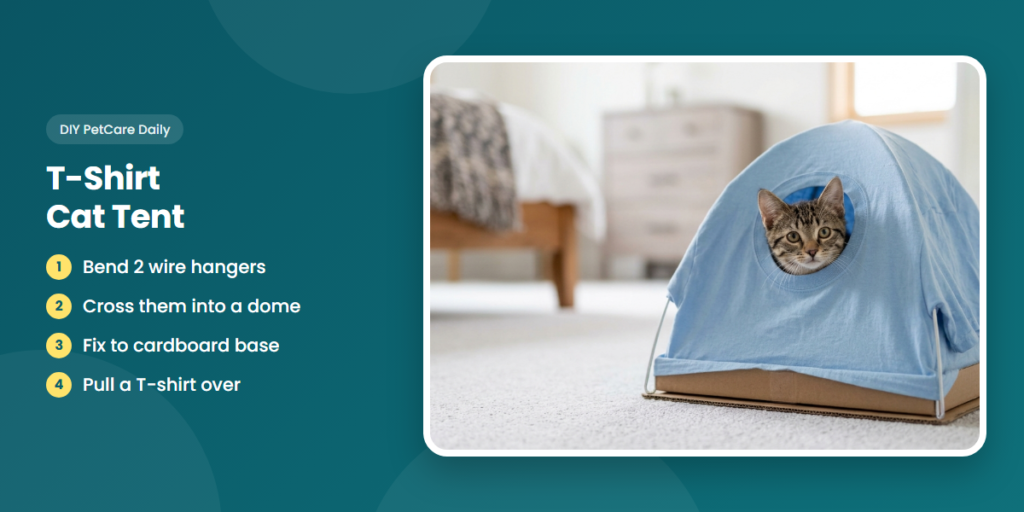
Bed 2: T-Shirt Cat Tent
A classic for a reason. It takes about 10 minutes and cats love the cozy, covered space.
You need:
- An old T-shirt (a medium or large works for most cats)
- 2 wire coat hangers
- A 15 x 15-inch piece of sturdy cardboard
- Pliers and tape
- Safety pins
How to make it:
- Use pliers to cut the hooks off the hangers. Straighten each hanger, then bend it into a U shape.
- Cross the two U shapes over each other to make a dome. Tape them together where they cross.
- Poke the four ends through the corners of the cardboard. Bend them flat underneath and tape them down. Cover any sharp wire ends with plenty of tape.
- Slide the T-shirt over the frame so the neck hole sits at the front. That’s the door.
- Pull the extra fabric under the base and pin it. Tuck the sleeves inside or pin them underneath.
- Add a small cushion or folded fleece inside.
Use a shirt you’ve worn (and not washed) for extra comfort. Your smell helps your cat feel safe.
Bed 3: Upcycled Sweater Bed
Got a soft, old sweater nobody wears anymore? Turn it into a donut bed.
You need:
- An old sweater (wool or a soft knit)
- Fiberfill or old pillow stuffing
- A small round pillow or cushion
- Needle and thread, or fabric glue
How to make it:
- Sew or glue the neck opening shut.
- Stuff the sleeves tightly with fiberfill.
- Sew a line across the chest of the sweater, from armpit to armpit, so the bottom part becomes a pocket.
- Stuff the body pocket below the line lightly, or slip in a flat cushion.
- Bring the stuffed sleeves around the front and stitch the cuffs together, forming a round bolster.
- Tuck a cushion into the center.
Bed 4: Drawer or Crate Bed
Old furniture makes charming cat beds.
- Take an old wooden drawer or a small wooden crate.
- Sand all edges and corners smooth. Remove handles or nails that stick out.
- Paint it with pet-safe paint if you like, and let it cure for several days.
- Screw on four short furniture legs to raise it off the cold floor (optional).
- Fit a cushion or folded blanket inside.
A drawer bed slides nicely under a side table or on a low shelf.
Bed 5: Cardboard Box Bed
Sometimes simple wins. Cut one side of a sturdy box down to about 4 inches to make a low entrance. Line it with a fleece blanket. For extra warmth, put a layer of a foil emergency blanket under the fleece (never on top, where your cat can chew it). It reflects body heat back up, like a self-warming bed.
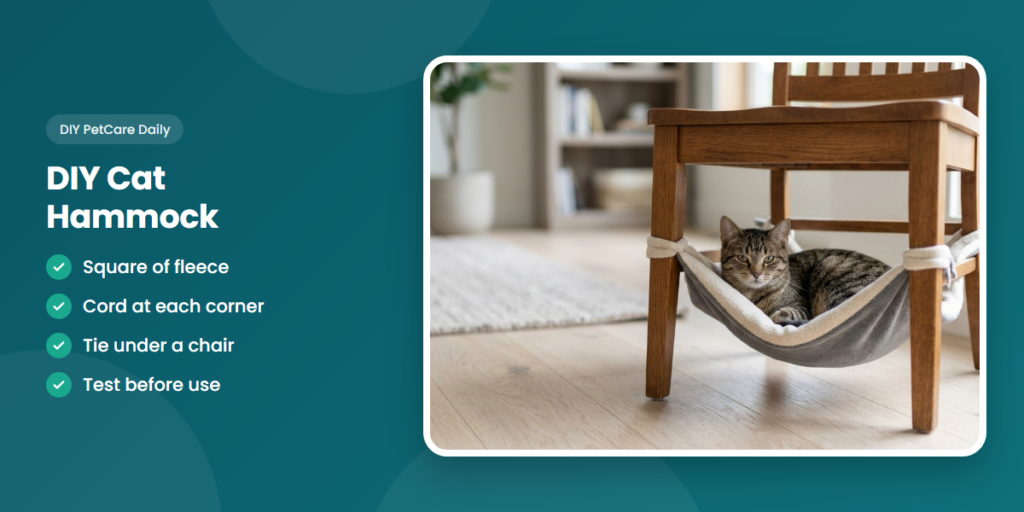
Bed 6: DIY Cat Hammock
Hammocks are perfect for cats who love to be up off the floor. This one hangs under a chair or side table.
You need:
- A piece of thick fleece or canvas, about 18 x 18 inches
- 4 strong cords or fabric strips, about 12 inches long
- A sturdy chair or small side table with four legs
How to make it:
- Cut a small slit near each corner of the fabric, about 1 inch in from the edges.
- Thread a cord through each slit and tie it in a tight knot.
- Turn the chair upside down, or work under the table.
- Tie each cord tightly around a leg, a few inches up, so the fabric hangs in a gentle sag.
- Push down on the middle to test that it holds. It should take more than your cat’s weight without slipping.
For a wall-mounted version, hang the hammock under a sturdy shelf. Our guide to DIY cat shelves shows how to mount shelves safely into studs.
Where to Put Your DIY Cat Bed
The spot matters as much as the bed. Try:
- In a sunny window for afternoon naps
- Up high, on a shelf, dresser, or cat tree
- Near you, like the end of your bed or by your desk
- In a quiet corner away from foot traffic and loud appliances
- Near a heat source but not on it, like a safe distance from a radiator
Give your cat two or three bed options in different rooms. Many cats rotate sleeping spots during the day.
Beds for Senior Cats
Older cats with stiff joints need a little extra comfort.
- Use thick foam or memory foam for joint support.
- Keep the entry low, about 2 to 3 inches.
- Put beds on the floor or a low step, not up high.
- Add a self-warming layer for achy joints.
If your senior cat seems stiff, sleeps more than usual, or stops jumping, it may be a sign of pain. Our guide on signs of pain in cats explains what to watch for, and our senior cat care guide has more comfort tips.
Safety and Cleaning Tips
- No loose parts. Skip buttons, beads, pom-poms, and bells that can be chewed off.
- Trim threads. Loose threads that are long can wind around toes or get swallowed.
- Cover wire ends on the T-shirt tent completely.
- Wash every 1 to 2 weeks with unscented detergent. Strong fragrances can put cats off a bed.
- Avoid essential oils and scented sprays on cat bedding. Many are toxic to cats.
- Check for fleas if your cat goes outside. Washing bedding in hot water helps.
For more fun projects, browse our DIY Cat Projects section.
Frequently Asked Questions
How do you make a cat bed without sewing?
Tie two pieces of fleece together around a pillow by cutting fringe along the edges and knotting each pair of strips. A T-shirt stretched over two crossed wire hangers on a cardboard base also makes a no-sew cat tent.
What fabric is best for a cat bed?
Fleece, faux fur, flannel, and soft wool are warm and cozy. Choose fabric that washes easily, and avoid loose weaves that catch claws.
Why won’t my cat sleep in their new bed?
The bed may be in the wrong spot, smell too new, or feel too open. Move it somewhere warm, quiet, or high, add a blanket that smells like you or your cat, and sprinkle a little catnip on it.
How do you make a DIY cat hammock?
Tie a square of thick fleece or canvas by its four corners to the legs of a sturdy chair or side table, leaving a gentle sag in the middle. Test it by pressing down firmly before your cat uses it.
How often should I wash my cat’s bed?
Every 1 to 2 weeks is a good routine, or right away if it gets dirty. Use unscented detergent, since cats may avoid beds with strong smells.