Table of Contents
- Table of Contents
- What Makes a Good Cat Treat?
- Safe and Unsafe Ingredients
- Recipe 1: Baked Tuna Bites
- Recipe 2: Chicken Crisps (One Ingredient)
- Recipe 3: Salmon Nibbles
- Recipe 4: Chicken and Egg Soft Bites
- Recipe 5: Frozen Chicken Broth Cubes
- How Many Treats Can a Cat Have?
- Tips for Picky Cats
- How to Store Homemade Cat Treats
- Treats vs Meals
- Frequently Asked Questions
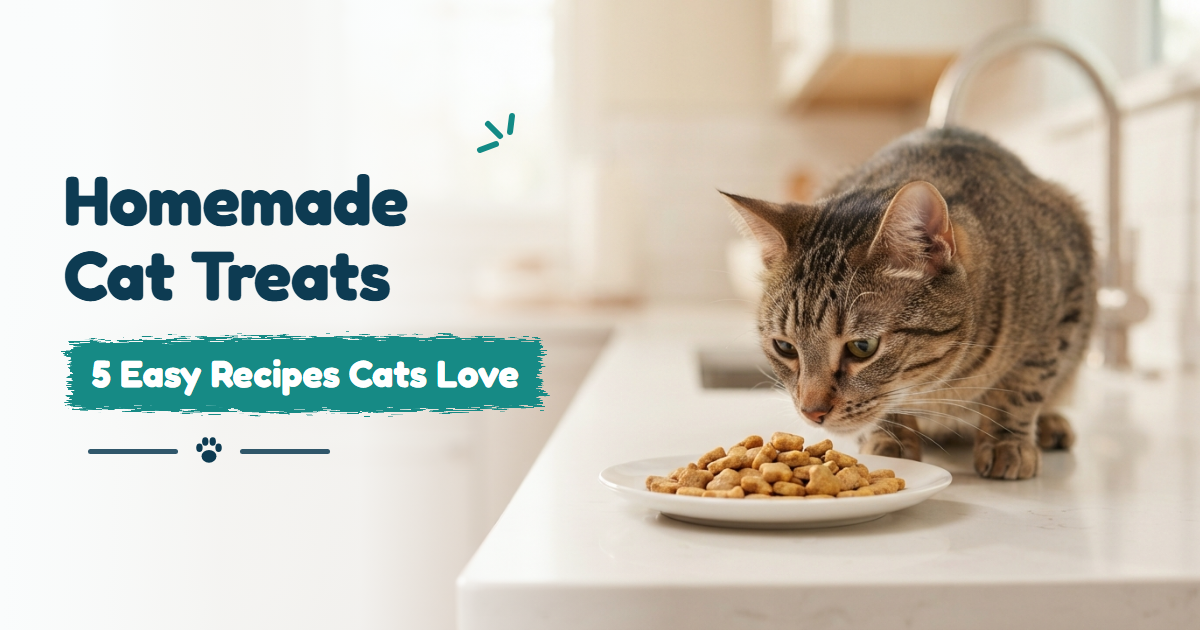
Quick answer: Homemade cat treats work best when they’re mostly meat or fish, since cats are strict carnivores. Easy recipes include baked tuna bites, dried chicken crisps, salmon nibbles, and frozen broth cubes. Use plain ingredients with no onion, garlic, or salt, cut treats to about the size of a pea, and keep them to 10% of your cat’s daily calories.
Cats can be harder to bake for than dogs. Many dog treat recipes are full of flour, peanut butter, and fruit, none of which cats need or usually care about. Cats want meat. The good news is that makes cat treat recipes simple. A can of tuna, a chicken breast, or a piece of salmon is most of what you need.
This guide covers five easy homemade cat treats, which ingredients are safe, how many treats your cat can have, and how to store them so they stay fresh.
Table of Contents
- What Makes a Good Cat Treat?
- Safe and Unsafe Ingredients
- Recipe 1: Baked Tuna Bites
- Recipe 2: Chicken Crisps (One Ingredient)
- Recipe 3: Salmon Nibbles
- Recipe 4: Chicken and Egg Soft Bites
- Recipe 5: Frozen Chicken Broth Cubes
- How Many Treats Can a Cat Have?
- Tips for Picky Cats
- How to Store Homemade Cat Treats
- Treats vs Meals
- Frequently Asked Questions
What Makes a Good Cat Treat?
Cats are obligate carnivores. Their bodies run on animal protein and fat, and they don’t need much in the way of carbs. A good homemade cat treat:
- Is made mostly from meat, fish, or eggs
- Uses little or no flour (just enough to hold the shape, if any)
- Has no added salt, sugar, or seasoning
- Is small, since cats need far fewer calories than dogs
- Has a strong smell, because cats choose food by scent
Safe and Unsafe Ingredients
| Safe for cat treats | Never use |
| Plain cooked chicken or turkey | Onion, garlic, chives (including powders) |
| Canned tuna or salmon in water, no salt added | Chocolate and cocoa |
| Cooked eggs | Grapes and raisins |
| Plain cooked fish (boneless) | Xylitol |
| Low-sodium broth with no onion or garlic | Raw yeast dough |
| Small amounts of oat flour or rice flour (as a binder) | Alcohol and caffeine |
| A pinch of dried catnip | Raw fish (fed often) |
| Plain pumpkin (tiny amounts) | Cooked bones |
Many adult cats are lactose intolerant, so skip milk and go light on cheese. See our full list of foods toxic to cats before trying new ingredients.
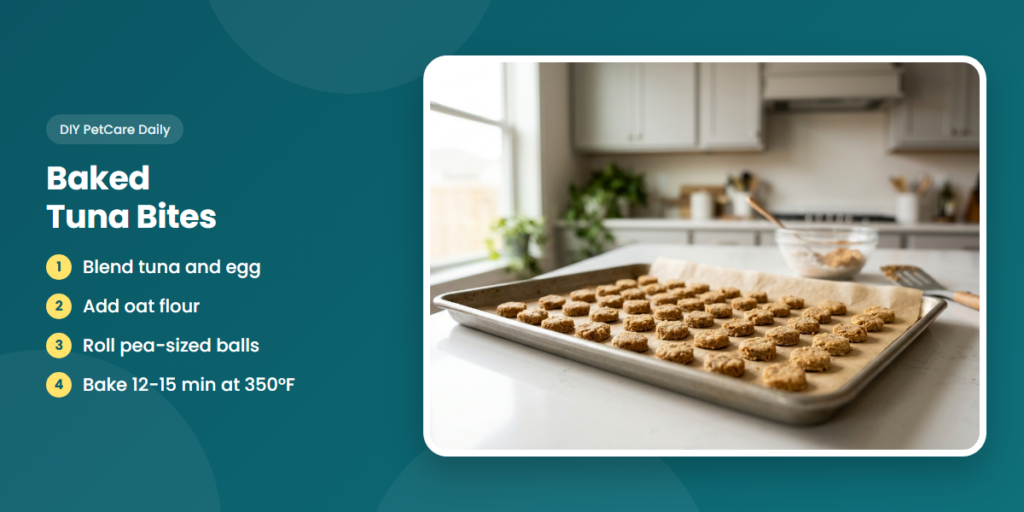
Recipe 1: Baked Tuna Bites
Crunchy, fishy, and a favorite with most cats.
Makes: about 60 tiny treats
Ingredients
- 1 can (5 oz) tuna in water, no salt added, drained
- 1 large egg
- 1/3 cup oat flour (blend rolled oats until fine)
Steps
- Heat your oven to 350°F and line a baking sheet with parchment paper.
- Blend the tuna and egg in a food processor until smooth.
- Add the oat flour and pulse until it forms a soft dough. Add a spoonful more flour if it’s too sticky.
- Roll the dough into balls the size of a pea and press them flat with a fork.
- Bake for 12 to 15 minutes, until firm and lightly golden.
- Turn off the oven and leave them inside for 30 minutes to crisp up.
Note: Tuna is fine as an occasional treat, but don’t let it become an everyday food. Too much tuna can upset a cat’s nutrient balance, and some cats get so hooked on it they refuse their regular meals.
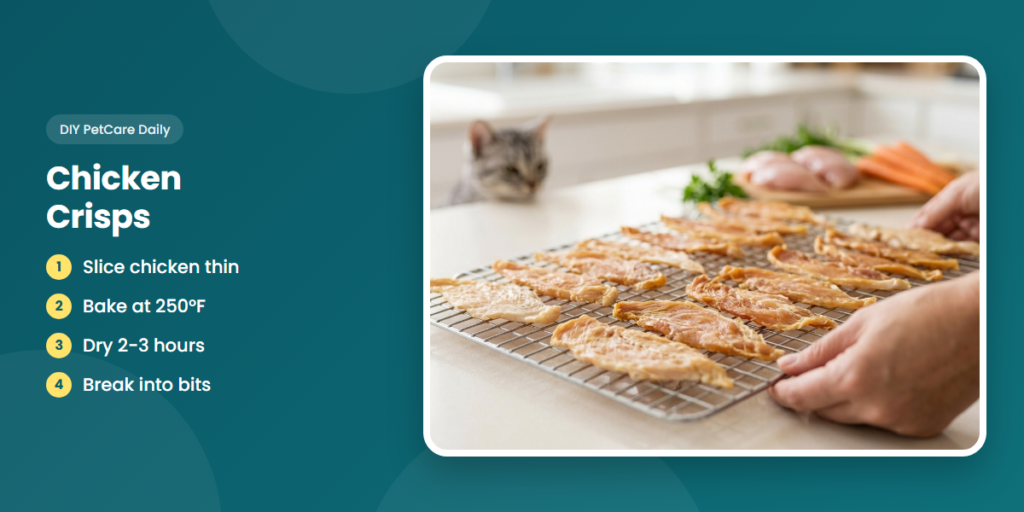
Recipe 2: Chicken Crisps (One Ingredient)
These dried chicken treats are like the freeze-dried treats sold in stores, at a fraction of the price.
Ingredients
- 1 boneless, skinless chicken breast
Steps
- Freeze the chicken for 30 to 60 minutes so it’s firm and easy to slice.
- Heat your oven to 250°F.
- Trim off all fat.
- Slice the chicken as thin as you can, about 1/8 inch.
- Lay the slices on a rack over a baking sheet.
- Bake for 2 to 3 hours, until completely dry and crisp. Make sure the meat reaches 165°F during cooking.
- Cool and break into tiny pieces.
Store these in the fridge. Even dried meat can spoil if any moisture remains.
Recipe 3: Salmon Nibbles
Ingredients
- 1 can (5 oz) salmon, boneless and skinless, no salt added, drained
- 1 large egg
- 2 tablespoons oat flour
Steps
- Heat your oven to 350°F.
- Mash the salmon with a fork until fine.
- Mix in the egg and oat flour.
- Spread the mix about 1/4 inch thick on a lined baking sheet.
- Bake for 15 to 20 minutes, until set.
- Cool, then cut into tiny squares.
Salmon has healthy omega-3 fats that support skin and coat. It’s still rich, so stick to small portions.
Recipe 4: Chicken and Egg Soft Bites
Great for older cats with sensitive teeth.
Ingredients
- 1/2 cup finely shredded plain cooked chicken
- 1 large egg
- 1 tablespoon oat flour
Steps
- Heat your oven to 325°F and grease a mini muffin tin.
- Mix everything together.
- Spoon a small amount into each cup, filling just the bottom.
- Bake for 10 to 12 minutes.
- Cool and cut each one into quarters.
These stay soft, so keep them in the fridge and use them within a few days.
Recipe 5: Frozen Chicken Broth Cubes
A no-bake, low-calorie treat that also adds water to your cat’s day.
Ingredients
- 1 cup low-sodium chicken broth with no onion or garlic (or homemade broth from plain chicken and water)
- A few tiny pieces of plain cooked chicken (optional)
Steps
- Drop a piece of chicken into each section of a mini ice cube tray.
- Pour broth over the top.
- Freeze until solid.
- Serve one cube in a bowl and let it melt a little.
Many cats don’t drink enough water. These cubes are a sneaky way to add a bit more. Our guide on how much water a cat should drink explains why hydration matters so much for cats.
How Many Treats Can a Cat Have?
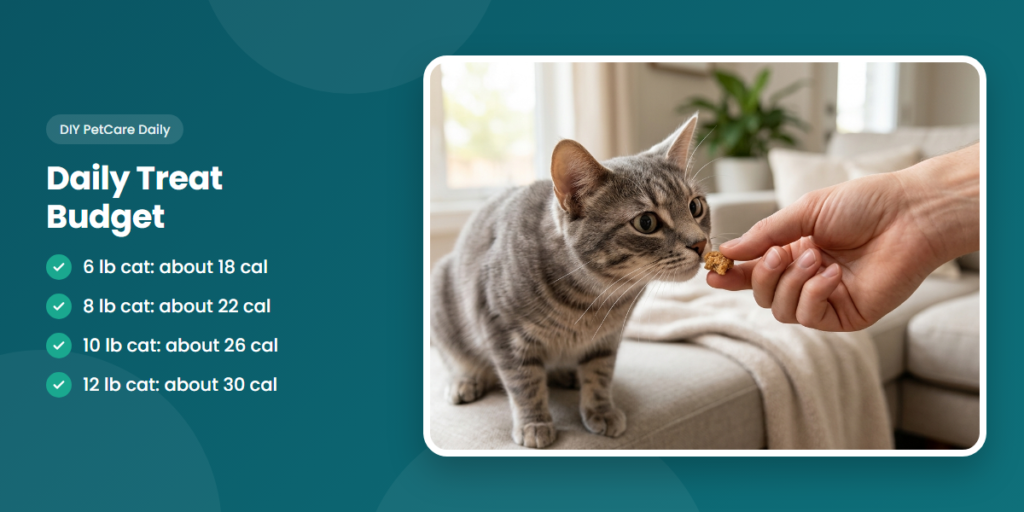
Cats need far fewer calories than most people think. An average 10-pound indoor cat needs roughly 220 to 260 calories a day. Following the 10% rule, that leaves only about 22 to 26 calories for treats.
| Cat weight | Rough daily calories | Treat budget (10%) |
| 6 lb | about 180 | about 18 |
| 8 lb | about 220 | about 22 |
| 10 lb | about 260 | about 26 |
| 12 lb | about 300 | about 30 |
In practice, that means just a few pea-sized pieces of homemade treats a day. Our guide on how many calories a cat needs helps you find your cat’s exact number. If your cat is carrying a little extra, check our guide on whether your cat is overweight.
Make Treats Last Longer
- Break every treat into tiny pieces. Cats care more about the smell and the moment than the size.
- Use treats in a puzzle so they take longer to eat. Our DIY cat puzzle feeder guide has easy ideas.
- Save treats for training, grooming, or tooth brushing. Our guide on how to brush cat teeth shows how treats help with that.
Tips for Picky Cats
Some cats sniff a new treat and walk away. That’s normal. Cats are cautious about new foods, and many decide by smell alone. A few tricks help:
- Warm it up. A few seconds in the microwave (then cooled to lukewarm) releases more scent.
- Start with a flavor they already like. If your cat loves their chicken wet food, try the chicken crisps first.
- Offer it at the right time. Cats are most interested in food just before a meal, not right after.
- Try a different texture. Some cats prefer crunchy treats; others only want soft ones.
- Be patient. Offer the new treat a few times over a week before giving up.
If your cat suddenly loses interest in all food, including treats they used to love, call your vet. Appetite loss in cats can be a sign of illness, and our guide to cat not eating explains why it shouldn’t wait.
How to Store Homemade Cat Treats
| Treat | Fridge | Freezer |
| Baked tuna or salmon bites | Up to 5 days | Up to 2 months |
| Chicken crisps | Up to 1 week | Up to 3 months |
| Soft chicken and egg bites | 3 days | Up to 1 month |
| Frozen broth cubes | Not applicable | Up to 1 month |
Keep treats in airtight containers. Throw out anything that smells sour, feels slimy, or shows mold. Because homemade treats have no preservatives, it’s better to make small batches often.
Treats vs Meals
Treats are just extras. They aren’t balanced enough to replace your cat’s regular food. If you’re interested in cooking your cat’s full meals, read our guide to homemade cat food recipes first. Complete homemade diets need careful planning and extra nutrients like taurine.
For more projects, explore our DIY Cat Projects section.
Frequently Asked Questions
What can I use to make homemade cat treats?
Plain cooked chicken, turkey, canned tuna or salmon in water, cooked eggs, and low-sodium broth without onion or garlic are all great. A little oat flour can help hold baked treats together. Avoid onion, garlic, chocolate, grapes, and xylitol.
Are homemade cat treats healthy?
They can be, since you control the ingredients and skip fillers and artificial additives. They’re still extras, though, and should stay under 10% of your cat’s daily calories.
Can cats eat tuna treats every day?
It’s better not to. Tuna is fine now and then, but eating it daily can upset your cat’s nutrient balance and expose them to more mercury. Some cats also become so fond of tuna they refuse their regular food.
How long do homemade cat treats last?
Most homemade cat treats last 3 to 7 days in the fridge and 1 to 3 months in the freezer. Dried chicken crisps keep the longest. Store treats in airtight containers.
How many treats should I give my cat a day?
Keep treats to about 10% of daily calories, which is only about 20 to 30 calories for most cats. That’s usually just a few pea-sized homemade treats.