Table of Contents
- Table of Contents
- Why the Right Amount Matters
- What Changes How Much Your Dog Needs
- Dog Feeding Chart by Weight
- What About Puppies?
- Feeding Senior Dogs
- How to Work Out Your Dog’s Calories (The Vet Formula)
- How Many Times a Day Should You Feed Your Dog?
- Is Your Dog at a Healthy Weight? Check Their Body Shape
- Don’t Forget Treats and Extras
- Feeding Wet Food or a Mix of Wet and Dry
- Tips for Getting Portions Right
- When to Talk to Your Vet
- Frequently Asked Questions
Quick answer: How much dog food should you feed your dog? A healthy, spayed or neutered adult dog needs roughly 3/4 to 1 cup of dry food a day at 10 pounds, about 2 cups at 30 pounds, and about 3 cups at 50 pounds (based on a food with about 400 calories per cup). Puppies need more food per pound, up to about twice as much when they are very young, and less active or senior dogs often need 10 to 20 percent less. Use the charts below as a starting point, then adjust based on your dog’s body shape.
“How much dog food should I feed my dog?” sounds like a simple question, but the answer on the back of the bag is only a rough guess. Two 50-pound dogs can need very different amounts depending on age, activity, whether they’re spayed or neutered, and even the food itself.
The good news is you don’t need to be a nutrition expert to get it right. This guide gives you an easy dog feeding chart by weight, a quick note on puppies, a simple way to work out calories, and clear signs that tell you when to feed more or less.
Table of Contents
- Why the Right Amount Matters
- What Changes How Much Your Dog Needs
- Dog Feeding Chart by Weight
- What About Puppies?
- Feeding Senior Dogs
- How to Work Out Your Dog’s Calories (The Vet Formula)
- How Many Times a Day Should You Feed Your Dog?
- Is Your Dog at a Healthy Weight? Check Their Body Shape
- Don’t Forget Treats and Extras
- Feeding Wet Food or a Mix of Wet and Dry
- Tips for Getting Portions Right
- When to Talk to Your Vet
- Frequently Asked Questions
Why the Right Amount Matters
About half of the dogs in the US are overweight or obese, according to vet surveys. Extra weight puts strain on joints, raises the risk of diabetes and breathing trouble, and can shorten a dog’s life by up to two years. Feeding too little is less common, but it can leave a dog low on energy and short on nutrients, especially puppies who are still growing.
Getting the portion right is one of the easiest ways to keep your dog healthy for years. It costs nothing extra and only takes a measuring cup and a few minutes each month.
What Changes How Much Your Dog Needs
Before you look at the charts, keep these factors in mind. They’re the reason two dogs of the same weight can eat very different amounts.
- Age. Puppies burn a lot of energy growing. Senior dogs usually slow down and need fewer calories.
- Activity level. A couch-loving Basset Hound needs far less than a Border Collie that runs every day.
- Spayed or neutered. Fixed dogs tend to need about 20 to 30 percent fewer calories than intact dogs.
- Breed and body type. Some breeds, like Labradors and Beagles, gain weight easily.
- The food itself. Dry dog foods range from about 300 to 550 calories per cup. A cup of one brand is not the same as a cup of another.
- Weather and lifestyle. Dogs that spend a lot of time outside in cold weather may need a little more.
Dog Feeding Chart by Weight
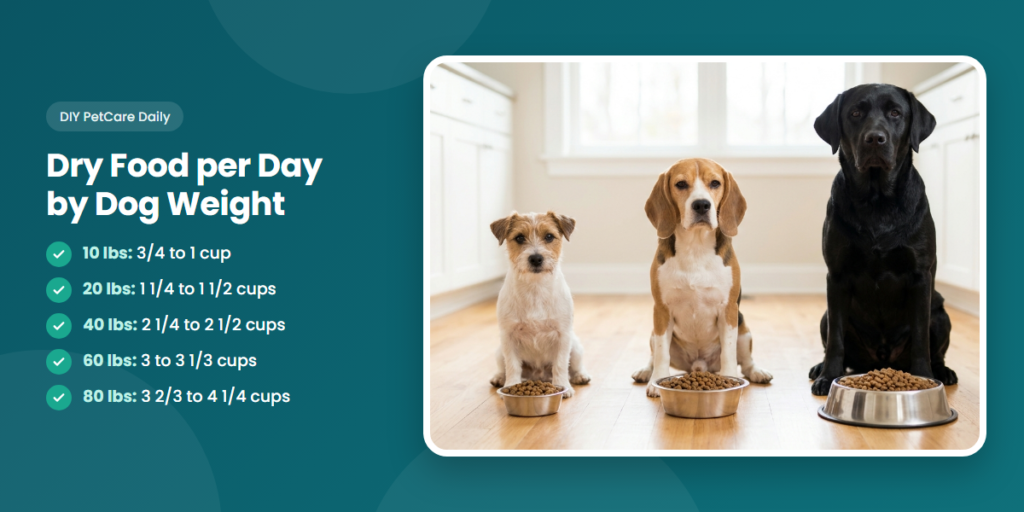
This chart is for healthy adult dogs (about 1 to 7 years old) who are spayed or neutered and get a daily walk or play session. The calorie numbers come from the standard vet formula explained further down. The cup amounts assume a dry food with about 400 calories per cup, so check your bag and adjust if yours is higher or lower.
| Dog’s Ideal Weight | Daily Calories (Approx.) | Dry Food per Day (400 kcal/cup) |
| 5 lbs | 180 to 210 | about 1/2 cup |
| 10 lbs | 300 to 350 | about 3/4 to 1 cup |
| 20 lbs | 510 to 590 | about 1 1/4 to 1 1/2 cups |
| 30 lbs | 690 to 790 | about 1 3/4 to 2 cups |
| 40 lbs | 860 to 980 | about 2 1/4 to 2 1/2 cups |
| 50 lbs | 1,020 to 1,170 | about 2 1/2 to 3 cups |
| 60 lbs | 1,170 to 1,330 | about 3 to 3 1/3 cups |
| 70 lbs | 1,310 to 1,500 | about 3 1/4 to 3 3/4 cups |
| 80 lbs | 1,450 to 1,660 | about 3 2/3 to 4 1/4 cups |
| 100 lbs | 1,710 to 1,960 | about 4 1/4 to 5 cups |
Use the lower number for calm or indoor dogs and the higher number for active dogs. Very active working or sporting dogs may need more than the top of the range.
Important: feed for your dog’s *ideal* weight, not their current weight. If your 60-pound dog should weigh 50 pounds, use the 50-pound row.
What About Puppies?
Puppies need more calories per pound than adult dogs, and they do best with 3 to 4 small meals a day until about 6 months, then 2 to 3 meals. Their portions also change every few weeks as they grow, so the adult chart above doesn’t fit them. For a full puppy feeding chart by age and weight, plus a sample feeding schedule, see our guide on how much to feed a puppy.
When to Switch From Puppy Food to Adult Food
- Small breeds (under 20 lbs adult weight): around 9 to 12 months
- Medium breeds (20 to 50 lbs): around 12 months
- Large breeds (50 to 100 lbs): around 12 to 18 months
- Giant breeds (over 100 lbs): up to 18 to 24 months
Large and giant breed puppies should eat a food labeled for large breed puppies. These foods control calcium and calories so bones grow at a steady pace. Growing too fast can lead to joint problems later. When it’s time to make the change, our guide on how to switch dog food walks you through a gentle 10-day plan.
Feeding Senior Dogs
Most dogs are seniors by about age 7, and large breeds can reach that stage around age 6. Older dogs usually move less and lose some muscle, so many need about 10 to 20 percent fewer calories than they did as younger adults.
That said, not every senior needs less food. Very old or thin seniors sometimes need *more* calories because they don’t digest food as well. Watch your dog’s body shape and weight, and talk to your vet if your senior starts losing weight without trying.
Signs your senior dog’s portion needs a check:
- Gaining weight around the belly or hips
- Losing weight or muscle over the back and back legs
- Leaving food in the bowl when they used to finish it
- Begging more than usual
How to Work Out Your Dog’s Calories (The Vet Formula)
If you want a number made for your dog, vets use a two-step formula. Don’t worry, it’s easier than it looks, and a phone calculator handles it fine.
Step 1: Find the Resting Energy Requirement (RER)
RER is the calories your dog burns just resting.
- Change your dog’s ideal weight to kilograms: pounds ÷ 2.2.
- Raise that number to the 0.75 power (on a phone calculator, use the x^y button).
- Multiply by 70.
For example, a 30-pound dog weighs about 13.6 kg. 13.6 to the 0.75 power is about 7.1. Multiply by 70 and you get an RER of about 497 calories.
Step 2: Multiply by Your Dog’s Life Stage
| Dog’s Situation | Multiply RER By |
| Spayed or neutered adult | 1.4 to 1.6 |
| Intact adult | 1.8 |
| Less active or senior | 1.2 to 1.4 |
| Needs to lose weight | 1.0 (vet-guided) |
| Very active or working | 2.0 to 5.0 |
| Puppy under 4 months | 3.0 |
| Puppy 4 months to adult | 2.0 |
So our 30-pound neutered adult needs about 497 × 1.6 = 795 calories a day.
Step 3: Turn Calories Into Cups
Look for “kcal/cup” on your dog food bag. It’s usually near the guaranteed analysis. Divide your dog’s daily calories by that number.
If the food has 380 kcal per cup: 795 ÷ 380 = about 2 cups per day. Split that into two meals of 1 cup each.
How Many Times a Day Should You Feed Your Dog?
Most adult dogs do well on two meals a day, about 8 to 12 hours apart. Two meals keep hunger steady, can lower the risk of bloat in deep-chested breeds, and make it easy to notice if your dog stops eating.
- Puppies: 3 to 4 meals a day until around 6 months, then 2 to 3
- Adults: 2 meals a day
- Toy breeds: 3 small meals can help prevent low blood sugar
- Large, deep-chested breeds (Great Danes, German Shepherds, Standard Poodles): 2 or more meals, and skip hard exercise right after eating
Free feeding, where food sits out all day, makes it very hard to control portions and is one of the most common causes of weight gain.
Is Your Dog at a Healthy Weight? Check Their Body Shape
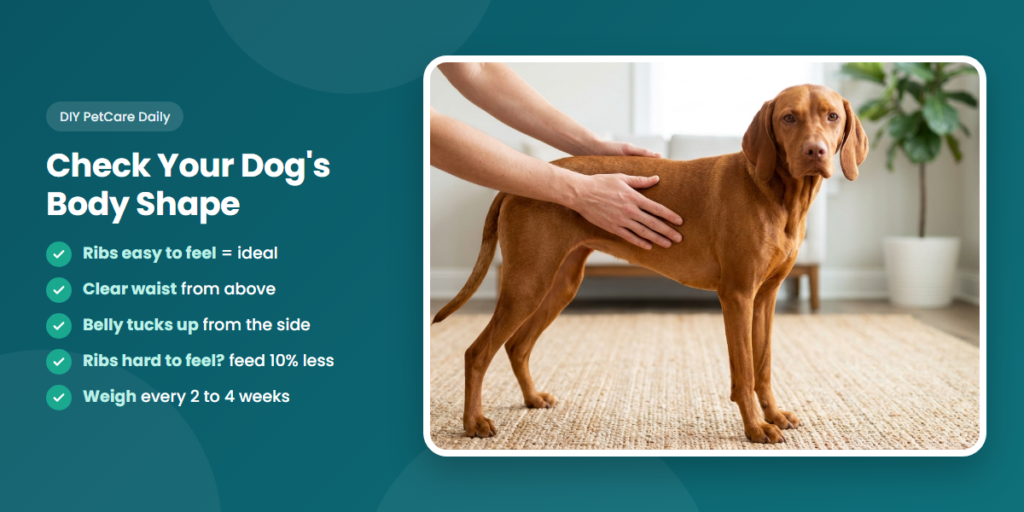
The best way to tell if you’re feeding the right amount is to look at and feel your dog. Vets use a 9-point body condition score, where 4 to 5 is ideal.
| What You See and Feel | What It Means | What to Do |
| Ribs, spine, and hip bones stick out; no fat felt | Too thin | Feed about 10% more and see your vet |
| Ribs easy to feel with a thin fat layer; clear waist from above; belly tucks up from the side | Ideal | Keep the same amount |
| Ribs hard to feel; waist barely visible; little or no belly tuck | Overweight | Feed about 10% less |
| Ribs can’t be felt; no waist; fat on the back and base of the tail | Obese | Talk to your vet about a weight-loss plan |
Here’s a quick home test: run your fingers along your dog’s side. It should feel like the back of your hand. If it feels like your palm, your dog may be carrying extra weight. If it feels like your knuckles, your dog may be too thin.
Weigh your dog every 2 to 4 weeks when you change portions. Most small dogs can be weighed on a kitchen or baby scale. For bigger dogs, weigh yourself holding your dog, then subtract your own weight.
Don’t Forget Treats and Extras
Treats count. A few biscuits, a chew, and some table scraps can add hundreds of calories a day without you noticing.
- Keep treats to no more than 10 percent of your dog’s daily calories.
- Count dental chews too. Some have 70 to 150 calories each. Our post on dog dental chews vs brushing explains which ones are worth it.
- Use low-calorie snacks like baby carrots, green beans, or apple slices. Our list of fruits dogs can eat shows which ones are safe and which to avoid.
- If you give a lot of treats during training, cut the meal portion a little that day.
Feeding Wet Food or a Mix of Wet and Dry
Wet dog food has much more water, so it has fewer calories per ounce. A 13-ounce can usually has about 350 to 500 calories, but this varies a lot by brand.
If you feed both, add up the calories from each:
- Find your dog’s daily calorie goal.
- Decide how much wet food you’ll give (for example, 1/4 can at 120 calories).
- Subtract that from the daily goal.
- Feed the rest as dry food.
Tips for Getting Portions Right
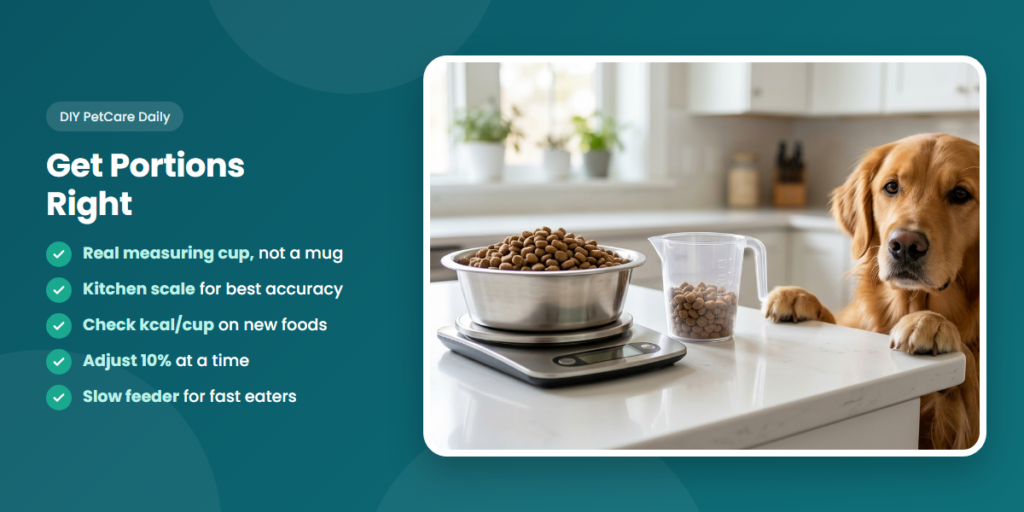
- Use a real measuring cup, not a coffee mug or scoop. Even better, weigh dry food on a kitchen scale in grams for the most accurate amount.
- Check the kcal/cup every time you change foods, since it can change the right portion a lot.
- Change portions slowly. Adjust by about 10 percent and recheck in 2 to 3 weeks.
- Get everyone on the same page. If three family members each feed “a little extra,” it adds up fast.
- Use a puzzle feeder or slow bowl for fast eaters. It slows them down and keeps them busy.
- Keep fresh water out at all times.
When to Talk to Your Vet
Call your vet if your dog:
- Loses or gains weight quickly without a change in diet
- Suddenly eats much more or much less than usual
- Drinks a lot more water than normal
- Has ongoing vomiting, diarrhea, or changes in their stool. Our guide to the dog poop color chart can help you tell what’s normal.
- Is pregnant, nursing, or has a health condition like kidney disease, diabetes, or allergies
Your vet can also help set a safe goal weight and calorie target for a dog who needs to slim down.
For more simple guides on feeding your dog, visit our Dog Food & Nutrition section.
Frequently Asked Questions
How much food should I feed my dog per day?
Most healthy adult dogs need about 300 to 350 calories a day at 10 pounds, 700 to 800 at 30 pounds, and 1,000 to 1,170 at 50 pounds. For a typical dry food, that’s roughly 3/4 to 1 cup for a 10-pound dog, 2 cups for a 30-pound dog, and 3 cups for a 50-pound dog. Check the calories per cup on your food and adjust to your dog’s body shape.
Is it better to feed my dog once or twice a day?
Twice a day is best for most adult dogs. It keeps their energy and hunger steady and lowers the risk of bloat in large, deep-chested breeds. Puppies need 3 to 4 meals a day.
How do I know if I’m feeding my dog too much?
If you can’t easily feel your dog’s ribs, there’s no visible waist from above, or your dog is gaining weight, you’re likely feeding too much. Cut the daily amount by about 10 percent and check again in 2 to 3 weeks.
Should I follow the feeding guide on the dog food bag?
Use it as a starting point only. Bag guides are often set for active, intact dogs, so many pet dogs gain weight on those amounts. Watch your dog’s body condition and adjust from there.
Can I use this chart for my puppy?
No. This chart is for adult dogs. Puppies need more calories per pound and more meals a day, and their portions change as they grow. Use a puppy feeding chart based on your puppy’s current weight and age instead.

One Response