Table of Contents
- Table of Contents
- Why Cat Vaccines Matter
- Core Vaccines for Cats
- Non-Core Vaccines for Cats
- Kitten Vaccination Schedule
- Adult Cat Vaccination Schedule
- How Often Do Cats Need Shots?
- Do Indoor Cats Need Vaccines?
- Cat Vaccine Side Effects
- How Much Do Cat Vaccines Cost in the USA?
- Tips for a Calm Vaccine Visit
- Frequently Asked Questions
Quick answer: Cat vaccines protect against serious and often deadly diseases. In the US, the core vaccines for cats are FVRCP (which covers feline distemper, herpesvirus, and calicivirus) and rabies, plus the feline leukemia (FeLV) vaccine for all kittens. Kittens start FVRCP at 6 to 8 weeks and get a dose every 3 to 4 weeks until 16 to 20 weeks old, with rabies at 12 to 16 weeks. Adults get boosters every 1 to 3 years, depending on the vaccine and your state’s laws.
Vaccines are one of the simplest ways to keep your cat healthy for life. A few shots in kittenhood and regular boosters later protect against viruses that can spread through the air, on your shoes, or from a single bite.
But vaccine names can be confusing. What’s FVRCP? Does an indoor cat really need shots? How often do cats need boosters? This guide explains cat vaccines in plain language, gives you a clear cat vaccination schedule from kitten to senior, and helps you know what to ask at your next vet visit.
Table of Contents
- Why Cat Vaccines Matter
- Core Vaccines for Cats
- Non-Core Vaccines for Cats
- Kitten Vaccination Schedule
- Adult Cat Vaccination Schedule
- How Often Do Cats Need Shots?
- Do Indoor Cats Need Vaccines?
- Cat Vaccine Side Effects
- How Much Do Cat Vaccines Cost in the USA?
- Tips for a Calm Vaccine Visit
- Frequently Asked Questions
Why Cat Vaccines Matter
Several cat diseases have no cure. Vets can only treat the symptoms and hope the cat survives. Feline distemper (panleukopenia), for example, spreads easily, survives in the environment for a year or more, and kills many unvaccinated kittens who catch it. Rabies is almost always fatal and can spread to people.
Vaccines teach your cat’s immune system to recognize these germs before they ever meet them. That way, if your cat is exposed, their body can fight back fast.
US vet groups, including the American Association of Feline Practitioners (AAFP) and the American Animal Hospital Association (AAHA), publish feline vaccination guidelines that most vets follow. This guide is based on those general recommendations. Your vet will adjust them for your cat.
Core Vaccines for Cats
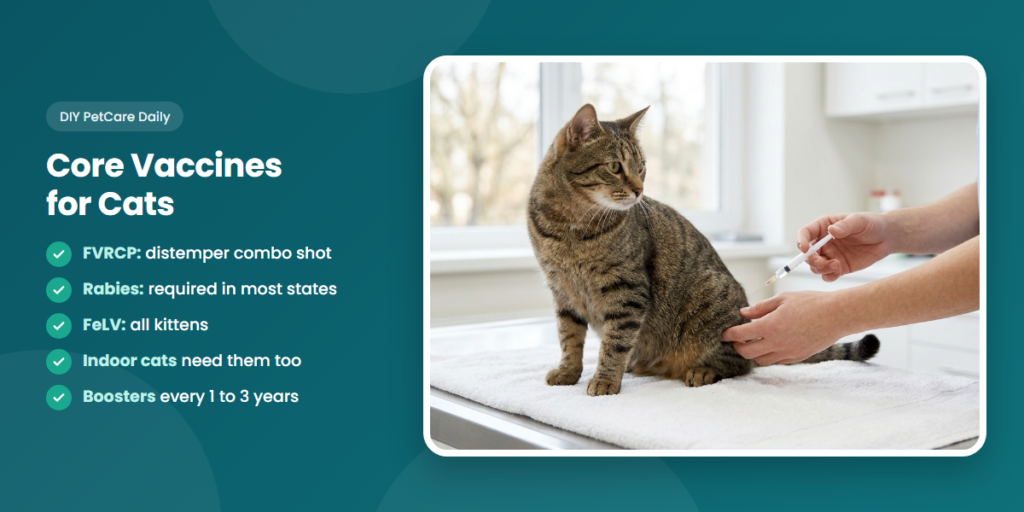
Core vaccines for cats are the ones every cat should get, no matter where they live or how they spend their days.
FVRCP (the Distemper Combo Shot)
The FVRCP vaccine is a combination shot that protects against three viruses:
- FVR (feline viral rhinotracheitis): caused by feline herpesvirus. It causes sneezing, eye infections, and fever, and many cats carry it for life.
- C (calicivirus): causes mouth ulcers, fever, and upper respiratory signs. Some strains can be severe.
- P (panleukopenia): also called feline distemper. It causes severe vomiting, diarrhea, and a crash in white blood cells. It’s often fatal in kittens.
FVRCP is the most important vaccine for every cat, including indoor-only cats, because these viruses can come in on clothes, shoes, and hands. For the full schedule, vaccine types, and side effects, see our complete guide to the FVRCP vaccine.
Rabies Vaccine for Cats
Rabies is fatal to cats and people. In the US, cats are now reported with rabies more often than dogs, mostly because fewer cats are vaccinated. Most states and many cities require rabies vaccination for cats by law.
The rabies vaccine for cats is given once at 12 to 16 weeks old, then boosted one year later. After that, boosters are every 1 or 3 years, depending on the vaccine type and your local law. Keep your rabies certificate. You may need it for boarding, travel, or if your cat ever bites someone.
FeLV Vaccine for Kittens
Feline leukemia virus (FeLV) weakens the immune system and can cause cancer and anemia. It spreads through close contact like grooming, sharing bowls, and bites, and kittens are much more likely to become infected than adults.
That’s why current guidelines treat the feline leukemia vaccine as core for all kittens and cats under 1 year old. After the first year, it’s recommended for cats who go outside, live with an FeLV-positive cat, or meet other cats often.
Your cat should be tested for FeLV (and FIV) before getting the vaccine, especially if you adopted them as a stray or don’t know their history. Our guide to the feline leukemia vaccine explains who needs boosters and how often.
Non-Core Vaccines for Cats
Non-core vaccines are given based on lifestyle and risk. Your vet will ask questions about where your cat goes and who they meet.
| Vaccine | Protects Against | Who May Need It |
| FeLV (adult boosters) | Feline leukemia virus | Outdoor cats, cats living with FeLV-positive cats, cats in multi-cat or foster homes |
| Chlamydia felis | Eye infections (conjunctivitis) | Cats in shelters or large multi-cat homes with known outbreaks |
| Bordetella | Respiratory infection | Cats who board often, go to shows, or live in crowded homes |
Some vaccines aren’t usually recommended. The FIP vaccine is generally not advised by feline vets, and the FIV vaccine is no longer sold in the US.
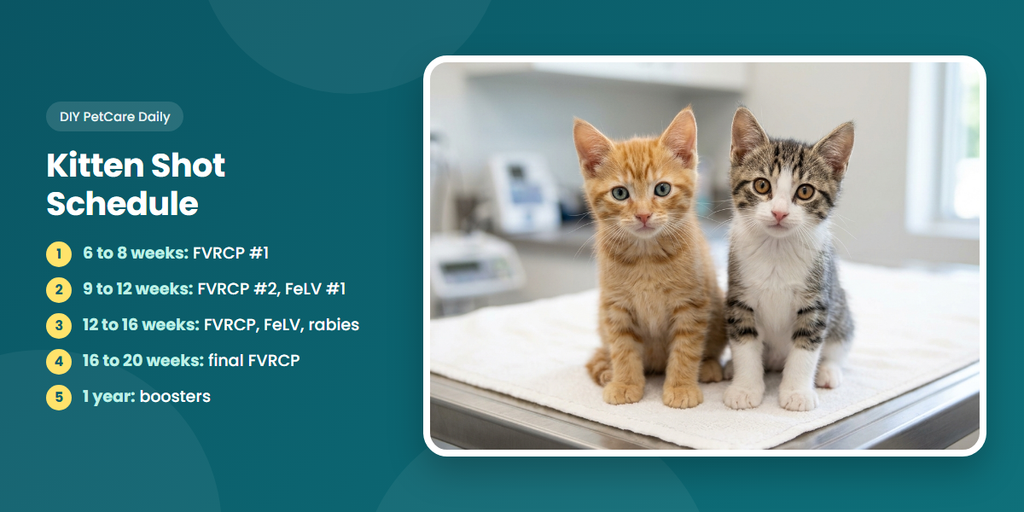
Kitten Vaccination Schedule
Kittens get antibodies from their mother’s milk. These fade over the first few months, but while they’re around, they can block vaccines from working. That’s why kittens need a series of shots instead of just one.
| Kitten’s Age | Vaccines Usually Given |
| 6 to 8 weeks | FVRCP #1 |
| 9 to 12 weeks | FVRCP #2, FeLV #1 (after a negative FeLV/FIV test) |
| 12 to 16 weeks | FVRCP #3, FeLV #2, rabies |
| 16 to 20 weeks | Final FVRCP (if the series started early) |
| 6 months after the last kitten shot | FVRCP booster |
| 1 year after the first doses | Rabies booster, FeLV booster |
Exact timing varies by clinic and by vaccine brand, but the rules are simple:
- FVRCP is given every 3 to 4 weeks until your kitten is at least 16 to 20 weeks old.
- FeLV needs two doses, 3 to 4 weeks apart, starting at 8 weeks or older.
- Rabies is given once at 12 to 16 weeks, based on the vaccine label and state law.
These kitten shots are often given at the same visits as deworming, flea prevention, and a check of your kitten’s growth. Feeding a growing kitten the right amount matters too; see our guide on how much should I feed my cat, which has a kitten feeding section.
Adult Cat Vaccination Schedule
Once your cat finishes their kitten series and first-year boosters, the schedule becomes much lighter.
| Vaccine | How Often for Adult Cats |
| FVRCP | Every 3 years (some low-risk cats less often, with vet guidance) |
| Rabies | Every 1 or 3 years, depending on the vaccine and state law |
| FeLV | Every 1 to 2 years, only for cats at risk |
| Non-core vaccines | Based on lifestyle, often yearly |
Even in years with no shots due, your cat still needs a yearly checkup. Many illnesses, like kidney disease and dental disease, are caught early at these visits. For signs to watch between visits, see our guide on how to tell if your cat is sick.
Adult Cats With Unknown Vaccine History
If you adopted an adult cat and don’t know their history, your vet will usually:
- Test for FeLV and FIV.
- Give two doses of FVRCP, 3 to 4 weeks apart.
- Give one dose of rabies vaccine, then a booster in a year.
- Give two doses of FeLV, 3 to 4 weeks apart, if your cat is at risk.
Senior Cats
Older cats still need core protection. Your vet may space out some boosters, check antibody levels with a blood test (called a titer test), or skip non-core vaccines for indoor seniors. Rabies is still required by law in most areas, regardless of age, unless your vet writes a medical exemption where your state allows it.
How Often Do Cats Need Shots?
Here’s the simple version:
- Kittens: every 3 to 4 weeks from 6 to 8 weeks old until about 16 to 20 weeks.
- Young adults: one round of boosters 6 to 12 months after the kitten series.
- Adults: most core shots every 1 to 3 years.
- Outdoor or high-risk cats: may need FeLV and other vaccines more often.
Your vet will send reminders, but it’s smart to keep your own record. Snap a photo of each vaccine certificate and store it on your phone.
Do Indoor Cats Need Vaccines?
Yes. Indoor cats need core vaccines too. Here’s why:
- Viruses travel indoors. Feline distemper and herpesvirus can come in on your shoes, clothes, and hands.
- Cats escape. Even the most indoor cat can slip out a door or window.
- Bats get into homes. In the US, bats are a common source of rabies, and indoor cats have been exposed this way.
- Life changes. Boarding, a move, a new cat, or a vet hospital stay can all bring new risks.
- The law. Most states require rabies vaccination for cats, indoor or not.
Indoor-only adult cats may be able to skip some non-core vaccines and FeLV boosters after their first year. Ask your vet what fits your cat’s lifestyle.
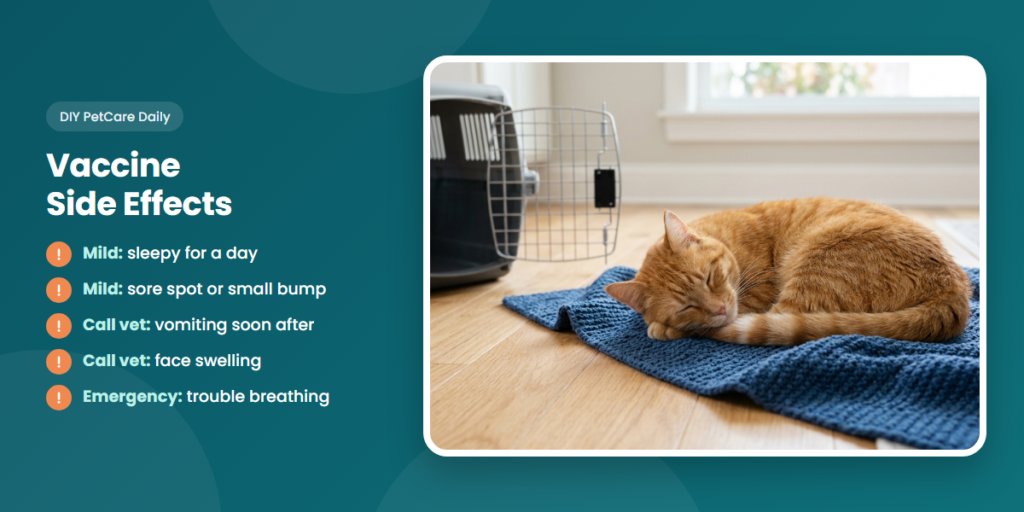
Cat Vaccine Side Effects
Most cats have no problems after vaccines, or only mild ones that pass in a day or two.
Common, mild side effects:
- Sleeping more or seeming a little quiet
- A slight fever
- Eating a bit less for a day
- Soreness or a small, firm bump where the shot was given
Rare, serious reactions (call your vet or go to an emergency clinic right away):
- Vomiting or diarrhea soon after the shot
- Swelling of the face, lips, or around the eyes
- Hives or itchy, bumpy skin
- Trouble breathing
- Collapse
Most serious reactions happen within minutes to a few hours, so watch your cat closely after you get home.
Injection Site Lumps
A small bump at the injection site is normal and usually goes away within a few weeks. Rarely, cats can develop a type of tumor at an injection site. To make any lump easier to treat, US vets often give vaccines low on the legs or tail. A common rule is “right for rabies, left for leukemia,” meaning the rabies vaccine goes in the right back leg and the FeLV vaccine in the left back leg.
Call your vet if a lump:
- Is still there 3 months after the shot
- Is bigger than about 3/4 inch across
- Keeps growing 1 month after the shot
How Much Do Cat Vaccines Cost in the USA?
Prices vary by state and clinic, but here are typical ranges:
| Service | Typical Cost |
| Vet exam | $50 to $90 |
| FVRCP vaccine | $20 to $50 |
| Rabies vaccine | $15 to $45 |
| FeLV vaccine | $25 to $50 |
| FeLV/FIV test | $40 to $75 |
| Full kitten series (all visits) | About $150 to $400 |
Many animal shelters, humane societies, and pet stores host low-cost vaccine clinics. Some cities also hold free or low-cost rabies clinics each year. Kittens adopted from shelters often come with their first shots already done.
Tips for a Calm Vaccine Visit
- Get your cat used to the carrier. Leave it out at home with a soft blanket and treats inside.
- Use a carrier with a top opening so the vet can examine your cat without pulling them out.
- Cover the carrier with a towel in the car and the waiting room.
- Bring treats your cat loves to reward calm behavior.
- Ask about cat-friendly options. Many clinics have cat-only waiting areas, and some vets can prescribe a calming medicine for very nervous cats.
- Keep the day after quiet. Let your cat rest and offer their favorite food.
For more guides on keeping your cat healthy, visit our Cat Health & Wellness section.
Frequently Asked Questions
What vaccines do cats need?
All cats need the core vaccines: FVRCP (feline distemper, herpesvirus, and calicivirus) and rabies. All kittens should also get the feline leukemia (FeLV) vaccine. Adult cats may need FeLV boosters and other non-core vaccines, depending on their lifestyle.
What is the FVRCP vaccine for cats?
The FVRCP vaccine is a combination shot that protects cats from feline viral rhinotracheitis (herpesvirus), calicivirus, and panleukopenia (feline distemper). It’s the most important core vaccine for every cat, including indoor cats.
How often do cats need shots?
Kittens need shots every 3 to 4 weeks until they’re about 16 to 20 weeks old. Adult cats usually need FVRCP every 3 years and rabies every 1 or 3 years, depending on the vaccine and state law. At-risk cats may need FeLV every 1 to 2 years.
Do indoor cats need vaccines?
Yes. Indoor cats need core vaccines because viruses can come inside on shoes and clothes, cats can escape, and bats can carry rabies into homes. Most states also require rabies vaccination for all cats.
Is it too late to vaccinate my adult cat?
No. Adult cats with no vaccine history can still be protected. Your vet will usually give two FVRCP shots 3 to 4 weeks apart, a rabies shot, and FeLV shots if your cat is at risk, after testing for FeLV and FIV first.