Table of Contents
Quick answer: Cat body language is how cats show their mood through their tail, ears, eyes, whiskers, and posture. An upright tail and forward ears usually mean a friendly cat. Flattened ears, a puffed tail, or a crouched body mean fear. A slow blink is a relaxed, trusting signal you can send back to your cat.
Cats don’t wag, bark, or jump up to greet you like dogs do. Their signals are quieter: a twitch of the tail tip, ears that swivel sideways, a long, slow blink from across the room. Once you know what to look for, your cat suddenly has a lot more to say.
Reading these signals helps you know when your cat wants affection, when they’ve had enough petting, and when they’re scared or in pain. This guide breaks it down part by part, then shows you how to put the clues together.
Table of Contents
- Why Reading Your Cat Matters
- Cat Body Language Chart
- Cat Tail Language
- Cat Ear Positions
- Eyes and the Cat Slow Blink
- Whiskers
- Posture and Body Position
- Putting It Together: Real Examples
- When Body Language Changes
- Frequently Asked Questions
Why Reading Your Cat Matters
Most bites and scratches happen because people miss early warning signs. A cat rarely goes from relaxed to swatting in a single second. Usually there’s a tail flick, a skin ripple, or ears turning sideways first.
Learning cat body language also helps you spot illness early. Cats are experts at hiding pain, so small changes in posture or facial expression may be the first clue that something’s wrong.
One rule matters more than any other: always read the whole cat. A single signal can mean different things. A twitching tail on a cat watching a bird is very different from a twitching tail on a cat you’re petting.
Cat Body Language Chart
Use this chart as a quick guide. You’ll find more detail on each body part below.
| Body Part | Relaxed or Friendly | Alert or Curious | Annoyed or Overstimulated | Scared or Defensive |
| Tail | Held high, tip may curve | Still, raised, or straight out | Thumping, lashing, tip twitching | Tucked low or puffed up |
| Ears | Facing forward, relaxed | Upright, swiveling toward sounds | Turned sideways (“airplane ears”) | Flat against the head |
| Eyes | Soft, half-closed, slow blinks | Wide open, focused | Narrowed, hard stare | Pupils very wide |
| Whiskers | Relaxed, pointing sideways | Pushed forward | Pulled back slightly | Flat against the face |
| Body | Loose, stretched out, belly showing | Upright, leaning forward | Tense, skin rippling | Crouched, arched back, fur raised |
Cat Tail Language
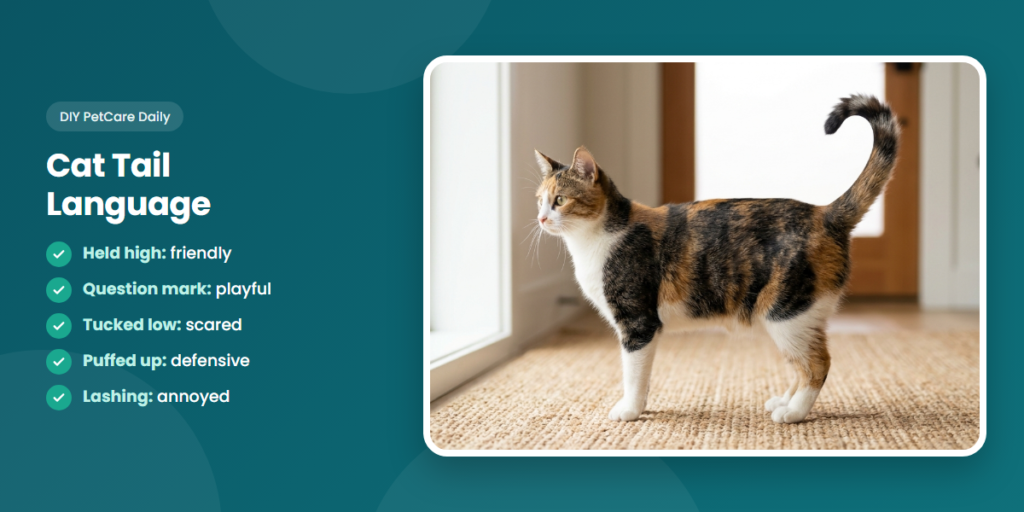
The tail is one of the easiest places to start. Cat tail language can tell you a lot at a glance.
Tail Held High
A tail pointing straight up is a friendly greeting. Cats often approach people and other cats they like with their tails up. Research on cat-to-cat behavior has found that cats are more likely to approach each other in a friendly way when one has its tail raised.
Question Mark Tail
A tail held up with a curl at the tip, like a question mark, usually means a playful or curious cat. It’s often an invitation to interact.
Tail Wrapped Around the Body
When a sitting or lying cat wraps their tail around their feet, they’re usually calm and settled. It can also mean a cat is cold or wants a bit of space.
Low or Tucked Tail
A tail held low or tucked between the legs often signals fear, worry, or feeling unwell.
Cat Tail Twitching
Cat tail twitching can mean two very different things. A gentle twitch at the tip, while your cat is watching birds out the window, means focus and excitement. A twitching or thumping tail while you’re petting your cat often means they’re getting annoyed and may soon bite or walk away.
Cat Tail Puffed Up
When a cat’s tail fluffs up to twice its size, the hair is standing on end. This is a fear or defensive response. The cat is trying to look bigger to scare off a threat. Kittens sometimes puff up their tails during wild play, too.
Lashing Tail
A tail swishing hard from side to side is a clear sign of irritation or agitation. Give your cat space when you see this.
Cat Ear Positions
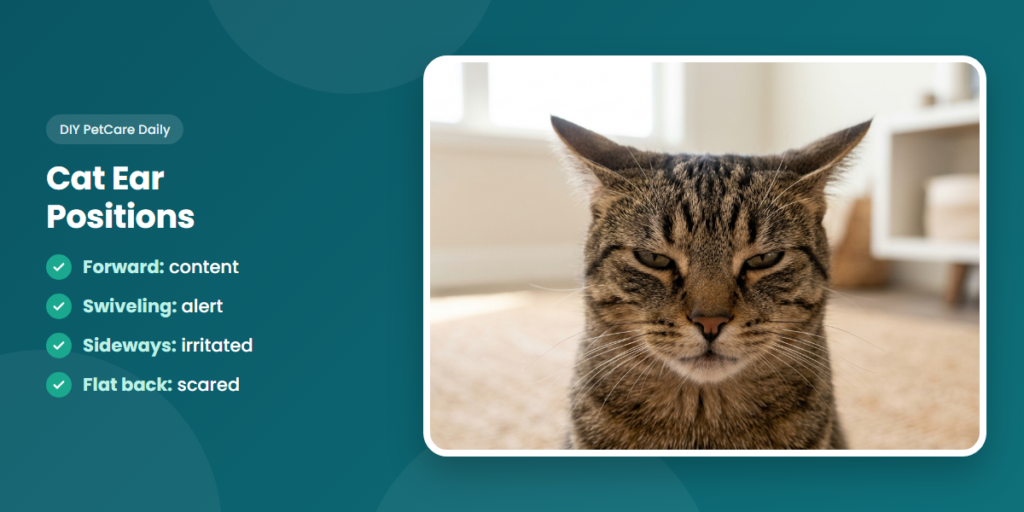
Cats have more than 30 muscles in each ear, which lets them swivel and tilt their ears in many directions. Cat ear positions change quickly, so watch them closely.
- Forward and relaxed: content and interested.
- Upright and swiveling: alert and listening to the world around them.
- Sideways or “airplane ears”: anxious, irritated, or unsure.
- Flat back against the head: scared or ready to defend themselves.
- One ear forward, one sideways: mixed feelings or listening to two things at once.
If your cat’s ears go from forward to sideways while you’re petting them, that’s a good time to stop.
Eyes and the Cat Slow Blink
What Does It Mean When a Cat Slow Blinks?
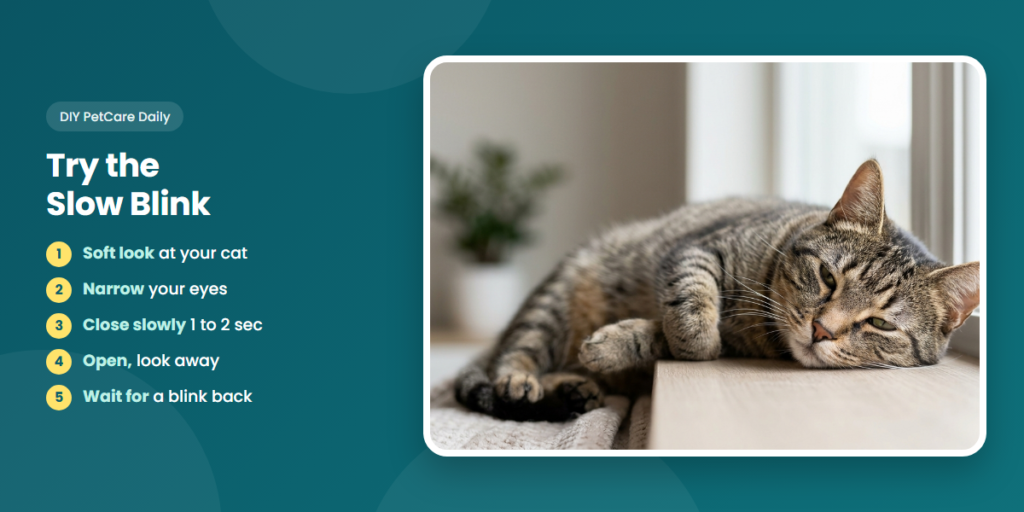
A cat slow blink is when your cat looks at you and closes their eyes slowly, holds them shut for a moment, and then opens them slowly. Cat lovers often call it a “cat kiss.”
A 2020 study from the University of Sussex and the University of Portsmouth, published in *Scientific Reports*, tested this. Cats were more likely to slow blink back at owners who slow blinked at them first. In a second test, cats were also more likely to approach a stranger’s outstretched hand after the stranger slow blinked at them.
Researchers don’t know exactly why cats do it. One idea is that slow blinking breaks up a direct stare, which cats can see as a threat. Either way, it seems to be a friendly, relaxed signal.
Try it yourself: look at your cat with a soft face, narrow your eyes, then close them slowly for a second or two. Open them gently and look slightly away. Many cats will slow blink back.
Pupils
Pupil size changes with light, but it also changes with mood:
- Narrow pupils in normal light: calm, or sometimes focused and tense.
- Wide, round pupils: excitement, fear, or play. Read the rest of the body to tell which.
- A hard, unblinking stare: can be a challenge or warning, especially between cats.
Whiskers
Whiskers are sensitive and show mood, too. Relaxed whiskers point out to the sides. Whiskers pushed forward mean your cat is interested or hunting. Whiskers pulled flat against the face mean fear.
Posture and Body Position
- Loaf position: paws tucked under, body round. A relaxed cat, but sometimes a cat in pain sits hunched in a similar position with a tense face.
- Belly up: a sign of trust, but not always an invitation for belly rubs. Many cats will grab and bite if you touch their tummy.
- Arched back with fur raised: a scared, defensive cat. Give them space.
- Arched back with fur flat and leaning into you: a happy stretch or greeting.
- Crouched low with a tense body: fearful, or about to pounce in play.
- Head bumping and rubbing: affection and scent marking. Your cat is saying you belong to them.
Putting It Together: Real Examples
Here’s how the signals work together in everyday situations.
| What You See | What It Likely Means | What to Do |
| Tail up, ears forward, trotting toward you | Happy greeting | Offer a hand to sniff, then pet the cheeks |
| Lying on lap, tail thumping, ears turning sideways | Overstimulated | Stop petting and let your cat rest |
| Crouched behind the couch, ears flat, tail tucked | Scared | Leave them alone, speak softly, give space |
| Puffed tail, arched back, hissing | Very scared or defensive | Step away and don’t reach for them |
| Hunched loaf, squinting eyes, not eating | Possible pain | Call your vet |
| Slow blinking from across the room | Relaxed and trusting | Slow blink back |
A cat that sits hunched with squinted eyes and a tense face may be in pain, not relaxed. The Feline Grimace Scale, a tool vets use to measure pain, looks at ear position, eye squinting, muzzle tension, whiskers, and head position. Learn how to use it in our guide to signs of pain in cats.
When Body Language Changes
Sudden changes in your cat’s normal body language can be an early sign of illness or stress. Watch for a cat that suddenly hides, stops grooming, holds their tail low all the time, or flinches when touched. Our guide on how to tell if your cat is sick lists other signs to look for.
Body language also explains a lot of common cat habits. Learn what kneading means, or why your cat bites you during petting.
Frequently Asked Questions
What does it mean when a cat’s tail is up?
A tail held straight up usually means a friendly, confident cat. Cats often greet people and other cats they like with their tails raised. A slight curl at the tip adds a playful or curious touch.
Why does my cat’s tail twitch when I pet them?
A twitching or thumping tail during petting often means your cat is getting overstimulated or annoyed. Stop petting and let your cat rest. If you keep going, they may swat or bite.
What does it mean when a cat slow blinks at you?
A slow blink is a relaxed, friendly signal. A 2020 study found cats were more likely to slow blink back at people who slow blinked at them first, and more likely to approach a stranger after a slow blink.
What do airplane ears mean on a cat?
Airplane ears, when a cat’s ears turn out to the sides, usually mean the cat is anxious, irritated, or unsure. It’s a sign to give them space or stop what you’re doing.
Do cats show their belly when they trust you?
Yes, showing the belly is a sign of trust, because it’s a vulnerable spot. But it’s not always an invitation to touch. Many cats will grab, kick, or bite if you rub their belly.