Table of Contents
- Table of Contents
- Why Homemade Cat Food Recipes Need Extra Care
- What Cats Need in Every Meal
- Step 1: Talk to Your Vet First
- Step 2: Gather the Right Ingredients
- A Sample Cooked Chicken Cat Food Recipe
- Raw vs Cooked Homemade Cat Food
- Easy Homemade Toppers (The Low-Risk Way to Start)
- Foods to Never Put in Homemade Cat Food
- How to Switch Your Cat to Homemade Food
- Storing Homemade Cat Food
- Frequently Asked Questions
Quick answer: Homemade cat food recipes can be healthy, but only if they’re complete and balanced. Cats are strict carnivores and need meat, organ meat, taurine, calcium, and vitamins that plain chicken or fish alone can’t give. The safest path is a recipe built by a veterinary nutritionist plus a supplement mix made for cats. For most owners, homemade toppers on a complete commercial food are the easiest start.
Lots of cat owners want to cook for their cats. Maybe your cat is picky, has a sensitive stomach, or you just want to know exactly what’s in the bowl. Those are good reasons.
But homemade cat food is trickier than homemade dog food or people food. Cats have very specific needs, and a diet that looks healthy can quietly cause heart and eye problems over a few months. This guide explains what cats need, how a balanced recipe is built, a sample cooked recipe, and simple homemade toppers you can try today without risk.
Table of Contents
- Why Homemade Cat Food Recipes Need Extra Care
- What Cats Need in Every Meal
- Step 1: Talk to Your Vet First
- Step 2: Gather the Right Ingredients
- A Sample Cooked Chicken Cat Food Recipe
- Raw vs Cooked Homemade Cat Food
- Easy Homemade Toppers (The Low-Risk Way to Start)
- Foods to Never Put in Homemade Cat Food
- How to Switch Your Cat to Homemade Food
- Storing Homemade Cat Food
- Frequently Asked Questions
Why Homemade Cat Food Recipes Need Extra Care
Cats are obligate carnivores. That means their bodies are built to run on animal protein and fat. Unlike dogs and people, cats can’t make certain nutrients on their own, so those have to come from food.
When researchers and veterinary nutritionists have reviewed homemade pet food recipes from books and websites, they’ve found that most fall short on at least one nutrient. A cat can eat an unbalanced diet for months and seem fine. The damage often shows up slowly.
Common problems with unbalanced homemade diets include:
- Heart disease from too little taurine (a condition called dilated cardiomyopathy)
- Vision loss from taurine deficiency affecting the retina
- Weak bones from too little calcium compared to phosphorus
- Vitamin A overload from too much liver
- Skin and coat problems from missing fatty acids
This doesn’t mean you can’t do it. It means you need a real recipe, the right supplements, and your vet in the loop.
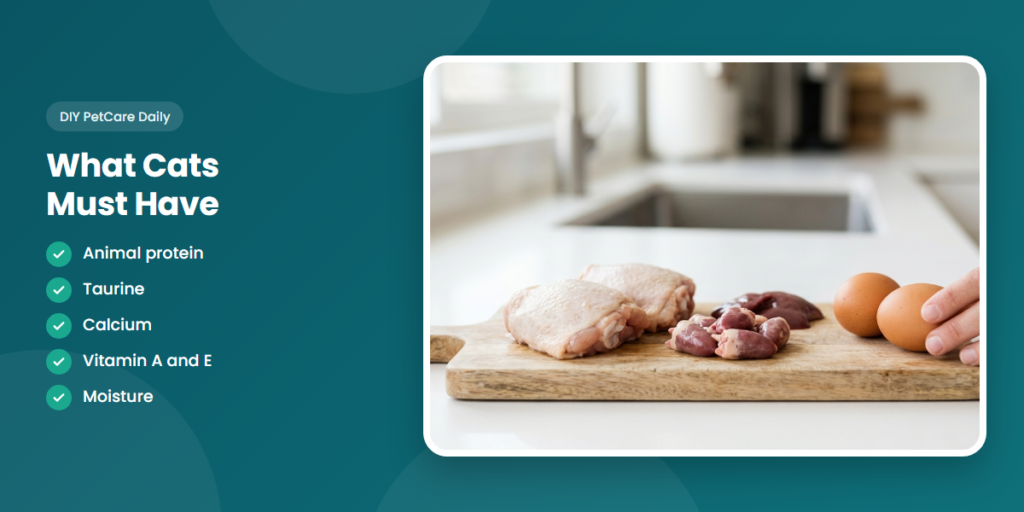
What Cats Need in Every Meal
Here are the key nutrients a homemade cat food must cover.
| Nutrient | Why cats need it | Where it comes from |
| Animal protein | Energy, muscles, organs | Chicken, turkey, rabbit, beef |
| Taurine | Heart, eyes, digestion | Dark meat, heart; added supplement |
| Arachidonic acid | Skin, coat, inflammation control | Animal fat |
| Preformed vitamin A | Vision, immune system | Liver (in small amounts) |
| Calcium | Bones and teeth | Supplement (meat alone is very low) |
| Vitamin E | Protects cells from damage | Supplement |
| B vitamins | Energy, nerves | Meat, organs, supplement |
| Water | Kidney and bladder health | Wet food, added water |
Why Taurine Matters So Much
Taurine is an amino acid found in animal tissue, especially heart muscle and dark meat. Cats can’t make enough of it, so it must come from food.
Here’s the catch: cooking, grinding, and freezing can all lower the taurine in meat. That’s why almost every vet-formulated homemade recipe adds taurine as a supplement, even when the recipe already has heart and dark meat.
Why You Can’t Just Feed Plain Chicken
Plain cooked chicken breast is a fine treat. As a full diet, it’s missing calcium, several vitamins, the right fats, and enough taurine. Meat is high in phosphorus and very low in calcium. Over time, that imbalance weakens bones. In the wild, cats balance this by eating small bones, organs, and everything else.
Step 1: Talk to Your Vet First
Before you change your cat’s diet, talk to your vet. This matters even more if your cat has kidney disease, diabetes, urinary crystals, food allergies, or another health issue. Each of these changes what a good recipe looks like.
Your vet may refer you to a board-certified veterinary nutritionist. These specialists can write a recipe made just for your cat. Many offer remote consultations, and some well-known online services let your vet build a balanced recipe for you.
Step 2: Gather the Right Ingredients
A balanced cooked cat food recipe usually includes:
- Muscle meat: chicken or turkey thighs (dark meat has more taurine than breast)
- Heart: chicken or turkey heart
- Liver: a small amount, usually around 5% of the recipe
- Eggs: cooked, for extra protein
- A cat-specific supplement mix: to supply taurine, calcium, vitamins, and minerals
- Fish oil (optional): only if your recipe calls for it
- Water: to add moisture
Skip grains, potatoes, and vegetables unless your recipe calls for them. Cats don’t need carbs, and many don’t digest them well.
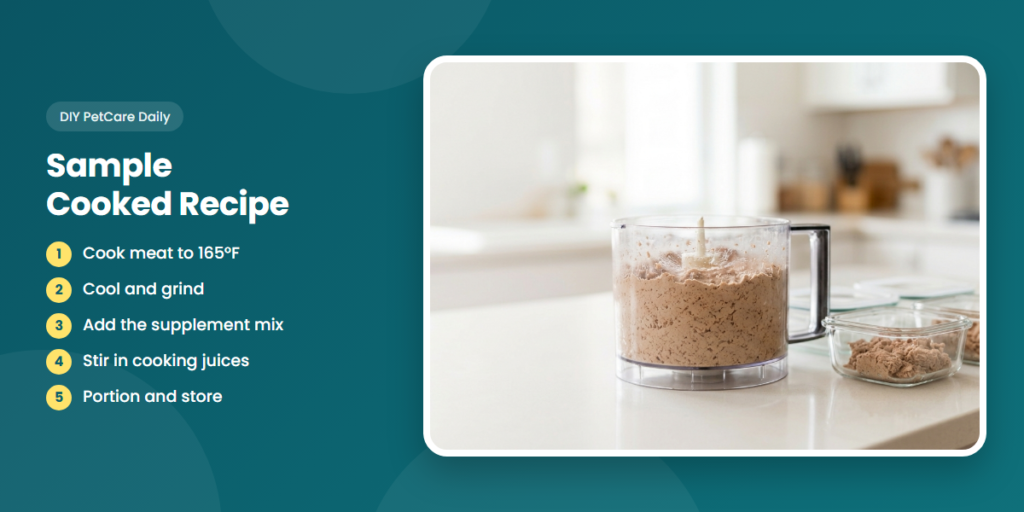
A Sample Cooked Chicken Cat Food Recipe
This sample shows how a balanced cooked recipe is put together. It’s meant as an example, not as a complete diet on its own. The supplement mix is what makes it balanced, so use one formulated for homemade cat food and follow its label exactly, or have your vet adjust the recipe.
Makes: about 3 pounds (roughly 6 to 9 days for an average 10 lb adult cat)
Ingredients
- 2 lb boneless chicken thighs, with skin
- 4 oz chicken hearts
- 3 oz chicken liver
- 2 large eggs
- A complete supplement mix for homemade cat food (amount per the product label)
- About 1/2 cup water
Steps
- Cook the meat. Gently poach or bake the chicken thighs, hearts, and liver until they reach 165°F inside. Save the cooking juices, since some nutrients leach into the liquid.
- Cook the eggs. Scramble or hard-boil them with no butter, oil, or salt.
- Cool everything. Let it cool to room temperature.
- Chop or grind. Use a food processor or grinder. Some cats like a smooth pâté; others prefer small chunks.
- Add the supplement. Mix in the supplement powder after cooking, not before, so heat doesn’t break down the vitamins and taurine.
- Add liquid. Stir in the saved cooking juices and water until it has a moist, wet-food texture.
- Portion and store. Divide into daily portions in airtight containers.
How Much to Feed
An average indoor adult cat needs roughly 200 to 250 calories a day, but this varies with age, size, and activity. Our guide on how many calories a cat needs explains how to work out your cat’s number. Weigh your cat every two weeks after switching and adjust portions. Our guide on how much to feed your cat has more detail.
Raw vs Cooked Homemade Cat Food
Some owners feed raw homemade diets. Cooking is the safer choice for most homes.
| Cooked | Raw | |
| Bacteria risk (Salmonella, Listeria) | Low | Higher, for cats and people |
| Taurine | Reduced by cooking, so supplement needed | Still needs a supplement |
| Prep and cleanup | Easier and safer | Strict kitchen hygiene needed |
| Good for homes with kids, seniors, or sick people | Yes | Not recommended |
Raw meat can carry bacteria that make cats sick. Even when the cat seems fine, they can shed bacteria in their saliva and litter box. If you’re thinking about raw feeding, talk it over with your vet first.
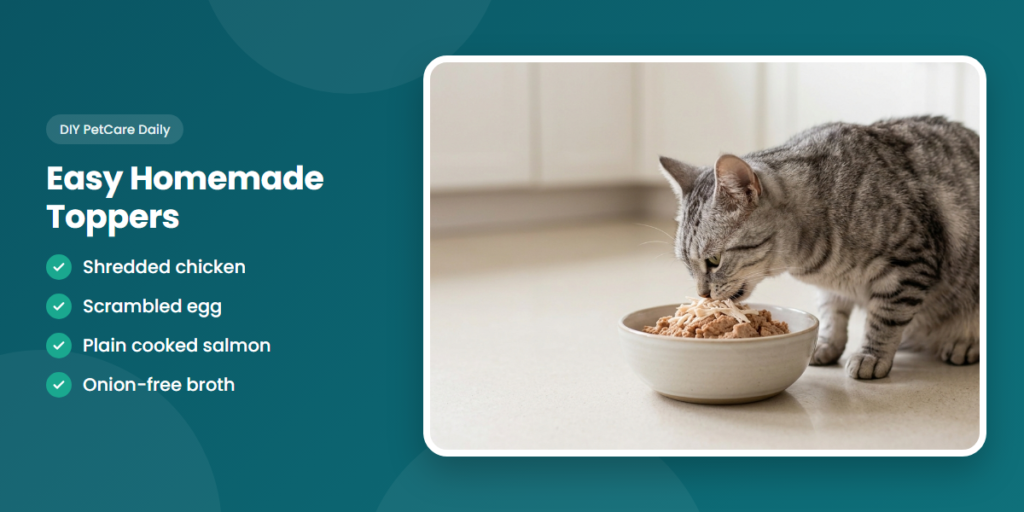
Easy Homemade Toppers (The Low-Risk Way to Start)
If you want to cook for your cat but aren’t ready to switch their whole diet, toppers are a great middle ground. Add a spoonful on top of a complete commercial food. Keep toppers to about 10% of daily calories so the main diet stays balanced.
Safe topper ideas:
- Shredded chicken or turkey: plain, cooked, no skin or seasoning
- Scrambled egg: cooked with no butter or salt
- Plain cooked salmon: boneless, in small amounts
- Bone broth: homemade, with no onion, garlic, or salt
- Chicken “gravy”: blend cooked chicken with warm water
Toppers are especially handy for picky eaters and older cats. If your cat has stopped eating for more than a day, though, call your vet. Our guide to cat not eating explains why that’s urgent in cats.
Foods to Never Put in Homemade Cat Food
Some common kitchen foods are toxic to cats, even in small amounts:
- Onions, garlic, chives, and leeks (including powders)
- Grapes and raisins
- Chocolate and caffeine
- Alcohol
- Raw bread dough
- Xylitol
- Cooked bones (they splinter)
- Too much liver or cod liver oil (vitamin A overload)
See our full list of foods toxic to cats before adding anything new.
How to Switch Your Cat to Homemade Food
Cats can be very set in their ways. A sudden change can cause an upset stomach or a hunger strike. Switch slowly over 7 to 10 days, or longer for picky cats.
| Days | Old food | New food |
| 1 to 3 | 75% | 25% |
| 4 to 6 | 50% | 50% |
| 7 to 9 | 25% | 75% |
| 10 and on | 0% | 100% |
Never let a cat go hungry to force them to eat the new food. Cats who don’t eat for even a few days can develop a serious liver problem called hepatic lipidosis.
Storing Homemade Cat Food
- Fridge: up to 3 days in an airtight container
- Freezer: up to 2 to 3 months
- Thawing: thaw overnight in the fridge, never on the counter
- Serving: warm to room temperature, or slightly warmer; cats often refuse cold food
- Leftovers: throw out any food left in the bowl after 30 minutes to an hour
Wondering how homemade compares to store-bought options? Our guide to wet vs dry cat food covers the pros and cons of each. For more cat projects, browse our DIY Cat Projects section.
Frequently Asked Questions
Is homemade cat food healthier than store-bought?
Not automatically. A homemade diet is only healthy if it’s complete and balanced. A good commercial food labeled “complete and balanced” is safer than a homemade recipe that’s missing nutrients. Homemade food made from a vet-built recipe can be a great choice.
Can I feed my cat only cooked chicken?
No. Plain chicken lacks enough calcium, taurine, vitamins, and the right fats. Fed alone for weeks or months, it can lead to heart, eye, and bone problems. Chicken is a fine treat or topper, though.
Do I need to add taurine to homemade cat food?
Yes, in almost every case. Cooking and grinding lower the taurine in meat, and cats need a steady supply for their heart and eyes. Most homemade recipes use a supplement mix that includes taurine.
How long does homemade cat food last in the fridge?
About 3 days in an airtight container. Freeze extra portions for up to 2 to 3 months and thaw them in the fridge overnight.
Can kittens eat homemade cat food?
Kittens have even higher needs for protein, calcium, and calories, and mistakes affect growth. Only feed a kitten homemade food from a recipe designed for kittens by a veterinary nutritionist.