Table of Contents
Quick answer: Is my cat overweight? Your cat may be carrying extra weight if you can’t easily feel their ribs, can’t see a waist from above, or notice a rounded belly with fat on the sides. Grooming less and jumping less can also be clues. These quick checks use just your hands and eyes, and they work better than judging by looks alone.
Fluffy coat? Big belly flap? Always napping? Cats can be hard to read. A long coat can hide a few extra pounds, and even a short-haired cat can look fine when they’re curled up in a ball.
It’s worth checking, though. Surveys from the Association for Pet Obesity Prevention suggest that around 6 in 10 US cats are overweight or obese. And since cats are small, even a pound can matter. This guide gives you simple home checks, explains what your results mean, and shows you what to do next.
Table of Contents
- Is My Cat Overweight? How to Check at Home
- What Your Results Mean
- How Much Should Your Cat Lose?
- Why Extra Weight Matters for Cats
- Why Cats Gain Weight
- What to Do If Your Cat Is Overweight
- Frequently Asked Questions
Is My Cat Overweight? How to Check at Home
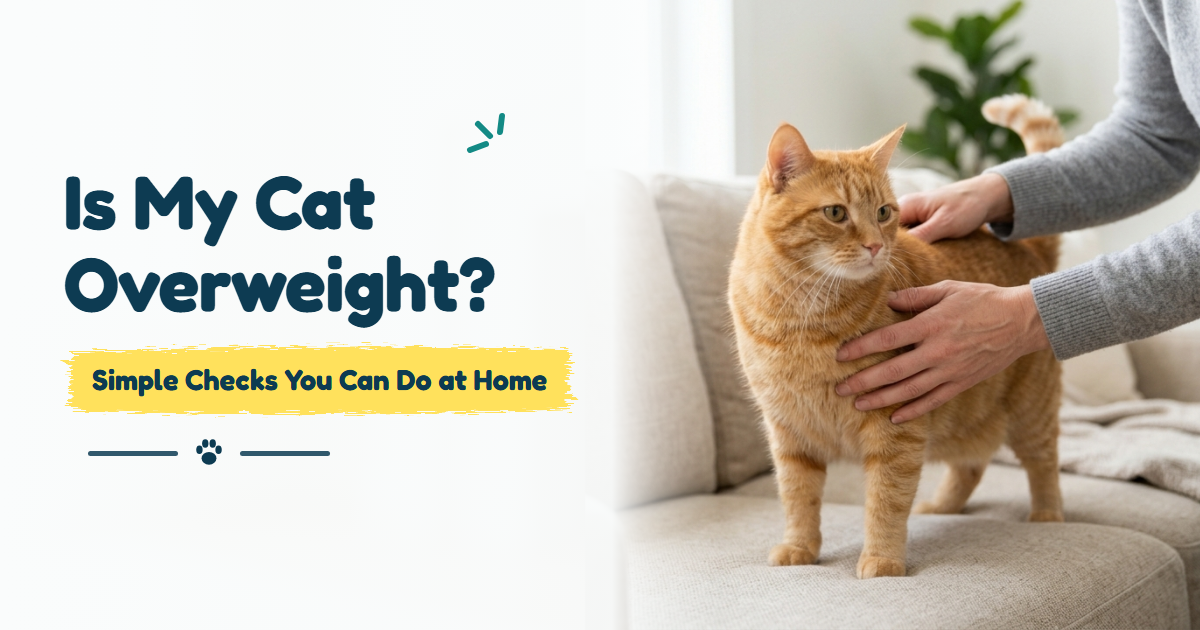
Pick a calm moment, like right after a meal. Have your cat stand on the floor if they’ll let you. Offering a toy or a few pieces of kibble can help them stay still. If your cat dislikes being handled, do just one check at a time.
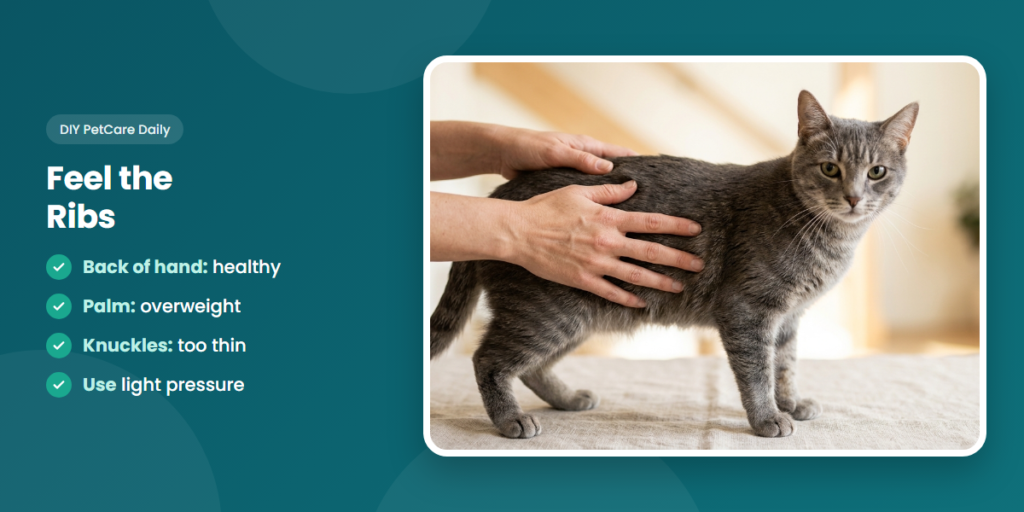
Check 1: Feel the Ribs
Gently run your fingers along your cat’s sides. Don’t press hard. You’re feeling for how much cover is on the ribs.
- Healthy: You can feel the ribs easily, with a thin layer of fat over them.
- Overweight: You have to press to feel the ribs, or you can’t feel them at all.
- Too thin: The ribs feel sharp and bony, and you can feel them very easily.
Try comparing it with your own hand. The ribs of a healthy cat should feel similar to the back of your hand. If they feel like your palm, your cat is likely carrying extra fat. If they feel like your knuckles, your cat may be too thin.
Check 2: Look for a Waist
Look down at your cat from above when they’re standing. A healthy cat has a slight waist behind the ribs. Cats don’t have an hourglass figure like some dogs, but you should see a gentle narrowing.
If your cat looks oval or wider in the middle, they may be overweight. In a long-haired cat, smooth your hands down their sides to feel for the waist, or check after wetting the fur if your cat ever gets a bath.
Check 3: Check the Belly
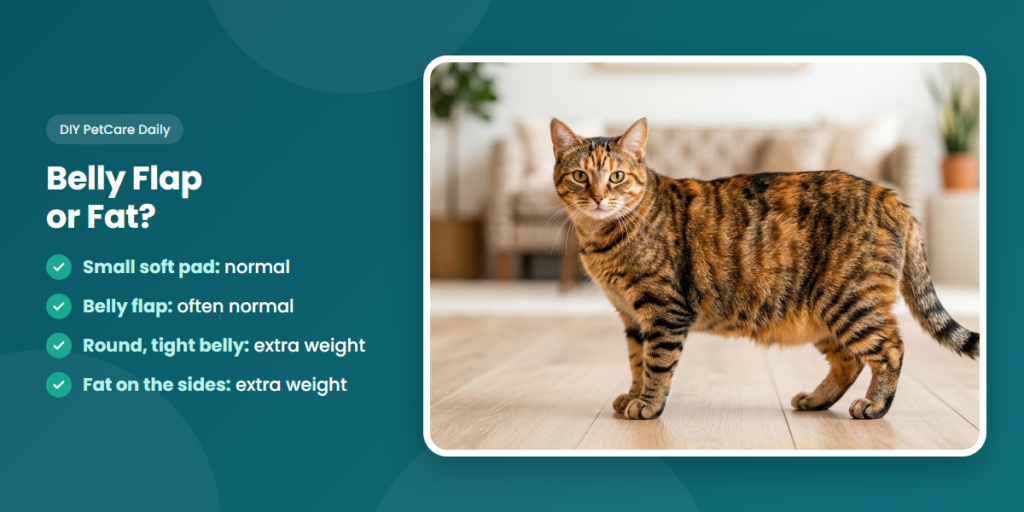
Look at your cat from the side, and feel gently under the belly.
- A small, soft pad of fat is normal in a healthy cat.
- A round, tight belly or a thick pad that swings as they walk suggests extra weight.
- Fat along the sides and spine is another sign.
Don’t be fooled by the belly flap. Many cats have a loose flap of skin between their back legs called a primordial pouch. It’s normal, even in lean cats, and it may swing when they walk or run. Check the ribs and waist as well, and don’t judge by the belly alone.
Check 4: Check Their Spine and Hips
Run your hand down the spine toward the tail. You should be able to feel the bones under a light covering, but not sharp edges. Heavy cats may have a soft layer of fat over the spine and at the base of the tail. A very bony spine could point to the opposite problem, and it can be an early sign of illness.
Check 5: Watch Their Daily Habits
Your cat’s habits can also give you clues. Overweight cats often:
- Jump less, or take a couple of tries to get up
- Rest more and play less
- Have trouble grooming, leaving a greasy, flaky, or matted coat along the lower back
- Have a messy rear end
- Have trouble fitting inside covered litter boxes
Some of these signs can also point to arthritis, pain, or illness. If you notice them, it’s a good idea to tell your vet.
Check 6: Weigh Your Cat
The number isn’t everything, but tracking it over time helps. Hold your cat and step on the scale, then step on by yourself and subtract the difference. A baby scale gives a more exact number, which matters since small changes count for a cat.
Many domestic cats do well at about 8 to 12 lb, but frame size matters. A large-framed cat may be fine at 14 lb, while a small-framed cat may be overweight at 10 lb. Our guide on average cat weight has ranges by breed.
What Your Results Mean
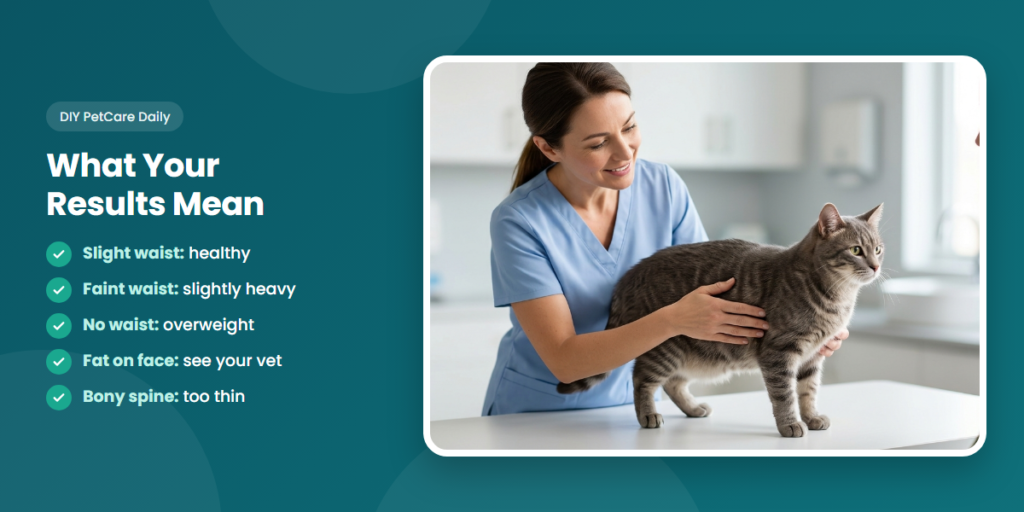
Use this chart to see where your cat fits best.
| What You Found | What It Likely Means | Next Step |
| Ribs easy to feel, slight waist, small belly pad | Healthy weight | Recheck every month or two |
| Ribs felt under some fat, faint waist | Slightly heavy | Measure food and play more |
| Ribs hard to feel, rounded belly, no waist | Overweight | Talk to your vet and start a slow plan |
| Ribs can’t be felt, large belly, fat on face and legs | Obese | See your vet before changing food |
| Ribs and spine stick out, sharp waist | Too thin | Book a vet visit soon |
For a more exact check, try our cat BMI calculator. It uses a tape measure and body score to estimate body fat. You can also read about the 9-point cat body condition score that vets use.
If your cat seems too thin instead, see our guide on why a cat may be so skinny.
How Much Should Your Cat Lose?
A common rule of thumb says each body condition point above 5 is about 10% extra weight. So a 12 lb cat with a score of 7 may have a goal weight of about 10 lb.
Two pounds might not sound like much, but it’s about one-sixth of that cat’s weight. For a 150 lb person, that’s like carrying an extra 25 pounds.
Why Extra Weight Matters for Cats
Extra weight affects much more than your cat’s appearance. It’s linked with:
- Diabetes
- Arthritis and joint pain
- Skin problems, because cats can’t groom properly
- Urinary problems
- Trouble breathing
- Higher surgery risk
- A shorter life
Extra weight also makes it harder for cats to do normal cat things, like jumping, climbing, and playing. Read more in our guide to obesity in cats.
Why Cats Gain Weight
Knowing the cause can make it much easier to fix.
Free Feeding
A bowl that’s always full is the most common cause. Dry food is packed with calories, so it’s easy for a cat to overeat out of boredom. Measured meals can help a lot. Our guide on how much to feed your cat explains how.
Too Many Treats
An extra 20 calories a day is nearly 8% of the daily food for a typical 10 lb cat. A few treats, a bit of tuna, or a lick of cream can add up.
Indoor Life
Indoor cats are safer, but they often burn fewer calories. Without daily play, many of them sleep their extra calories away.
Spay or Neuter
Spayed and neutered cats usually need fewer calories. If you keep feeding the same amount after surgery, weight can creep up.
Age
Many cats gain weight during their middle years, from about 7 to 10 years old. After that, some older cats begin to lose weight, which can be a sign of illness.
Food Type
Dry food has more calories per bite than wet food, so it’s easier to overfeed. Our wet vs dry cat food guide compares them.
Medical Problems
Weight gain is usually related to food and activity, but a swollen belly isn’t always fat. If it comes on quickly, or your cat also seems unwell, see your vet.
What to Do If Your Cat Is Overweight
Slow, steady changes are the safest way for a cat to lose weight.
- See your vet first. This helps rule out medical problems and sets a goal weight.
- Set a calorie target. Our cat calorie calculator can give you a starting number.
- Measure every meal. Use a kitchen scale or a real measuring cup.
- Cut back on treats. Keep them under 10% of your cat’s daily calories.
- Play every day. Try two or three short sessions with a wand toy.
- Weigh every 2 weeks. Aim for about 0.5% to 1% of body weight per week.
Never put a cat on a crash diet. If an overweight cat stops eating or loses weight too quickly, they can develop hepatic lipidosis, a life-threatening liver problem. Call your vet right away if your cat stops eating.
Our full guide on how to help a cat lose weight walks you through a safe plan, and our cat weight calculator can estimate how long it may take.
For more guides, visit our Cat Health & Wellness section.
Frequently Asked Questions
How can I tell if my cat is overweight?
Feel for the ribs, check for a waist from above, and look for a rounded belly or fat on the sides. If the ribs are hard to feel and there’s no waist, your cat is probably overweight.
Is my cat fat or just fluffy?
Use your hands rather than your eyes. If you can feel the ribs easily under a light layer of fat and can find a waist, your cat is probably at a healthy weight under all that fur.
Is my cat’s belly flap a sign of being overweight?
Not usually. Many cats have a loose flap called a primordial pouch, even at a healthy weight. Check the ribs and waist to get a better answer.
What is a healthy weight for a cat?
Many domestic cats do well at about 8 to 12 lb, but frame and breed matter. A score of 4 or 5 out of 9 on the body condition scale is a better sign than a number on a scale.
Can indoor cats get overweight easily?
Yes. Indoor cats often move less, and many have food available all day. Measured meals and daily play can help keep them at a healthy weight.