
Table of Contents
Quick answer: The average cat weight for most adult domestic cats is about 8 to 12 lb, and males are often a little heavier than females. Breed matters too: a Siamese may weigh 6 to 12 lb, while a Maine Coon can reach 25 lb. Body shape tells you more than the scale, so check your cat’s ribs and waist as well.
How much should your cat weigh? It seems like a simple question, but the answer depends on your cat’s age, sex, breed, and frame. A 14 lb cat could be perfectly fit or carrying a few extra pounds.
An average gives you a good first check. This guide covers the healthy ranges for every life stage and popular breed, then shows you how to work out what’s right for your own cat. It also explains when a change on the scale is worth a call to your vet.
Table of Contents
- What Is the Average Cat Weight?
- Average Cat Weight by Age
- Average Cat Weight by Breed
- Male vs Female Cat Weight
- Why Body Shape Matters More Than the Scale
- How to Weigh Your Cat at Home
- What If Your Cat Is Above or Below Average?
- When a Weight Change Needs a Vet
- Frequently Asked Questions
What Is the Average Cat Weight?
Most adult domestic cats weigh about 8 to 12 lb when they’re at a healthy weight. Since most US cats aren’t a specific breed, this is the range that applies to the majority of pets.
Within that range, individual cats vary a lot:
- Small-framed cats may be healthy at 6 to 8 lb.
- Large-framed cats may be healthy at 13 or 14 lb.
- Large breeds can be healthy at well over 15 lb.
So don’t worry if your cat falls outside the range. It’s a reference point, not a rule.
Average Cat Weight by Age
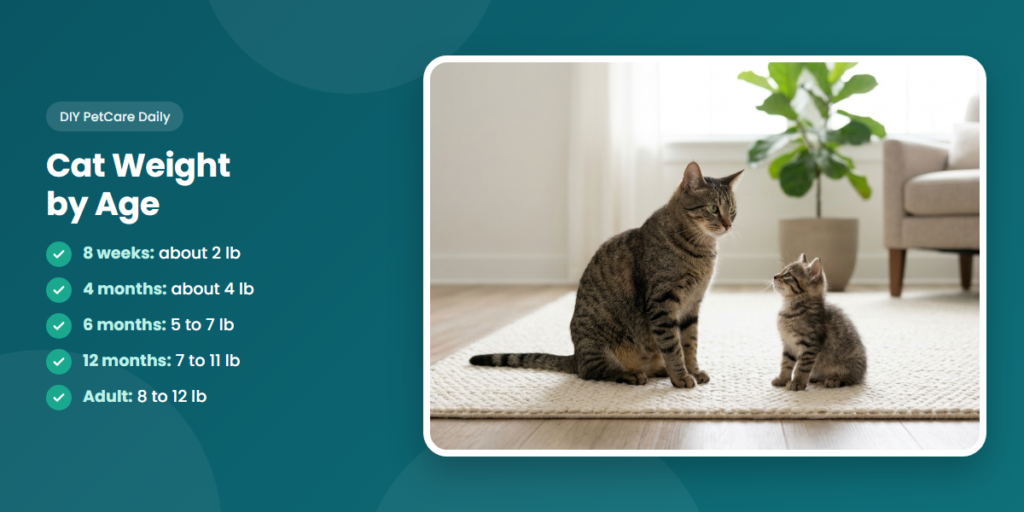
Kittens gain quickly and then level off. Here are typical weights for domestic cats at each age. Large breeds can weigh a lot more.
| Age | Typical Weight |
| Newborn | 3 to 4 oz |
| 2 weeks | 6 to 10 oz |
| 4 weeks | 12 to 16 oz |
| 8 weeks | About 2 lb |
| 3 months | About 3 lb |
| 4 months | About 4 lb |
| 6 months | 5 to 7 lb |
| 9 months | 6 to 9 lb |
| 12 months | 7 to 11 lb |
| Adult (1 to 6 years) | 8 to 12 lb |
| Mature adult (7 to 10 years) | 8 to 12 lb, though many gain |
| Senior (over 10 years) | Varies; many slowly lose weight |
A handy rule is that many kittens gain about 1 lb a month for their first several months. If you want to predict your own kitten’s adult size, read our guide on how big a kitten will get. Our cat weight calculator can also make an estimate.

Average Cat Weight by Breed
These are general ranges for healthy adults, with males often at the higher end. Treat them as a guide, not a goal.
| Breed | Typical Adult Weight | Size |
| Singapura | 4 to 8 lb | Small |
| Abyssinian | 6 to 10 lb | Small to medium |
| Siamese | 6 to 12 lb | Small to medium |
| Sphynx | 6 to 12 lb | Medium |
| Scottish Fold | 6 to 13 lb | Medium |
| Domestic or mixed breed | 8 to 12 lb | Medium |
| Persian | 7 to 12 lb | Medium |
| Russian Blue | 7 to 15 lb | Medium |
| Bengal | 8 to 15 lb | Medium to large |
| British Shorthair | 7 to 17 lb | Medium to large |
| Norwegian Forest Cat | 9 to 16 lb | Large |
| Ragdoll | 10 to 20 lb | Large |
| Maine Coon | 10 to 25 lb | Large |
A healthy Maine Coon can easily outweigh three healthy Singapuras. That’s why you can’t compare your cat with just any cat. If you have a mixed-breed cat, their frame and body shape will give you a better answer.
Male vs Female Cat Weight
Male cats tend to be bigger, especially in large breeds. For domestic cats, the difference is usually about 1 to 3 lb.
| Cat | Domestic Cat | Maine Coon |
| Female | About 7 to 10 lb | About 10 to 15 lb |
| Male | About 9 to 12 lb | About 15 to 25 lb |
Spaying and neutering can also change things. Fixed cats often burn fewer calories, so weight may creep up if their portions stay the same. That’s a good reason to weigh your cat before and a few months after surgery.
Why Body Shape Matters More Than the Scale
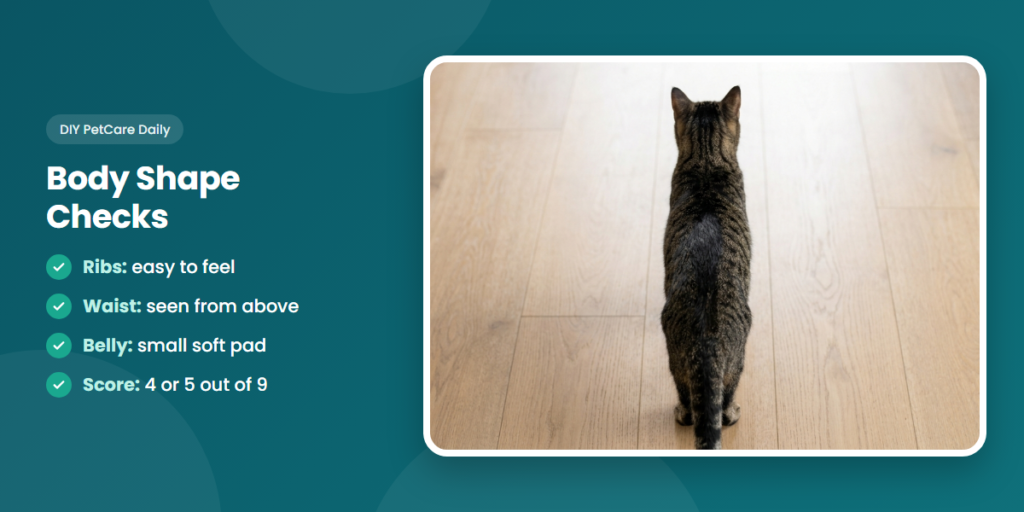
Averages can’t tell you if your own cat is at the right weight. A big-boned 14 lb cat may be fit, while a small-framed 10 lb cat may be overweight. Here’s what to check instead.
- Ribs: You should feel them easily under a light fat covering, like the back of your hand.
- Waist: Look from above for a slight narrowing behind the ribs.
- Belly: A small fat pad is normal, but it shouldn’t be big or swing heavily.
- Spine and hips: You should feel them, but they shouldn’t be sharp.
Vets turn these checks into a score from 1 to 9. A score of 4 or 5 is ideal. You can learn how in our guide to the cat body condition score, or use our cat BMI calculator for a quick estimate.
Watch out for the belly flap. Many cats have a loose flap of skin between the back legs called a primordial pouch. It’s normal, even in lean cats, so don’t judge by the belly alone.
How to Find Your Own Cat’s Healthy Weight
Here’s a better approach than relying on an average:
- Find an old record. Your cat’s weight at about 1 year old is often a good target, if they were lean then.
- Score your cat today. Each point above 5 is about 10% extra weight.
- Do the math. A 12 lb cat with a score of 7 may have a goal of about 10 lb, since 12 divided by 1.2 is 10.
- Ask your vet. They can confirm your target and adjust for your cat’s frame.
How to Weigh Your Cat at Home
For a small animal, a small change can be a big deal. One pound on a 10 lb cat is 10% of their body weight. So it’s worth getting a good reading.
- Bathroom scale: Weigh yourself holding your cat, then weigh yourself alone, and subtract the difference.
- Baby or pet scale: This is more accurate, which helps with small changes. Some cats happily sit in a box on one. Just zero out the box’s weight first.
- At the vet: Ask for a copy of your cat’s weight record.
How often should you check?
| Cat | How Often |
| Kittens | Every 1 to 2 weeks |
| Healthy adults | About once a month |
| Cats on a weight plan | Every 2 weeks |
| Seniors | About once a month |
What If Your Cat Is Above or Below Average?
Above Average
First check their shape. If the ribs are hard to feel and there’s no waist, your cat is probably carrying extra weight. Our guide, is my cat overweight, has simple checks. Extra weight raises the risk of diabetes and joint pain, as explained in our guide on obesity in cats.
If your cat does need to lose weight, follow our plan on how to help a cat lose weight. Never crash diet a cat, since rapid weight loss can cause a life-threatening liver problem.
Below Average
If you can see or easily feel sharp ribs, a bony spine, or hips, your cat may be too thin. See our guide on why a cat may be so skinny. Thin older cats are especially worth a vet visit, since thyroid and kidney problems are common.
Keeping Your Cat in a Healthy Range
A few simple habits can make a big difference:
- Measure meals. Our guide on how much to feed your cat can help.
- Use our cat calorie calculator for a starting number.
- Play every day, even for just a few minutes.
- Keep treats under 10% of daily calories.
- Adjust portions as your cat ages or after surgery.
When a Weight Change Needs a Vet
Slow weight gain often comes from too much food and too little activity. Weight loss deserves more attention, because cats often lose weight quietly when they’re sick.
Call your vet if your cat:
- Is losing weight without trying; see our guide on cat losing weight
- Has a big appetite but is losing weight
- Is drinking or peeing more than usual
- Has a swollen belly that came on quickly
- Is a kitten who has stopped gaining weight
Go to a vet right away if your cat hasn’t eaten for more than a day. Cats who stop eating can get seriously sick. Read our guide on cat not eating to find out what to do.
For more guides, visit our Cat Health & Wellness section.
Frequently Asked Questions
What is the average weight of a cat?
Most adult domestic cats weigh about 8 to 12 lb. Small-framed cats can weigh less and large breeds can weigh much more, so check body shape as well as weight.
Is 15 pounds overweight for a cat?
For most domestic cats, yes, but not always. A 15 lb Maine Coon or Ragdoll may be perfectly healthy. Check the ribs and waist, then ask your vet about your cat’s frame.
How much should a 1-year-old cat weigh?
Most 1-year-old domestic cats weigh about 7 to 11 lb, and they usually finish growing soon after. Large breeds can weigh more and keep growing for another 2 to 3 years.
Do male cats weigh more than female cats?
Usually, yes. In domestic cats, the difference is often about 1 to 3 lb. In large breeds like Maine Coons, males can be several pounds heavier than females.
What is the heaviest a healthy cat can be?
It depends on the breed. Large male Maine Coons can be healthy at 20 to 25 lb. For a typical domestic cat, a healthy adult usually tops out at about 14 lb.