Table of Contents
- Table of Contents
- Why Portion Control Matters for Cats
- What Affects How Much Your Cat Needs
- Cat Feeding Chart by Weight
- Kitten Feeding Guide by Age
- Feeding Senior Cats
- How to Work Out Your Cat’s Calories (The Vet Formula)
- Feeding Wet and Dry Food Together
- How Often Should You Feed Your Cat?
- Is Your Cat at a Healthy Weight? Do a Body Check
- How to Help an Overweight Cat Lose Weight Safely
- Treats Count Too
- When to Call Your Vet
- Frequently Asked Questions
Quick answer: How much should you feed your cat? A healthy, indoor, spayed or neutered adult cat at an ideal weight of 10 pounds needs about 215 to 260 calories a day. That’s roughly 1/2 to 2/3 cup of dry food (at 400 calories per cup), or about 2 1/2 to 3 three-ounce cans of wet food. Kittens need two to three times more calories per pound. Use the chart below as a starting point, then adjust based on your cat’s body shape and weight.
Cats are masters at convincing you they’re starving. One sad meow at the food bowl and it’s easy to add a little extra. But extra food adds up fast. About 6 in 10 cats in the US are overweight or obese, according to vet surveys, and many owners don’t realize their cat is carrying extra pounds.
So, how much should I feed my cat? The honest answer is that it depends on your cat’s weight, age, activity level, and the food you use. This guide gives you a simple cat feeding chart by weight, a kitten feeding guide by age, and easy ways to tell if your cat is eating the right amount.
Table of Contents
- Why Portion Control Matters for Cats
- What Affects How Much Your Cat Needs
- Cat Feeding Chart by Weight
- Kitten Feeding Guide by Age
- Feeding Senior Cats
- How to Work Out Your Cat’s Calories (The Vet Formula)
- Feeding Wet and Dry Food Together
- How Often Should You Feed Your Cat?
- Is Your Cat at a Healthy Weight? Do a Body Check
- How to Help an Overweight Cat Lose Weight Safely
- Treats Count Too
- When to Call Your Vet
- Frequently Asked Questions
Why Portion Control Matters for Cats
Extra weight raises a cat’s risk of diabetes, arthritis, urinary problems, liver disease, and skin issues (overweight cats often can’t reach to groom their back end). It can also shorten their life.
Underfeeding is a concern too. Cats are not like dogs. If a cat stops eating or loses weight too fast, fat can build up in the liver and cause a serious illness called hepatic lipidosis. That’s why changes to your cat’s portions should always be slow and steady.
What Affects How Much Your Cat Needs
- Ideal body weight. Feed for the weight your cat *should* be, not their current weight.
- Age. Kittens need much more energy per pound. Seniors vary.
- Spayed or neutered. Fixed cats need about 20 to 30 percent fewer calories than intact cats.
- Indoor or outdoor. Indoor cats usually burn fewer calories.
- Activity level. A playful young cat needs more than a cat who naps all day.
- The food. Dry cat foods range from about 300 to 550 calories per cup, and a 3-ounce can of wet food has about 70 to 110 calories.
Cat Feeding Chart by Weight
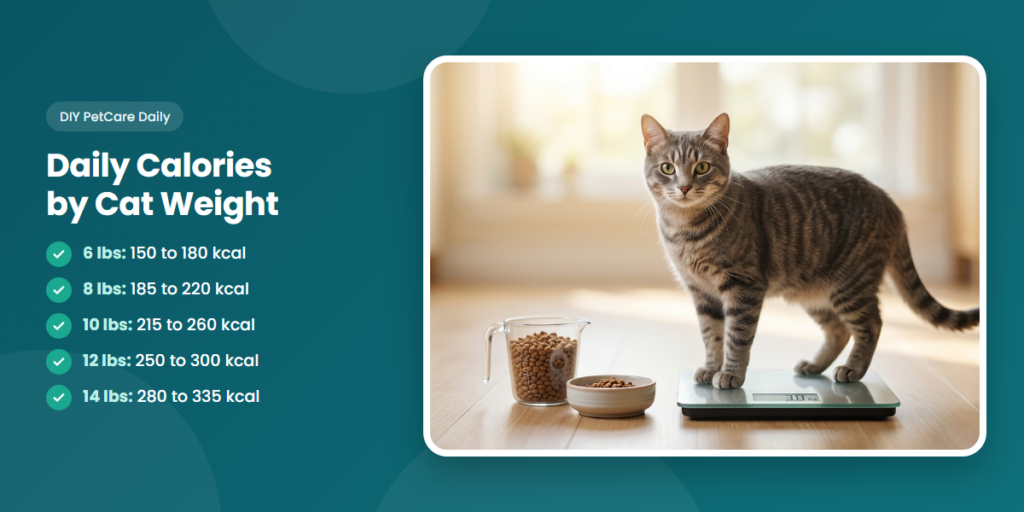
This chart is for healthy adult cats (1 to 10 years old) who are spayed or neutered and live mostly indoors. Calories come from the standard vet formula explained below. Use the lower number for less active cats and the higher number for more active cats.
| Cat’s Ideal Weight | Daily Calories | Dry Food Only (400 kcal/cup) | Wet Food Only (3 oz cans, about 85 kcal each) |
| 6 lbs | 150 to 180 | about 1/3 to 1/2 cup | about 1 3/4 to 2 cans |
| 8 lbs | 185 to 220 | about 1/2 cup | about 2 to 2 1/2 cans |
| 10 lbs | 215 to 260 | about 1/2 to 2/3 cup | about 2 1/2 to 3 cans |
| 12 lbs | 250 to 300 | about 2/3 to 3/4 cup | about 3 to 3 1/2 cans |
| 14 lbs | 280 to 335 | about 3/4 cup | about 3 1/4 to 4 cans |
| 16 lbs (large breeds) | 310 to 370 | about 3/4 to 1 cup | about 3 2/3 to 4 1/3 cans |
Most domestic shorthair cats have an ideal weight of about 8 to 11 pounds. Weights of 14 pounds or more are usually only ideal for large breeds like Maine Coons or Ragdolls. If your cat is a regular-size breed and weighs 14 pounds, they are likely overweight, so use their ideal weight row instead.
Always check your food’s label. The calories per cup or per can are printed on the bag or can, often as “kcal/cup” or “kcal/can.” If your food has more or fewer calories than the chart uses, adjust the amount.
Kitten Feeding Guide by Age
Kittens grow fast and need lots of energy, protein, and nutrients. Feed a food labeled for growth or “all life stages.”
| Kitten’s Age | Meals per Day | How Much |
| 4 to 8 weeks | Weaning: 4 to 6 small meals | Kitten milk replacer plus soft wet kitten food |
| 8 weeks to 3 months | 4 meals | About 3 times an adult’s resting calorie needs |
| 3 to 6 months | 3 meals | About 2.5 to 3 times resting needs |
| 6 to 12 months | 2 to 3 meals | About 2 to 2.5 times resting needs, easing down |
Many vets are fine with letting young kittens eat as much as they want, as long as they stay lean. After spaying or neutering, which often happens around 5 to 6 months in the US, a kitten’s calorie needs drop. That’s a common time for weight gain to start, so start measuring meals.
Most cats can switch to adult food at about 12 months. Large breeds like Maine Coons may stay on kitten food until about 18 months, so ask your vet.
Never give cow’s milk to kittens. It can cause diarrhea. Use a kitten milk replacer if they need one.
Feeding Senior Cats
Cats are usually considered seniors around age 11, though some changes start at 7 to 10.
- Ages 7 to 11: many cats slow down and need about 10 to 20 percent fewer calories.
- Ages 12 and up: many cats actually need *more* calories, because they digest fat and protein less well and lose muscle as they age.
Weigh your senior cat every month if you can. Sudden or ongoing weight loss in an older cat can point to kidney disease, an overactive thyroid, diabetes, or dental pain. Bad breath and trouble chewing are common clues, and our guide on why does my cat’s breath smell explains what can cause it.
How to Work Out Your Cat’s Calories (The Vet Formula)
Want a number made for your cat? Vets use a simple two-step formula.
Step 1: Find the Resting Energy Requirement (RER)
- Change your cat’s ideal weight to kilograms: pounds ÷ 2.2.
- Raise that number to the 0.75 power (use the x^y key on a phone calculator).
- Multiply by 70.
Example: a 10-pound cat weighs about 4.5 kg. 4.5 to the 0.75 power is about 3.1. Multiply by 70 and you get an RER of about 217 calories.
Step 2: Multiply by Your Cat’s Situation
| Cat’s Situation | Multiply RER By |
| Spayed or neutered adult | 1.2 |
| Indoor, less active, or tends to gain weight | 1.0 |
| Intact adult | 1.4 |
| Needs to lose weight | 0.8 (vet-guided) |
| Kitten under 4 months | 3.0 |
| Kitten 4 to 12 months | 2.0 to 2.5 |
So a 10-pound neutered indoor cat needs about 217 to 260 calories a day.
Step 3: Turn Calories Into Food
Divide the daily calories by the kcal per cup (for dry food) or kcal per can (for wet food). For example, 230 calories ÷ 400 kcal per cup = a little over 1/2 cup of dry food a day.
Feeding Wet and Dry Food Together
Many cats eat a mix of wet and dry food. To do this without overfeeding:
- Start with your cat’s daily calorie goal.
- Add up the calories from the wet food you plan to give.
- Subtract that from the goal.
- Feed the rest as measured dry food.
For example, a 10-pound cat needing 230 calories who eats one 3-ounce can (85 calories) has about 145 calories left, or a bit over 1/3 cup of dry food at 400 kcal per cup.
Not sure which type is best for your cat? Our guide on wet vs dry cat food compares the pros and cons.
How Often Should You Feed Your Cat?
In the wild, cats eat several small meals a day. Most house cats do well with:
- Adults: at least 2 measured meals a day, about 12 hours apart. 3 or 4 smaller meals is even better if your schedule allows.
- Kittens: 3 to 4 meals a day.
- Seniors: 2 to 4 small meals.
Free Feeding vs Meal Feeding
Free feeding, where dry food is left out all day, works for some lean cats. But for most indoor cats it leads to weight gain. It also makes it hard to notice when your cat stops eating, which is often the first sign they feel sick.
Good options for busy owners:
- Measure the whole day’s dry food into a bowl each morning. When it’s gone, it’s gone.
- Use an automatic feeder set to release small meals through the day.
- Try a puzzle feeder. Cats “hunt” for kibble, which slows them down and keeps them busy.
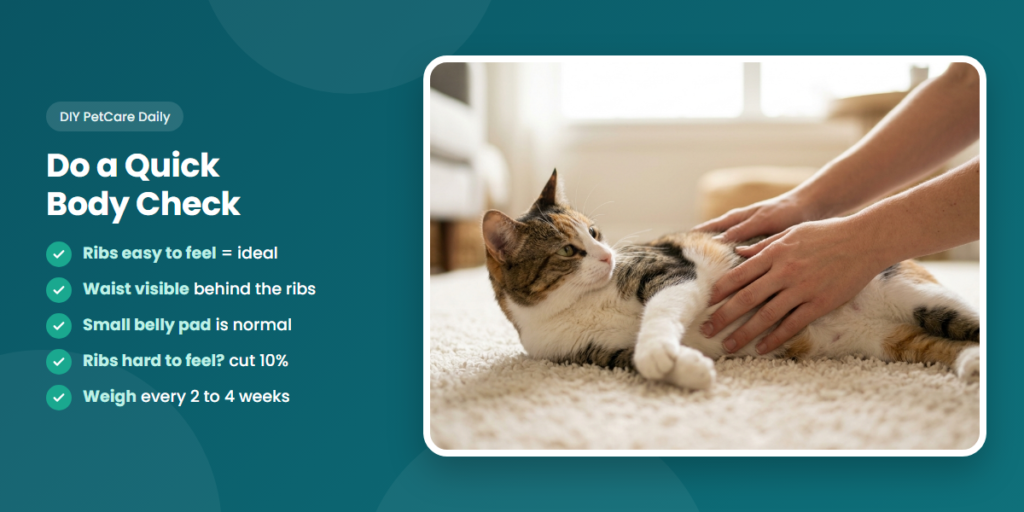
Is Your Cat at a Healthy Weight? Do a Body Check
Vets use a body condition score from 1 to 9, where 5 is ideal. You can check your cat at home:
| What You See and Feel | What It Means | What to Do |
| Ribs, spine, and hips easy to see; no fat | Too thin | Talk to your vet, then increase food slowly |
| Ribs easy to feel under a thin layer of fat; waist visible behind the ribs; small belly pad | Ideal | Keep the same amount |
| Ribs hard to feel; waist barely there; rounded belly | Overweight | Reduce food by about 10% |
| Ribs can’t be felt; no waist; large, hanging belly; fat on the back and face | Obese | See your vet for a safe weight-loss plan |
Weigh your cat every 2 to 4 weeks when you’re changing portions. Weigh yourself, then weigh yourself holding your cat, and subtract the difference.
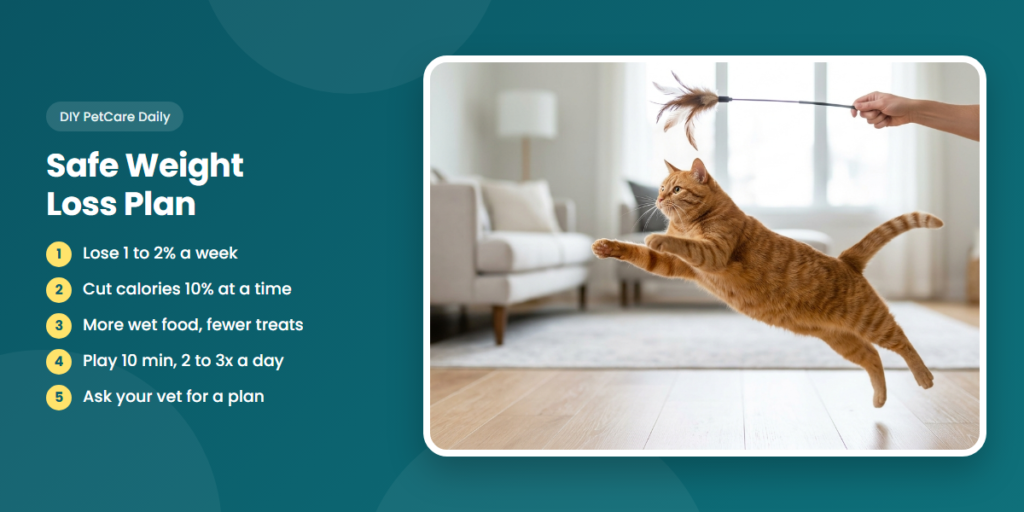
How to Help an Overweight Cat Lose Weight Safely
- Go slow. Aim for about 1 to 2 percent of body weight per week. Fast weight loss can cause liver disease in cats.
- Cut calories gradually, about 10 percent at a time, and recheck in 2 to 3 weeks.
- Switch to more wet food. It has fewer calories per bite and helps your cat feel full.
- Cut back on treats. Keep them to no more than 10 percent of daily calories.
- Add play. Two or three 10-minute play sessions a day with a wand toy help a lot.
- Feed cats separately in multi-cat homes, so one cat doesn’t eat another’s share.
- Talk to your vet about a weight-loss food made to keep cats full on fewer calories.
Treats Count Too
Treats can quietly add a lot of calories. Many cat treats have 1 to 3 calories each, so a handful a day can be 20 to 40 calories. For a 10-pound cat, that’s up to 15 percent of their daily needs.
Keep treats small, and use part of your cat’s daily kibble as treats for training or play. If you share human food, stick to plain cooked meat in tiny pieces, and check our list of foods toxic to cats first.
When to Call Your Vet
Call your vet if your cat:
- Hasn’t eaten for 24 hours (cats should never go more than a day or two without food)
- Loses weight without a change in diet
- Is suddenly much hungrier than usual, especially if they’re also losing weight
- Drinks or pees a lot more than normal
- Vomits often, or has hairballs more than once or twice a month. Our guide on how to prevent hairballs in cats covers diet tips that help.
- Seems tired, hides more, or acts differently. These can be early signs of a sick cat.
For more simple guides on feeding your cat, visit our Cat Food & Nutrition section.
Frequently Asked Questions
How much should I feed my cat a day?
A healthy indoor adult cat at 10 pounds needs about 215 to 260 calories a day. That’s roughly 1/2 to 2/3 cup of dry food, or 2 1/2 to 3 three-ounce cans of wet food, depending on the brand. Check the calories on your food label and adjust to your cat’s body shape.
How many times a day should a cat eat?
Most adult cats do well with 2 to 4 small, measured meals a day. Kittens need 3 to 4 meals a day. Small, frequent meals match how cats eat naturally.
How much wet food should I feed my cat?
Most 3-ounce cans of wet food have about 70 to 110 calories. A 10-pound adult cat eating only wet food usually needs about 2 1/2 to 3 three-ounce cans a day, or about 1 1/2 five-and-a-half-ounce cans. Always check the kcal per can on the label.
Why is my cat always hungry?
Some cats just love food or beg out of habit. But constant hunger can also be a sign of an overactive thyroid, diabetes, or worms, especially if your cat is losing weight. Talk to your vet if your cat’s appetite changes suddenly.
Should I leave food out for my cat all day?
For most indoor cats, it’s better not to. Free feeding often leads to weight gain and makes it hard to notice appetite changes. Measured meals, timed feeders, or puzzle feeders work better for most cats.